
Catalogue Search | MBRL


Are you sure you want to remove the book from the shelf?

{{itemTitle}}
18,118
result(s) for
"Location based services"
Sort by:


Spatiotemporal Mobility Based Trajectory Privacy-Preserving Algorithm in Location-Based Services
Recent years have seen the wide application of Location-Based Services (LBSs) in our daily life. Although users can enjoy many conveniences from the LBSs, they may lose their trajectory privacy when their location data are collected. Therefore, it is urgent to protect the user’s trajectory privacy while providing high quality services. Trajectory k-anonymity is one of the most important technologies to protect the user’s trajectory privacy. However, the user’s attributes are rarely considered when constructing the k-anonymity set. It results in that the user’s trajectories are especially vulnerable. To solve the problem, in this paper, a Spatiotemporal Mobility (SM) measurement is defined for calculating the relationship between the user’s attributes and the anonymity set. Furthermore, a trajectory graph is designed to model the relationship between trajectories. Based on the user’s attributes and the trajectory graph, the SM based trajectory privacy-preserving algorithm (MTPPA) is proposed. The optimal k-anonymity set is obtained by the simulated annealing algorithm. The experimental results show that the privacy disclosure probability of the anonymity set obtained by MTPPA is about 40% lower than those obtained by the existing algorithms while the same quality of services can be provided.
Journal Article


Enhanced Privacy and Authentication: An Efficient and Secure Anonymous Communication for Location Based Service Using Asymmetric Cryptography Scheme
Past few years, the mobile technology and location based services have experienced a great increment in number of its users. The privacy issues related to these services are becoming main concerns because of the leakage of users’ private information and contents. To prevent revelation of private information, many researchers have proposed several secure and authentication schemes which apply various technologies to provide integral security properties, such as symmetric encryption, digital signature, timestamp, etc. Unfortunately, some of these schemes still exhibit security and efficiency issues. In this research paper, we proposed an efficient and secure anonymous communication for location based service using asymmetric cryptography scheme over the wireless system was attempted missing some system detail. We also proposed the prevent user private information and secure communication by asymmetric cryptography scheme. We solved the wireless communication problem in A3 algorithm such as eavesdropping and this problem solved by asymmetric cryptography scheme because of its robustness against this type of attack by providing mutual authentication make the system more secure. Finally, performance and cost analysis show our scheme is more suitable for low-power and resource limited wireless system and thus availability for real implementation. According to our security analysis and performance, we can prove that our proposed asymmetric cryptography scheme is able to improve wireless communication system security and enhance efficiency in comparison to previous schemes.
Journal Article
Smart Device-Supported BDS/GNSS Real-Time Kinematic Positioning for Sub-Meter-Level Accuracy in Urban Location-Based Services
Using mobile smart devices to provide urban location-based services (LBS) with sub-meter-level accuracy (around 0.5 m) is a major application field for future global navigation satellite system (GNSS) development. Real-time kinematic (RTK) positioning, which is a widely used GNSS-based positioning approach, can improve the accuracy from about 10–20 m (achieved by the standard positioning services) to about 3–5 cm based on the geodetic receivers. In using the smart devices to achieve positioning with sub-meter-level accuracy, a feasible solution of combining the low-cost GNSS module and the smart device is proposed in this work and a user-side GNSS RTK positioning software was developed from scratch based on the Android platform. Its real-time positioning performance was validated by BeiDou Navigation Satellite System/Global Positioning System (BDS/GPS) combined RTK positioning under the conditions of a static and kinematic (the velocity of the rover was 50–80 km/h) mode in a real urban environment with a SAMSUNG Galaxy A7 smartphone. The results show that the fixed-rates of ambiguity resolution (the proportion of epochs of ambiguities fixed) for BDS/GPS combined RTK in the static and kinematic tests were about 97% and 90%, respectively, and the average positioning accuracies (RMS) were better than 0.15 m (horizontal) and 0.25 m (vertical) for the static test, and 0.30 m (horizontal) and 0.45 m (vertical) for the kinematic test.
Journal Article

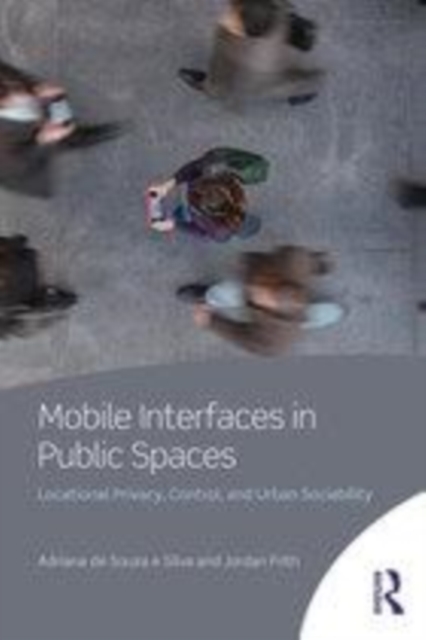
Mobile Interfaces in Public Spaces
Mobile phones are no longer what they used to be. Not only can users connect to the Internet anywhere and anytime, they can also use their devices to map their precise geographic coordinates - and access location-specific information like restaurant reviews, historical information, and locations of other people nearby. The proliferation of location-aware mobile technologies calls for a new understanding of how we define public spaces, how we deal with locational privacy, and how networks of power are developed today.
In Mobile Interfaces in Public Spaces, Adriana de Souza E. Silva and Jordan Frith examine these social and spatial changes by framing the development of location-aware technology within the context of other mobile and portable technologies such as the book, the Walkman, the iPod, and the mobile phone. These technologies work as interfaces to public spaces - that is, as symbolic systems that not only filter information but also reshape communication relationships and the environment in which social interaction takes place. Yet rather than detaching people from their surroundings, the authors suggest that location-aware technologies may ultimately strengthen our connections to locations.
eBook


Examining the Human Activity-Intensity Change at Different Stages of the COVID-19 Pandemic across Chinese Working, Residential and Entertainment Areas
The COVID-19 pandemic has already resulted in more than 6 million deaths worldwide as of December 2022. The COVID-19 has also been greatly affecting the activity of the human population in China and the world. It remains unclear how the human activity-intensity changes have been affected by the COVID-19 spread in China at its different stages along with the lockdown and relaxation policies. We used four days of Location-based services data from Tencent across China to capture the real-time changes in human activity intensity in three stages of COVID-19—namely, during the lockdown, at the first stage of work resuming and at the stage of total work resuming—and observed the changes in different land use categories. We applied the mean decrease Gini (MDG) approach in random forest to examine how these changes are influenced by land attributes, relying on the CART algorithm in Python. This approach was also compared with Geographically Weighted Regression (GWR). Our analysis revealed that the human activity intensity decreased by 22–35%, 9–16% and 6–15%, respectively, in relation to the normal conditions before the spread of COVID-19 during the three periods. The human activity intensity associated with commercial sites, sports facilities/gyms and tourism experienced the relatively largest contraction during the lockdown. During the relaxations of restrictions, government institutions showed a 13.89% rise in intensity at the first stage of work resuming, which was the highest rate among all the working sectors. Furthermore, the GDP and road junction density were more influenced by the change in human activity intensity for all land use categories. The bus stop density was importantly associated with mixed-use land recovery during the relaxing stages, while the coefficient of density of population in entertainment land were relatively higher at these two stages. This study aims to provide additional support to investigate the human activity changes due to the spread of COVID-19 at different stages across different sectors.
Journal Article