
Catalogue Search | MBRL


Are you sure you want to remove the book from the shelf?

{{itemTitle}}
25,382
result(s) for
"Lockouts"
Sort by:


Strike Action and Nation Building
Strike-action has long been a notable phenomenon in Israeli society, despite forces that have weakened its recurrence, such as the Arab-Jewish conflict, the decline of organized labor, and the increasing precariousness of employment. While the impact of strikes was not always immense, they are deeply rooted in Israel's past during the Ottoman Empire and Mandate Palestine. Workers persist in using them for material improvement and to gain power in both the private and public sectors, reproducing a vibrant social practice whose codes have withstood the test of time. This book unravels the trajectory of the strikes as a rich source for the social-historical analysis of an otherwise nation-oriented and highly politicized history.
eBook

Industrial politics and the 1926 mining lockout : the struggle for dignity
The ten-month national mining lock-out of 1926 was one of the most important industrial disputes of the 20th century. This volume of specifically commissioned essays re-examines this key moment in British social history.
Book
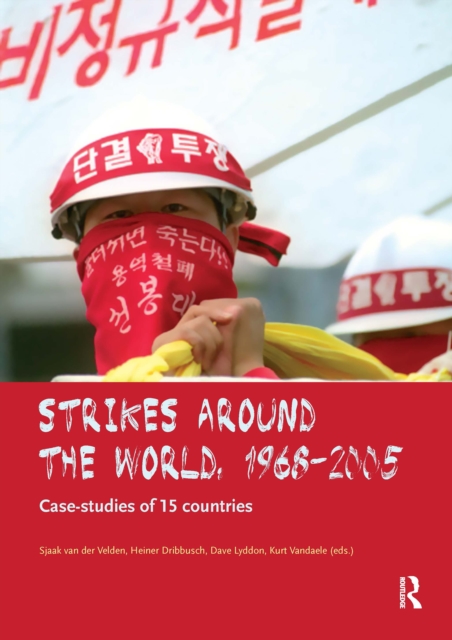
Strikes Around the World: Case Studies of 15 Countries
Are strikes going out of fashion or are they an inevitable feature of working life? This is a longstanding debate. The much-proclaimed withering away of the strike in the 1950s was quickly overturned by the resurgence of class conflict in the late 1960s and 1970s. The period since then has been characterized as one of labor quiescence. Commentators again predict the strikes demise, at least in the former heartlands of capitalism.Patterns of employment are constantly changing and strike activity reflects this. The secular decline of manufacturing in mature industrialized economies is of major importance here (though the global relocation of manufacturing may lead to some relocation of strikes). Simultaneously we see the growth of disputes in the service sector (the tertiarization of strikes). This is evident particularly in public services, including health care, social care and education, and is accompanied by a feminization of strikes, given the prevalence of women working there. This unique study draws on the experience of fifteen countries around the world South Africa, Argentina, Canada, Mexico, United States, Korea, Australia, New Zealand, Belgium, Denmark, France, Germany, the Netherlands, Sweden and the United Kingdom. Covering the high and low points of strike activity over the period 19682005, the study shows continuing evidence of the durability, adaptability and necessity of the strike.
eBook

Jack Strong takes a stand
Tired of being forced to participate in sports and take extra lessons and tutoring to become well-rounded in anticipation of college, middle-schooler Jack Strong stages a sit-in on his couch until his parents ease up.
Book

Women, workplace protest and political identity in England, 1968–85
This book draws upon original research into women's workplace protest to deliver a new account of working-class women's political identity and participation in post-war England. Focusing on the voices and experiences of women who fought for equal pay, skill recognition and the right to work between 1968 and 1985, it explores why working-class women engaged in such action when they did, and it analyses the impact of workplace protest on women's political identity. A combination of oral history and written sources are used to illuminate how everyday experiences of gender and class antagonism shaped working-class women's political identity and participation. The book contributes a fresh understanding of the relationship between feminism, workplace activism and trade unionism during the years 1968-1985.
eBook

Please please the bees
Accustomed to the daily jars of honey provided by the bees living in his yard, Benedict the bear is upset when they go on strike, but he listens to their requests for better working conditions and makes an effort to please the unhappy bees.
Book


Roots of resistance : a story of gender, race, and labor on the North Coast of Honduras
Winner of the 2021 Sara A. Whaley Prize of the National Women's Studies Association (NWSA)
A first-of-its-kind study of the working-class culture of resistance on the Honduran North Coast and the radical organizing that challenged US capital and foreign intervention at the onset of the Cold War, examining gender, race, and place.
On May 1, 1954, striking banana workers on the North Coast of Honduras brought the regional economy to a standstill, invigorating the Honduran labor movement and placing a series of demands on the US-controlled banana industry. Their actions ultimately galvanized a broader working-class struggle and reawakened long-suppressed leftist ideals. The first account of its kind in English, Roots of Resistance explores contemporary Honduran labor history through the story of the great banana strike of 1954 and centers the role of women in the narrative of the labor movement.
Drawing on extensive firsthand oral history and archival research, Suyapa G. Portillo Villeda examines the radical organizing that challenged US capital and foreign intervention in Honduras at the onset of the Cold War. She reveals the everyday acts of resistance that laid the groundwork for the 1954 strike and argues that these often-overlooked forms of resistance should inform analyses of present-day labor and community organizing. Roots of Resistance highlights the complexities of transnational company hierarchies, gender and race relations, and labor organizing that led to the banana workers' strike and how these dynamics continue to reverberate in Honduras today.
eBook