
Catalogue Search | MBRL


Are you sure you want to remove the book from the shelf?

{{itemTitle}}
16
result(s) for
"Logic Miscellanea."
Sort by:

A cabinet of philosophical curiosities : a collection of puzzles, oddities, riddles, and dilemmas
\"A Cabinet of Philosophical Curiosities is a colorful collection of puzzles and paradoxes, both historical and contemporary, by philosopher Roy Sorensen.\"-- Provided by publisher.
BOOK

A Cabinet of Philosophical Curiosities
If you want to learn how to conform to confound, raze hopes, succeed your successor, order absence in the absence of order, win by losing and think contrapositively, look no further. Here you can unlock the secrets of Plato's void, Wittgenstein's investigations, Schopenhauer's intelligence test, Voltaire's big bet, Russell's slip of the pen and lobster logic. Among your discoveries will be why the egg came before the chicken, what the dishwasher missed and just what it was that made Descartes disappear. Experience the unbearable lightness of logical conclusions in Professor Sorensen's intriguing cabinet of riddles, problems, paradoxes, puzzles and the anomalies of human utterance. As you accompany him on investigations into the mysteries of truth, falsehood, reason and delusion, prepare to be surprised, enlightened, mystified and, above all, entertained.
eBook

Master-mind : over 100 games, tests, and puzzles to unleash your inner genuis
An introduction to the human brain uses quizzes, trivia, and puzzles to explore the different functions of the brain, how to improve brain power, and why each brain is unique.
Book

Mathematical Fallacies, Flaws, and Flimflam
Through hard experience, mathematicians have learned to subject even the most evident assertions to rigorous scrutiny, as intuition and facile reasoning can often lead them astray. However, the impossibility and impracticality of completely watertight arguments make it possible for errors to slip by the most watchful eye. They are often subtle and difficult of detection. When found, they can teach us a lot and can present a real challenge to straighten out. Presenting students with faulty arguments to troubleshoot can be an effective way of helping them critically understand material, and it is for this reason that I began to compile fallacies and publish them first in the Notes of the Canadian Mathematical Society and later in the College Mathematics Journal in the Fallacies, Flaws and Flimflam section. I hoped to challenge and amuse readers, as well as to provide them with material suitable for teaching and student assignments. This book collects the items from the first eleven years of publishing in the CMJ. One source of such errors is the work of students. Occasionally, a text book will weigh in with a specious result or solution. Nonprofessional sources, such as newspapers, are responsible for a goodly number of mishaps, particularly in arithmetic (especially percentages) and probability; their use in classrooms may help students become critical readers and listeners of the media. Quite a few items come from professional mathematicians. The reader will find in this book some items that are not erroneous but seem to be. These need a fuller analysis to clarify the situation. All the items are presented for your entertainment and use. The mathematical topics covered include algebra, trigonometry, geometry, probability, calculus, linear algebra, and modern algebra.
eBook
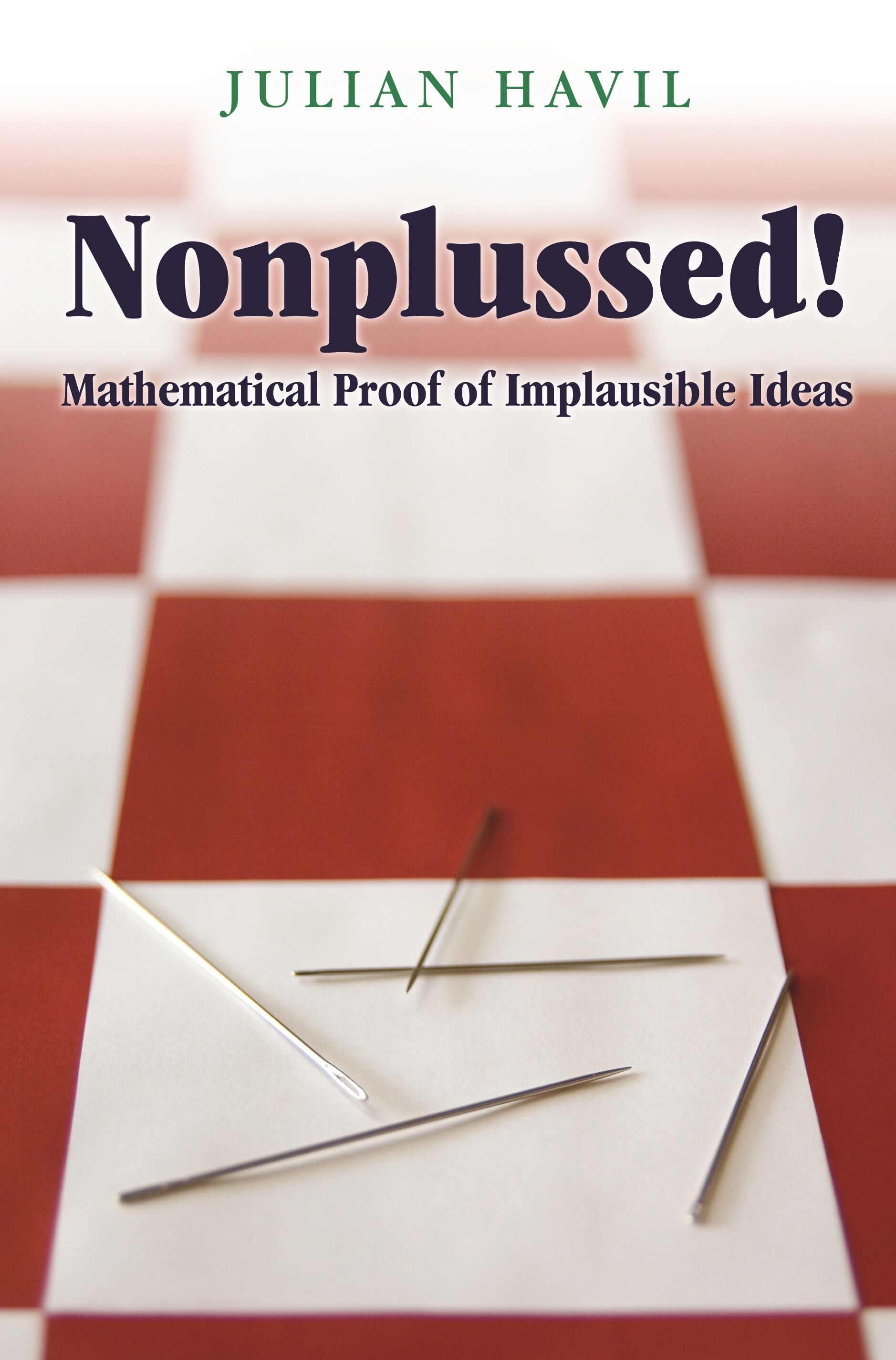
Nonplussed
Math--the application of reasonable logic to reasonable assumptions--usually produces reasonable results. But sometimes math generates astonishing paradoxes--conclusions that seem completely unreasonable or just plain impossible but that are nevertheless demonstrably true: Conclusions that, for example, tell us that a losing sports team can become a winning one by adding worse players than its opponents. Or that the thirteenth of the month is more likely to be a Friday than any other day. Or that cones can roll unaided uphill. In Nonplussed!--a delightfully eclectic collection of paradoxes from many different areas of math--popular-math writer Julian Havil reveals the math that shows the truth of these and many other unbelievable ideas.
eBook

Yet More Everyday Science Mysteries
In the fourth book of this award-winning series, author Richard Konicek-Moran explores 15 new mysteries children and adults encounter in their daily lives. Relating the mysteries to experiences familiar to elementary and middle school students, the stories show how science is part of everyday life and initiate inquiry-based learning by leaving each mystery without an ending. Students identify the problem to be solved, formulate questions, form hypotheses, test their ideas, and come up with possible explanations.
eBook
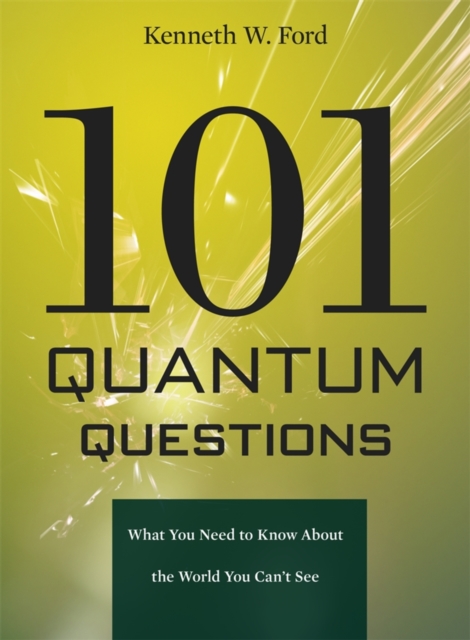
101 Quantum Questions
This reader-friendly, richly illustrated book provides an engaging overview of quantum physics, from “big ideas\" like probability and uncertainty and conservation laws to the behavior of quarks and photons and neutrinos, and on to explanations of how a laser works and why black holes evaporate.
eBook

Identification of a competing risks model with unknown transformations of latent failure times
This paper is concerned with identification of a competing risks model with unknown transformations of latent failure times. The model includes, as special cases, competing risks versions of proportional hazards, mixed proportional hazards and accelerated failure time models. It is shown that covariate effects on latent failure times, cause-specific link functions and the joint survivor function of the disturbance terms can be identified without relying on modelling the dependence between latent failure times parametrically nor using an exclusion restriction among covariates. As a result, the paper provides an identification result about the joint survivor function of the latent failure times conditional on covariates.
Journal Article

Plautus, Truculentus 78
Fontaines clarifies that the phrase suom nomen omne 'that name of hers entirely' in Plautus, Truculentus 78 would certainly be acceptable in later Latin, but this use of the singular omne in the predicative and amplying sense is difficult to parallel in Platus. Among other things, he stresses that the preponderance of evidence offered by amatory elegy shows that omni ex pectore 'out of one's whole heart' is a standard Latin idiom.
Journal Article