
Catalogue Search | MBRL


Are you sure you want to remove the book from the shelf?

{{itemTitle}}
7
result(s) for
"Lord of the Rings films -- History and criticism"
Sort by:

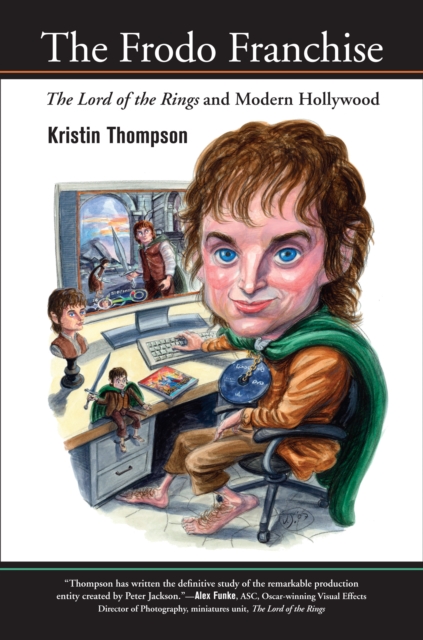
The Frodo franchise : the Lord of the rings and modern Hollywood
\"Once in a lifetime.\" The phrase comes up over and over from the people who worked on Peter Jackson's The Lord of the Rings. The film's seventeen Oscars, record-setting earnings, huge fan base, and hundreds of ancillary products attest to its importance and to the fact that Rings is far more than a film. Its makers seized a crucial moment in Hollywood—the special effects digital revolution plus the rise of \"infotainment\" and the Internet—to satisfy the trilogy's fans while fostering a huge new international audience. The resulting franchise of franchises has earned billions of dollars to date with no end in sight. Kristin Thompson interviewed seventy-six people to examine the movie's scripting and design and the new technologies deployed to produce the films, video games, and DVDs. She demonstrates the impact Rings had on the companies that made it, on the fantasy genre, on New Zealand, and on independent cinema. In fast-paced, compulsively readable prose, she affirms Jackson's Rings as one the most important films ever made.
eBook


Unsung heroes of the Lord of the rings : from the page to the screen
Most criticism of The Lord of the Rings trilogy emphasizes the most likely heroes in the tales: Aragorn, Frodo, Gandalf, and even Sam. From popular to scholarly literature, the women and smaller characters often go overlooked. But our notions of what makes a hero have altered since September 11, and sometimes the most unlikely people can come to embody all that we look up to and admire in a person. Here, Lynnette Porter examines what we mean when we talk about heroes, and for the first time illustrates the heroic qualities that can be found in the women and other beloved, though less-celebrated, characters in the The Lord of the Rings books and movies. She takes a critical look at the importance of literary and cinematic heroes in general, emphasizing the roles of Merry, Pippin, Galadriel, Eowyn, Arwen, Legolas, and Gimli, who can all be considered heroes despite their relatively smaller roles. She shows, ultimately, that our attraction to and celebration of heroes does not have to be limited to the leading man, but rather that women and youth often display essential characteristics of true heroes. Bringing together a discussion of both the books and the movies, Porter reveals for readers the heroic nature of several characters in The Lord of the Rings who have been ignored in terms of their status as heroes. Nevertheless, these female and youthful characters have received incredible popular acclaim and illustrate the shift in the way the Western movie-going public identifies and glorifies heroes. While other stars may have outshone the likes of Merry and Pippin, Arwen and Galadriel, Porter redirects the spotlight on these favorites of the books and movies to show us how the roles they play, the actions they take, and the behaviors they display are worthy of our praise and admiration. This unique and refreshing perspective adds dimension to our understanding of The Lord of the Rings phenomenon.
eBook

Middle-Earth from script to screen : building the world of The lord of the rings & The hobbit
Describes how The Lord of the Rings film trilogy and The Hobbit film trilogy were brought to life on the screen, looking at the technology, people, and creative processes involved in their creation.
Book
From Hobbits to Hollywood : essays on Peter Jackson's Lord of the Rings
Peter Jackson's film version of The Lord of the Rings (2001-2003) is the grandest achievement of 21st century cinema so far. But it is also linked to topical and social concerns including war, terrorism, and cultural imperialism. Its style, symbols, narrative, and structure seem always already linked to politics, cultural definition, problems of cinematic style, and the elemenal mythologies that most profoundly capture our imaginations. From Hobbits to Hollywood: Essays on Peter Jackson's Lord of the Rings treats Jackson's trilogy as having two conditions of existence: an aesthetic and a political. Like other cultural artefacts, it leads a double life as objet d'art and public statement about the world, so that nothing in it is ever just cinematically beautiful or tasteful, and nothing is ever just a message or an opinion. Written by leading scholars in the study of cinema and culture From Hobbits to Hollywood gives Jackson's trilogy the fullest scholarly interrogation to date. Ranging from interpretations of The Lord of the Rings' ideological and philosophical implications, through discussions of its changing fandoms and its incorporation into the Hollywood industry of stars, technology, genre, and merchandising, to considerations of CGI effects, acting, architecture and style, the essays contained here open a new vista of criticism and light, for ardent fans of J.R.R. Tolkien, followers of Jackson, and all those who yearn for a deeper appreciation of cinema and its relation to culture.
eBook

Cinematic countrysides
Recent years have witnessed an explosion of interest in the 'spatialities of cinema' across the social sciences and humanities, yet to date critical inquiry has tended to explore this issue as a question of the 'city' and the 'urban'. For the first time, leading scholars in geography, film and cultural studies have been drawn together to explore the multiple ways in ideas of cinema and countryside are co-produced: how 'film makes rural' and 'rural makes film'. From the expanse of the American great west to the mountainous landscapes of North Korea, Cinematic Countrysides draws on a range of popular and alternative film genres to demonstrate how film texts come to prefigure expectations of rural social space, and how these representations come to shape, and be shaped by, the material and embodied circumstances of 'lived' rural experience. At the heart of this volume's varied apprehensions of the 'cinematic countryside' is a concern to argue that ideas of rurality in film are central to wider questions of 'modernity' and 'tradition', 'self' and 'other', 'nationhood' and 'globalisation', and crucially, ones that are central to an account of the 'cinematic city'
eBook