
Catalogue Search | MBRL


Are you sure you want to remove the book from the shelf?

{{itemTitle}}
109
result(s) for
"Los Angeles (Calif.) -- Race relations -- History"
Sort by:


South Central is home : race and the power of community investment in Los Angeles
South Central Los Angeles is often characterized as an African American community beset by poverty and economic neglect. But this depiction obscures the significant Latina/o population that has called South Central home since the 1970s. More significantly, it conceals the efforts African American and Latina/o residents have made together in shaping their community. As residents have faced increasing challenges from diminished government social services, economic disinvestment, immigration enforcement, and police surveillance, they have come together in their struggle for belonging and justice. South Central Is Home investigates the development of relational community formation and highlights how communities of color like South Central experience racism and discrimination—and how in the best of situations, they are energized to improve their conditions together. Tracking the demographic shifts in South Central from 1945 to the present, Abigail Rosas shows how financial institutions, War on Poverty programs like Headstart for school children, and community health centers emerged as crucial sites where neighbors engaged one another over what was best for their community. Through this work, Rosas illuminates the promise of community building, offering findings indispensable to our understandings of race, community, and place in U.S. society.
eBook

Biting the hand : growing up Asian in Black and White America
\"A passionate, no-holds-barred memoir about the Asian American experience in a nation defined by racial stratification When Julia Lee was fifteen, her hometown went up in smoke during the 1992 Los Angeles riots. The daughter of Korean immigrant store owners in a predominantly Black neighborhood, Julia was taught to be grateful for the privilege afforded to her. However, the acquittal of four white police officers in the beating of Rodney King, following the murder of Latasha Harlins by a Korean shopkeeper, forced Julia to question her racial identity and complicity. She was neither Black nor white. So who was she? This question would follow Julia for years to come, resurfacing as she traded in her tumultuous childhood for the white upper echelon of elite academia. It was only when she began a PhD in English that she found answers--not in the Brontës or Austen, as Julia had planned, but rather in the brilliant prose of writers like James Baldwin and Toni Morrison. Their works gave Julia the vocabulary and, more important, the permission to critically examine her own tortured position as an Asian American, setting off a powerful journey of racial reckoning, atonement, and self-discovery that has shaped her adult life. With prose by turns scathing and heart-wrenching, Julia Lee lays bare the complex disorientation and shame that stems from this country's imposed racial hierarchy to argue that Asian Americans must leverage their liminality for lasting social change alongside Black and brown communities\"-- Provided by publisher.
Book

Spaces of conflict, sounds of solidarity
In Spaces of Conflict, Sounds of Solidarity, Gaye Theresa Johnson examines interracial anti-racist alliances, divisions among aggrieved minority communities, and the cultural expressions and spatial politics that emerge from the mutual struggles of Blacks and Chicanos in Los Angeles from the 1940s to the present. Johnson argues that struggles waged in response to institutional and social repression have created both moments and movements in which Blacks and Chicanos have unmasked power imbalances, sought recognition, and forged solidarities by embracing the strategies, cultures, and politics of each others' experiences. At the center of this study is the theory of spatial entitlement: the spatial strategies and vernaculars utilized by working class youth to resist the demarcations of race and class that emerged in the postwar era. In this important new book, Johnson reveals how racial alliances and antagonisms between Blacks and Chicanos in L.A. had spatial as well as racial dimensions.
eBook


Fit to Be Citizens?
Meticulously researched and beautifully written, Fit to Be Citizens? demonstrates how both science and public health shaped the meaning of race in the early twentieth century. Through a careful examination of the experiences of Mexican, Japanese, and Chinese immigrants in Los Angeles, Natalia Molina illustrates the many ways local health officials used complexly constructed concerns about public health to demean, diminish, discipline, and ultimately define racial groups. She shows how the racialization of Mexican Americans was not simply a matter of legal exclusion or labor exploitation, but rather that scientific discourses and public health practices played a key role in assigning negative racial characteristics to the group. The book skillfully moves beyond the binary oppositions that usually structure works in ethnic studies by deploying comparative and relational approaches that reveal the racialization of Mexican Americans as intimately associated with the relative historical and social positions of Asian Americans, African Americans, and whites. Its rich archival grounding provides a valuable history of public health in Los Angeles, living conditions among Mexican immigrants, and the ways in which regional racial categories influence national laws and practices. Molina's compelling study advances our understanding of the complexity of racial politics, attesting that racism is not static and that different groups can occupy different places in the racial order at different times.
eBook

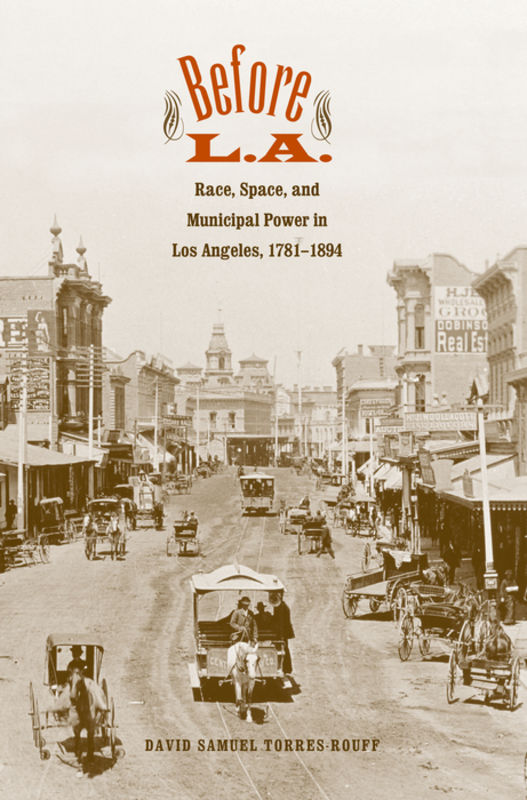
Before L.A
David Torres-Rouff significantly expands borderlands history by examining the past and original urban infrastructure of one of America's most prominent cities; its social, spatial, and racial divides and boundaries; and how it came to be the Los Angeles we know today. It is a fascinating study of how an innovative intercultural community developed along racial lines, and how immigrants from the United States engineered a profound shift in civic ideals and the physical environment, creating a social and spatial rupture that endures to this day.
eBook

Koreatown, Los Angeles : immigration, race, and the \American dream\
\"Koreatown, Los Angeles tells the story of how one ethnic neighborhood came to signify a shared Korean American identity. At the turn of the twentieth century, Los Angeles's Korean population stood at about 186,000--the largest concentration of Koreans outside of Asia. Most of this growth took place following the passage of the Hart-Celler Act of 1965, which dramatically altered US immigration policy and ushered in a new era of mass immigration, particularly from Asia and Latin America. Over the following decades, Korean immigrants continued to build community in LA, and in 1979, a group of Koreans sought city development funds to turn the area around Olympic Boulevard near downtown Los Angeles into a full-fledged \"Koreatown.\" As Korean immigrants seized the opportunity to purchase inexpensive commercial and residential property and transformed the area to serve their community's needs, other minority communities in nearby South LA--notably Black and Latino working-class communities--faced increasing segregation, urban poverty, and displacement. Beginning with the early development of LA's Koreatown and culminating with the 1992 Los Angeles riots and their aftermath, Shelley Sang-Hee Lee demonstrates how Korean Americans' lives were shaped by patterns of racial segregation and urban poverty, and legacies of anti-Asian racism and orientalism. \"Koreatown, Los Angeles\" tells the story of an American ethnic community often equated with socioeconomic achievement and assimilation, but whose experiences as racial minorities and immigrant outsiders illuminate key economic and cultural developments in the United States since 1965. Lee argues that building Koreatown was an urgent objective for Korean immigrants and US-born Koreans eager to carve out a spatial niche within Los Angeles to serve as an economic and social anchor for their growing community. More than a dot on a map, Koreatown holds profound emotional significance for Korean immigrants across the nation as a symbol of their shared bonds and place in American society\"-- Provided by publisher.
BOOK

Shameful Victory
On May 8, 1959, the evening news shocked Los Angeles residents, who saw LA County sheriffs carrying a Mexican American woman from her home in Chavez Ravine not far from downtown. Immediately afterward, the house was bulldozed to the ground. This violent act was the last step in the forced eviction of 3,500 families from the unique hilltop barrio that in 1962 became the home of the Los Angeles Dodgers.John H. M. Laslett offers a new interpretation of the Chavez Ravine tragedy, paying special attention to the early history of the barrio, the reform of Los Angeles's destructive urban renewal policies, and the influence of the evictions on the collective memory of the Mexican American community.In addition to examining the political decisions made by power brokers at city hall,Shameful Victoryargues that the tragedy exerted a much greater influence on the history of the Los Angeles civil rights movement than has hitherto been appreciated. The author also sheds fresh light on how the community grew, on the experience of individual home owners who were evicted from the barrio, and on the influence that the event had on the development of recent Chicano/a popular music, drama, and literature.
eBook