
Catalogue Search | MBRL


Are you sure you want to remove the book from the shelf?

{{itemTitle}}
700
result(s) for
"Los Angeles (Calif.) In art."
Sort by:

Dennis Hopper : colors, the polaroids
After losing himself in Taos, New Mexico, for 15 years, Dennis Hopper (1936--2010) returned to Los Angeles in the mid-'80s. In 1987, on the verge of directing Colors, Hopper made use of a Polaroid camera to document gang graffiti in Los Angeles. He was particularly drawn to the abstract shapes of overlapping paint that appeared when graffiti had been covered up or written over, reminding him, he said, \"that art is everywhere in every corner that you choose to frame and not just ignore and walk by.\" The Polaroids presented for the first time in this book are proof of that observation. Hopper firmly considered himself an \"abstract expressionist and action painter by nature, and a Duchampian finger pointer by choice,\" subscribing wholeheartedly to the idea that \"the artist of the future will merely point his finger and say it's art--and it will be art.\" In turning the instantaneous, disposable nature of the medium of Polaroid film into pictures as deliberate and final as an image achieved by an artist painting on canvas, these images represent the first part of Hopper's journey back to the world of photography, picking up where he had left off so many years before. This book is in many ways a companion to Drugstore Camera (2015), also edited and designed by Michael Schmelling, which presented Hopper's personal photographs taken in Taos, New Mexico. -- Provided by publisher.
Book

Land of Smoke and Mirrors
Unlike the more forthrightly mythic origins of other urban centers-think Rome via Romulus and Remus or Mexico City via the god Huitzilopochtli-Los Angeles emerged from a smoke-and-mirrors process that is simultaneously literal and figurative, real and imagined, material and metaphorical, physical and textual. Through penetrating analysis and personal engagement, Vincent Brook uncovers the many portraits of this ever-enticing, ever-ambivalent, and increasingly multicultural megalopolis. Divided into sections that probe Los Angeles's checkered history and reflect on Hollywood's own self-reflections, the book shows how the city, despite considerable remaining challenges, is finally blowing away some of the smoke of its not always proud past and rhetorically adjusting its rear-view mirrors.
Part I is a review of the city's history through the early 1900s, focusing on the seminal 1884 novelRamonaand its immediate effect, but also exploring its ongoing impact through interviews with present-day Tongva Indians, attendance at the 88th annualRamonapageant, and analysis of its feature film adaptations.
Brook deals with Hollywood as geographical site, film production center, and frame of mind in Part II. He charts the events leading up to Hollywood's emergence as the world's movie capital and explores subsequent developments of the film industry from its golden age through the so-called New Hollywood, citing such self-reflexive films asSunset Blvd.,
Singin' in the Rain, andThe Truman Show.
Part III considers LA noir, a subset of film noir that emerged alongside the classical noir cycle in the 1940s and 1950s and continues today. The city's status as a privileged noir site is analyzed in relation to its history and through discussions of such key LA noir novels and films asDouble Indemnity,Chinatown, andCrash.
In Part IV, Brook examines multicultural Los Angeles. Using media texts as signposts, he maps the history and contemporary situation of the city's major ethno-racial and other minority groups, looking at such films asMi Familia(Latinos),Boyz N the Hood(African Americans),Charlotte Sometimes(Asians),Falling Down(Whites), andThe Kids Are All Right(LGBT).
eBook


Fit to Be Citizens?
Meticulously researched and beautifully written, Fit to Be Citizens? demonstrates how both science and public health shaped the meaning of race in the early twentieth century. Through a careful examination of the experiences of Mexican, Japanese, and Chinese immigrants in Los Angeles, Natalia Molina illustrates the many ways local health officials used complexly constructed concerns about public health to demean, diminish, discipline, and ultimately define racial groups. She shows how the racialization of Mexican Americans was not simply a matter of legal exclusion or labor exploitation, but rather that scientific discourses and public health practices played a key role in assigning negative racial characteristics to the group. The book skillfully moves beyond the binary oppositions that usually structure works in ethnic studies by deploying comparative and relational approaches that reveal the racialization of Mexican Americans as intimately associated with the relative historical and social positions of Asian Americans, African Americans, and whites. Its rich archival grounding provides a valuable history of public health in Los Angeles, living conditions among Mexican immigrants, and the ways in which regional racial categories influence national laws and practices. Molina's compelling study advances our understanding of the complexity of racial politics, attesting that racism is not static and that different groups can occupy different places in the racial order at different times.
eBook
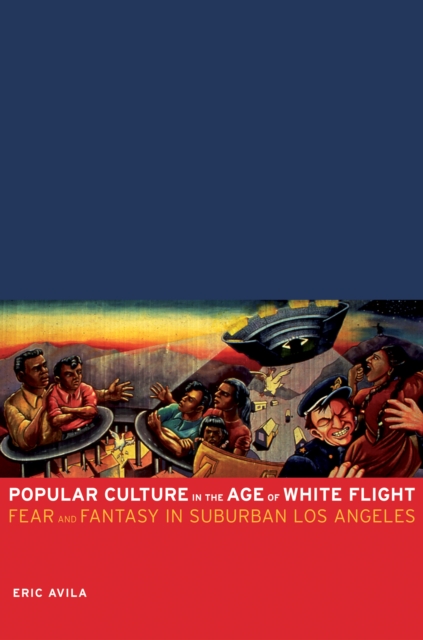
Popular culture in the age of white flight
Los Angeles pulsed with economic vitality and demographic growth in the decades following World War II. This vividly detailed cultural history of L.A. from 1940 to 1970 traces the rise of a new suburban consciousness adopted by a generation of migrants who abandoned older American cities for Southern California's booming urban region. Eric Avila explores expressions of this new \"white identity\" in popular culture with provocative discussions of Hollywood and film noir, Dodger Stadium, Disneyland, and L.A.'s renowned freeways. These institutions not only mirrored this new culture of suburban whiteness and helped shape it, but also, as Avila argues, reveal the profound relationship between the increasingly fragmented urban landscape of Los Angeles and the rise of a new political outlook that rejected the tenets of New Deal liberalism and anticipated the emergence of the New Right. Avila examines disparate manifestations of popular culture in architecture, art, music, and more to illustrate the unfolding urban dynamics of postwar Los Angeles. He also synthesizes important currents of new research in urban history, cultural studies, and critical race theory, weaving a textured narrative about the interplay of space, cultural representation, and identity amid the westward shift of capital and culture in postwar America.
eBook

Bohemian Los Angeles
Bohemian Los Angeles brings to life a vibrant and all-but forgotten milieu of artists, leftists, and gay men and women whose story played out over the first half of the twentieth century and continues to shape the entire American landscape. It is the story of a hidden corner of Los Angeles, where the personal first became the political, where the nation's first enduring gay rights movement emerged, and where the broad spectrum of what we now think of as identity politics was born. Portraying life over a period of more than forty years in the hilly enclave of Edendale, near downtown Los Angeles, Daniel Hurewitz considers the work of painters and printmakers, looks inside the Communist Party's intimate cultural scene, and examines the social world of gay men. In this vividly written narrative, he discovers why and how these communities, inspiring both one another and the city as a whole, transformed American notions of political identity with their ideas about self-expression, political engagement, and race relations. Bohemian Los Angeles, incorporating fascinating oral histories, personal letters, police records, and rare photographs, shifts our focus from gay and bohemian New York to the west coast with significant implications for twentieth-century U.S. history and politics.
eBook

Art and the City
No longer represented only by Hollywood and the commercial fashion industry, Los Angeles in recent years has received international media attention as one of the world's new art centers. From the appearance of local artists in major European exhibitions to widely reported multimillion-dollar museum endowments, Los Angeles has entered the world cultural stage.
Art and the City: Civic Imagination and Cultural Authority in Los Angelesplaces this celebrated arrival in the richer context of art controversies and political contests over modern art and art spaces in the twentieth century. The Ferus Gallery's pop-infused \"L.A. Look\" and \"finish-fetish,\" now synonymous with Los Angeles's postwar modernist aesthetics, emerged from a dispersed art community that struggled in the 1950s to find a toehold in a local scene reeling from the censure of the McCarthy era. The Watts Towers have long faced neglect despite their international fame, while Venice Beach, Barnsdall Park, Griffith Park, and Olvera Street proved highly contentious sites of urban cultural expression.
Challenging historical accounts that situate the city's origins as an art center in the 1960s,Art and the Cityargues that debates over modernism among artists and civic leaders alike made art a charged political site as early as the 1910s. The legacy of those early battles reverberated throughout the century. Because of a rich tradition of arts education and the presence of Hollywood, Los Angeles historically hosted a talented population of contemporary artists. However, because of the snug relationship between urban aesthetics and capital investment that underscored the booster goals of the civic arts movement, modern artists were pushed out of public exhibition spaces until after World War II.Art and the Cityuncovers the historic struggles for cultural expression and creative space that are hidden behind the city's booster mythology.
eBook

From Tinseltown to Bordertown
Close readings that look for \"the real Los Angeles\" in a selection of contemporary movies.
Los Angeles is a global metropolis whose history and social narrative is linked to one of its top exports: cinema. L.A. appears on screen more than almost any city since Hollywood and is home to the American film industry. Historically, conversations of social and racial homogeneity have dominated the construction of Los Angeles as a cosmopolitan city, with Hollywood films largely contributing to this image. At the same time, the city is also known for its steady immigration, social inequalities, and exclusionary urban practices, not dissimilar to any other borderland in the world. The Spanish names and sounds within the city are paradoxical in relation to the striking invisibility of its Hispanic residents at many economic, social, and political levels, given their vast numbers. Additionally, the impact of the 1992 Los Angeles riots left the city raw, yet brought about changing discourses and provided Hollywood with the opportunity to rebrand its hometown by projecting to the world a new image in which social uniformity is challenged by diversity. It is for this reason that author Celestino Deleyto decided to take a closer look at how the quintessential cinematic city contributes to the ongoing creation of its own representation on the screen.
From Tinseltown to Bordertown: Los Angeles on Film starts from the theoretical premise that place matters. Deleyto sees film as predominantly a spatial system and argues that the space of film and the space of reality are closely intertwined in complex ways and that we should acknowledge the potential of cinema to intervene in the historical process of the construction of urban space, as well as its ability to record place. The author asks to what extent this is also the city that is being constructed by contemporary movies. From Tinseltown to Bordertown offers a unique combination of urban, cultural, and border theory, as well as the author's direct observation and experience of the city's social and human geography with close readings of a selection of films such as Falling Down, White Men Can't Jump, and Collateral. Through these textual analyses, Deleyto tries to situate filmic narratives of Los Angeles within the city itself and find a sense of the \"real place\" in their fictional fabrications. While in a certain sense, Los Angeles movies continue to exist within the rather exclusive boundaries of Tinseltown, the special borderliness of the city is becoming more and more evident in cinematic stories.
Deleyto's monograph is a fascinating case study on one of the United States' most enigmatic cities. Film scholars with an interest in history and place will appreciate this book.
eBook

L.A. Chic
Los Angeles is undergoing a makeover. Leaving behind its image as all freeways and suburbs, sunshine and noir, it is reinventing itself for the twenty-first century as a walkable, pedestrian friendly, ecologically healthy and global urban hotspot of fashion and style, while driving initiatives to rejuvenate its downtown core, public spaces and ethnic neighborhoods. By providing a locational history of Los Angeles fashion and style mythologies through the lens of institutions such as manufacturing, museums and designers and readings of contemporary film, literature and new media, L.A. Chic provides an in-depth analysis of the social changes, urban processes, desires and politics that inform how the good life is being re-imagined in Los Angeles.
Throughout the book, Susan Ingram and Markus Reisenleitner dig up submerged and marginalized elements of the city's cultural history but also tap into the global circuits of urban affect that are being mobilized for promoting L.A. as an example for the global, multi-ethnic city of the future. Engagingly written, highly visual and featuring numerous photographs throughout, L.A. Chic will appeal to any culturally inclined reader with an interest in Los Angeles, its cultural history and modern urban style.
eBook

Hollywood cinema and the real Los Angeles
In Hollywood Cinema and the Real Los Angeles, Mark Shiel explores Los Angeles from the invention of motion pictures in the 1890s to the decline of the studio system in the 1950s. Written by an expert in the history and theory of cinema and the city, this book describes the ever-changing cinematic image of Los Angeles.
eBook