
Catalogue Search | MBRL


Are you sure you want to remove the book from the shelf?

{{itemTitle}}
136
result(s) for
"Lost articles Fiction."
Sort by:

The letters are lost!
Long ago all the letters of the alphabet were together in their box, but one by one they disappeared and now the reader helps to find them.
Book

A Fantasy in Black: The Death Drive in Fitzgerald's Lost Stories
This keynote address presented at the Fifteenth International F. Scott Fitzgerald Society Conference in Toulouse, France, on 26 June 2019, examines the relevance of the Freudian concept of the death drive to works gathered in I'd Die for You and Other Lost Stories, a collection of previously unpublished short fiction edited by Anne Margaret Daniel and published in 2017. A leading proponent of psychoanalytic theory in literary studies, a practicing psychoanalyst, and the translator of I'd Die for You into French, Amfreville examines the lurking recognition of the preeminence of death in three specific pieces in the collection: the title text, \"Nightmare (Fantasy in Black),\" and \"The Women in the House (Temperature).\" As the article demonstrates, even when Fitzgerald appended comic twists and happy endings to these 1930s efforts-none of which appeared in print during his lifetime-there remained within his attempts at literary resolution an awareness that the primal instinct of life is not toward organic fulfillment but toward the inertia of the state that precedes being-namely, nonbeing. Against the \"infinite immobility of prevailing death,\" the creative instinct can only proffer a displacement of that inexorable fact of existence, so that \"the very act of creation functions as a way to hide the void and simultaneously to give it a shape.\"
Journal Article

Bits & pieces
\"Tink is a very old cat with no common sense, but when he escapes outside he realizes how much he really does mean to his family\"-- Provided by publisher.
Book

Network Fictions and the Global Unhomely
The paper suggests that the increasing proliferation of network fictions in literature, film, television and the internet may be interpreted through a theoretical framework that reconceptuallises the originally strictly psychoanalytic concept of the Unheimlich (Freud’s idea of the ‘unhomely’ or ‘uncanny’) within the context of political, economic and cultural disources fo globalisation. ‘Network fictions’ are those texts consisting of multiple interlocking narratives set in various times and places that explore the interconnections of characters and events across different storylines: novels such as William Gibson’s Pattern Recognition (2003), Hari Kunzro’s Transmission (2005) and Gods Without Men (2011), David Mitchell’s Cloud Atlas (2004), or Rana Dasgupta’s Tokyo Cancelled (2005) are some examples. My argument is that central to these fictions is a sense of a ‘global unhomely’. The sense of displacement, unhomeliness and global mobility that is conveyed in these fictions is fundamental to the experience of the Unheimlich. In addition, the ability of the concept to convey a combined sense of the familiar and the strange is useful in exploring the ways in which these fictions engage with theoretical debates on globalisation that perceive the interaction between global flows and local cultures either in terms of homogenisation and uniformity or of heterogenisation and hybridity. Moreover, the repetitive temporality of the Unheimlich is another distinctive aspect that allows a reading of the disjunctive, non-linear temporal structure of these fictions from this perspective. The ‘repetition compulsion’, however, that Freud considered to be an example of uncanniness was also theorised by him as a post-traumatic symptom, and this implicit association of uncanniness with post-traumatic experience also allows to interpret the persistent preoccupation of these fictions with suffering and disaster, as well as their explorations of the ways in which collective tragedy and personal trauma reverberate within an increasingly globalised, interconnected world.
Journal Article

Henry's bright idea
Deep in the shade of a walnut grove stands a tall tree that houses the Walnut Animal Society. Henry is a founding member, an inventor, and a tinkerer. Today Eleanor the bear and Henry search for his lost idea, but discover much more.
Book
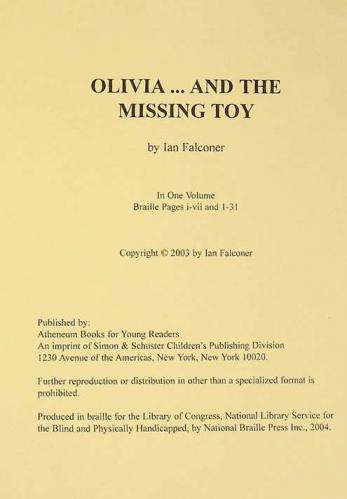
Olivia- and the missing toy
When her best toy mysteriously disappears, Olivia the feisty pig is determined to find out who is responsible.
Braille

Lost in the snow
Fluff the kitten gets lost in the snow when she runs away from the farm where she was born, but finally, after several frightening days on the run, she is found by the little girl who wants her more than anything.
Book

Corduroy lost and found
Corduroy the teddy bear sets out one night to find a birthday present for his owner, Lisa, but soon realizes that he cannot find his way home.
Book

Have you seen my dinosaur?
A five-year-old boy searches high and low for his missing dinosaur, and the people he asks for help do not believe such a creature actually exists.
Book

I must have Bobo
When Willy wakes up without his favorite toy, he looks everywhere until he finds it.
Book