
Catalogue Search | MBRL


Are you sure you want to remove the book from the shelf?

{{itemTitle}}
991
result(s) for
"Lost articles."
Sort by:

The letters are lost!
Long ago all the letters of the alphabet were together in their box, but one by one they disappeared and now the reader helps to find them.
Book
PBS newshour. Mudlarkers uncover archaeological treasures along London’s river banks
The phrase \"One person's trash is another's treasure,\" certainly applies to author Lara Maiklem. She is what's known as a \"mudlarker\" and spends her spare time scouring the shores of London’s River Thames for artifacts. Maiklem wrote a best-selling book explaining her passion for this unusual pastime. Special correspondent Malcolm Brabant joined her down in the mud.
Streaming Video

Bits & pieces
\"Tink is a very old cat with no common sense, but when he escapes outside he realizes how much he really does mean to his family\"-- Provided by publisher.
Book

Property and the Law of Finders
Are finders keepers? This most simple of questions has long evaded a satisfactory legal answer. Generally it seems to have been accepted that a finder acquires a property right in the object of her find and can protect it from subsequent interference, but even this turns out to be the baldest statement of principle, resting on obscure and confused authority. This first full-length treatment of finders sets them in their legal-historical context, and discovers a fascinating area of law lying at the crossroads of crime, obligations, and property. That on the same facts a finder might be thief, bailee, and/or property right holder has clouded our conceptual analysis, and prevented us from stating simply our rules about finding. Nonetheless, when the applicable doctrines and policies of our property law (particularly the central concept of possession) are explored and understood in the light of countervailing rules of crime and tort, we can argue confidently that, despite centuries of doubt and confusion, English law has succeeded in producing a body of law that is theoretically and practically coherent. Property and the Law of Finders makes this argument, and will appeal to anyone specifically interested in the law of personal property, and also to those with broader concerns about the evolution of common law concepts and their ability to yield workable, practical solutions.
eBook

Henry's bright idea
Deep in the shade of a walnut grove stands a tall tree that houses the Walnut Animal Society. Henry is a founding member, an inventor, and a tinkerer. Today Eleanor the bear and Henry search for his lost idea, but discover much more.
Book

LostNet: A smart way for lost and find
The rapid population growth in urban areas has led to an increased frequency of lost and unclaimed items in public spaces such as public transportation, restaurants, and other venues. Services like Find My iPhone efficiently track lost electronic devices, but many valuable items remain unmonitored, resulting in delays in reclaiming lost and found items. This research presents a method to streamline the search process by comparing images of lost and recovered items provided by owners with photos taken when items are registered as lost and found. A photo matching network is proposed, integrating the transfer learning capabilities of MobileNetV2 with the Convolutional Block Attention Module (CBAM) and utilizing perceptual hashing algorithms for their simplicity and speed. An Internet framework based on the Spring Boot system supports the development of an online lost and found image identification system. The implementation achieves a testing accuracy of 96.8%, utilizing only 0.67 GFLOPs and 3.5M training parameters, thus enabling the recognition of images in real-world scenarios and operable on standard laptops.
Journal Article
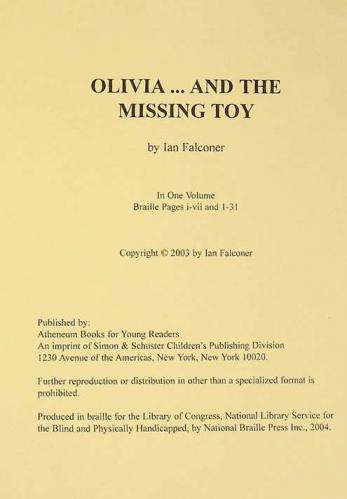
Olivia- and the missing toy
When her best toy mysteriously disappears, Olivia the feisty pig is determined to find out who is responsible.
Braille

Surveying Buddhist Cultural Heritage Lost During the Korean War
For the half-century following the armistice halting the Korean War (1950–1953), the immense loss of Korea’s Buddhist cultural heritage during the conflict has remained largely unexamined by scholars and historians, not only because of the topic’s immense scope and sensitivity but also the dearth of accurate and objective information. Thus, the research and resulting publications launched by Jogye Order’s Ministry of Culture in 2003 provide an invaluable and comprehensive survey of the hundreds of Buddhist temples and thousands of related cultural assets lost or damaged during the war. These efforts, however, have faced numerous difficulties. The ROK government made almost no official attempts to survey and catalog the damage sustained by the nation’s Buddhist temples during the war or its aftermath. Instead, by necessity, the Jogye Order’s surveys rely heavily on firsthand accounts of survivors, many of whom have since passed away, that were recorded often many decades after the war itself. The temple property records compiled by the Japanese Colonial Government likewise provide an important source for Jogye Order researchers in determining which temple assets were destroyed or lost during the conflict. However, in many instances, these records are incomplete or only note the names and numbers of assets that are now lost. Nor are such records insightful regarding what became of such assets but only indicate their current absence. Fortunately, over recent decades, the Jogye Order archivists have invested significant time and effort into digitizing surviving historical records and miscellanea recovered from individual temples.
Journal Article

Lost in the snow
Fluff the kitten gets lost in the snow when she runs away from the farm where she was born, but finally, after several frightening days on the run, she is found by the little girl who wants her more than anything.
Book

The Public Archaeology of Treasure
The Public Archaeology of Treasure comprises the select
proceedings of the 5th University of Chester Archaeology Student
Conference which took place on 31 January 2020 in the lecture
theatre of the Grosvenor Museum, Chester and was complemented by an
online Twitter conference on the following morning, 1 February
2020. Reflecting on the shifting and conflicting meanings, values
and significances for treasure in archaeology's public engagements,
interactions and manifestations, the volume emphasises how
education and research cannot avoid the persistent and evocative
associations of 'treasure' in socio-political discourse and popular
culture. This first-ever exploration of 'the public archaeology of
treasure' thus offers a host of timely themes and perspectives on
the public engagement with, and popular receptions of,
archaeological artefacts and assemblages written by students,
researchers, educators and heritage practitioners.
eBook