
Catalogue Search | MBRL


Are you sure you want to remove the book from the shelf?

{{itemTitle}}
2,838
result(s) for
"Lucretius"
Sort by:


CIL, VI 21521 = 34137 (CLE 1109): UN SOGNO IN FORMA POETICA
The text, although not devoid of a certain originality, seems to draw upon a rich repertoire of poetic references, which ranges from Lucretius, to Virgil, Horace, and Ovid: it tells the appearance of a deceased young man, now risen among the gods, to his relative. Non ego Tartareas penetrabo tristis ad undas, 20 non Acheronteis transvehar umbra vadis, non ego caeruleam remo pulsabo carinam nec te terribilem fronte timebo, Charon, nec Minos mihi iura dabit grandaevus et atris non errabo locis nec cohibebor aquis. 25 Surge, refer matri ne me noctesque diesque defleat ut maerens Attica mater Ityn. Nam me sancta Venus sedes non nosse silentum iussit et in caeli lucida templa tulit. Questi doni sono piu grandi di corone e unguenti: né il tempo vorace, né [-] li portano via. 2.COMMENTO EPIGRAFICO L'iscrizione, di carattere funerario, fu dedicata da Sex(tus) Onussianus Com[-] alla memoria del suo parente M(arcus) Lucceius Nepos.
Journal Article

The swerve : how the world became modern
In this book the author transports readers to the dawn of the Renaissance and chronicles the life of an intrepid book lover who rescued the Roman philosophical text On the Nature of Things from certain oblivion. In this work he has crafted both a work of history and a story of discovery, in which one manuscript, plucked from a thousand years of neglect, changed the course of human thought and made possible the world as we know it. Nearly six hundred years ago, a short, genial, cannily alert man in his late thirties took a very old manuscript off a library shelf, saw with excitement what he had discovered, and ordered that it be copied. That book was the last surviving manuscript of an ancient Roman philosophical epic, On the Nature of Things, by Lucretius, a beautiful poem of the most dangerous ideas: that the universe functioned without the aid of gods, that religious fear was damaging to human life, and that matter was made up of very small particles in eternal motion, colliding and swerving in new directions. The copying and translation of this ancient book, the greatest discovery of the greatest book-hunter of his age, fueled the Renaissance, inspiring artists such as Botticelli and thinkers such as Giordano Bruno; shaped the thought of Galileo and Freud, Darwin and Einstein; and had a revolutionary influence on writers such as Montaigne and Shakespeare and even Thomas Jefferson.
BOOK
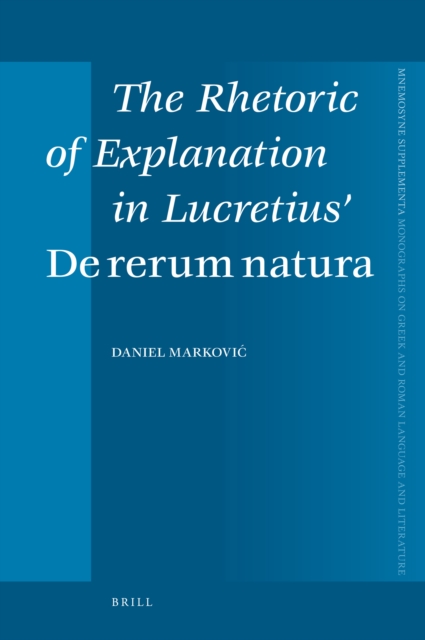
The Rhetoric of Explanation in Lucretius' De rerum natura
Based on the understanding of the term rhetoric that transcends the notion of literary genre, this book offers new answers to the questions of the provenance and the role of the main rhetorical strategies in Lucretius' De rerum natura.
eBook


LUCRETIUS’ HOMERIC MOURNERS
Lucretius (3.894–9) puts words into the mouths of mourners as part of his attack on the fear of death. The language of the passage has been read simply as mockery of the bereaved, but the poet is using language strongly reminiscent of Homer, in particular from Circe's speech advising Odysseus about the dangers of hearing the Sirens’ singing. This adds a level of irony to the passage as the poet has a complex relationship with the bewitching power of poetry.
Journal Article


LUCRETIAN DIDO: A STICHOMETRIC ALLUSION
In the fourth line of her first speech in Book 1, to Ilioneus and the Trojan castaways, Dido quotes the first word of the first line of Lucretius’ De rerum natura, and in the fourth line of her second speech, to Aeneas, she quotes the first words of the second line of the De rerum natura. This is not a coincidence but a signal of the importance of Lucretius and Epicureanism for the characterization of Dido in the Aeneid.
Journal Article