
Catalogue Search | MBRL


Are you sure you want to remove the book from the shelf?

{{itemTitle}}
74
result(s) for
"Ludwig, Andreas"
Sort by:

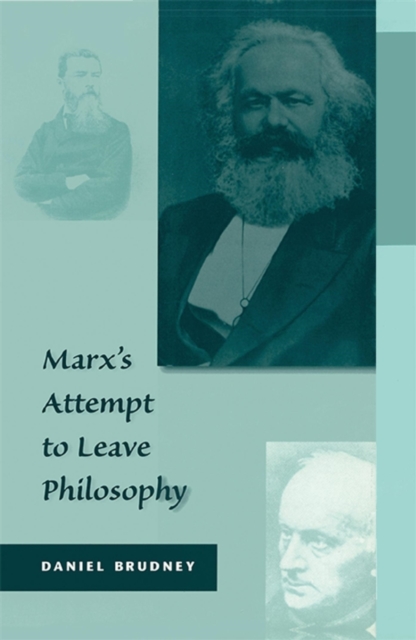
Marx’s Attempt to Leave Philosophy
Daniel Brudney traces the development of post-Hegelian thought from
Ludwig Feuerbach and Bruno Bauer to Karl Marx's work of 1844 and
his Theses on Feuerbach , and concludes with an examination
of The German Ideology . Brudney focuses on the
transmutations of a set of ideas about human nature, the good life,
and our relation to the world and to others; about how we end up
with false beliefs about these matters; about whether one can, in a
capitalist society, know the truth about these matters; and about
the critique of capitalism which would flow from such knowledge.
Brudney shows how Marx, following Feuerbach, attempted to reveal
humanity's nature and what would count as the good life, while
eschewing and indeed polemicizing against \"philosophy\"--against any
concern with metaphysics and epistemology. Marx attempted to avoid
philosophy as early as 1844, and the central aims of his texts are
the same right through The German Ideology . There is thus
no break between an early and a late Marx; moreover, there is no
\"materialist\" Marx, no Marx who subscribes to a metaphysical view,
even in The German Ideology , the text canonically taken as
the origin of Marxist materialism. Rather, in all the texts of this
period Marx tries to mount a compelling critique of the present
while altogether avoiding the dilemmas central to philosophy in the
modern era. Table of Contents:
Abbreviations
Introduction Themes from the Young Hegelians
Feuerbach's and Marx's Complaint against Philosophy The Interest of
These Texts Chapter by Chapter
1. Feuerbach's Critique of Christianity The
Critique of Christianity The Method of The Essence of Christianity
Comparisons The Geistiger Naturforscher
2. Feuerbach's Critique of Philosophy The
Status of Philosophy The Method of the Critique of Philosophy The
Content of the Critique of Philosophy Problems Antecedents Final
Comment
3. Bruno Bauer Self-Consciousness State and
Civil Society The Critique of Religion Bauer's Method
Assessment
4. The 1844 Marx I: Self-Realization Species
Being: Products Species Being: Enjoyments The Human Relation to
Objects Species Being: Immortality The Human Self-Realization
Activity
5. The 1844 Marx II: The Structure of Community
Completing One Another Mediation with the Species 3 Digression on
Community
6. The 1844 Marx III: The Problem of
Justification The Workers' Ignorance of Their True Nature
The Problem of Justification The Problem of Communists' Ends and
Beliefs Marx's 1844 Critique of Philosophy The Problem of the
Present
7. The Theses on Feuerbach Fundamental
Relations/Orientations Thesis Eleven Labor The Practical-Idealist
Reading The Problem of the First Step Thesis Six
8. The German Ideology I: More Anti-Philosophy
Some General Comments The Attack on the Young Hegelian Empirical
Verification Anti-Philosophy I Anti-Philosophy II
Transformation
9. The German Ideology II: The Picture of the Good Life
and the Change from 1844 Division of Labor Community
Self-Activity The Change from 1844
10. The German Ideology III: The Critique of Morality
(and the Return to Philosophy) What Is the Problem with
Morality? The (Weak) Sociological Thesis The Strong Sociological
Thesis and the Structural Thesis Morality and Moral Philosophy
under Communism Can The German Ideology Justify a Condemnation of
Capitalism? Returning to Philosophy
Conclusion
Notes Index
Reviews of this book: \"[ Marx's Attempt to Leave
Philosophy ] is plainly the work of a thoughtful and
intelligent philosopher. The discussions of Bruno Bauer and Marx's
writings of 1844-6, in particular, are valuable resources for
students of German philosophy of the 1840s.\" --Brian Leiter,
Times Literary Supplement
\"Brudney's work offers some fascinating insights into the world
of the Young Hegelians from whence Marx came. It also makes some
subtle points about the epistemology of moral theory and about the
communitarian aspects of Marx's vision that are important for
contemporary philosophy.\"
--R. Hudelson, Choice
eBook
Doka USA Ltd
Doka USA, part of Germany-based Doka Group, manufactures, sells, and rents frameworks for concrete construction projects. Its products include formwork beams, panels, floor props, and supporting frames for walls, floors, platforms, and load-bearing towers. They are used in major public structures, such as bridges, roadways, tunnels, airports, and dams. The company also offers tie rods and anchors, climbing cones, and suspension accessories, all used to ensure safety when installing formworks. Formerly known as Conesco Doka, Doka USA has sales and branch offices in California, Florida, Georgia, Illinois, Maryland, New Jersey, and Texas.
Report

Object, Relic, Fetish, Thing: Joseph Beuys and the Museum
Scribner discusses artist Joseph Beuys' installation \"Economic Values\" and curator Andreas Ludwig's historical exhibition of the GDR quotidian at the Open Depot, which both exhibited Tempo Peas. Tempo Peas, a quick cooking food product formulated in the sixties for the millions of working mothers in Germany, offer a juncture between current museal and artistic practices. Ludwig reads Tempo Peas as an object in the narrative of the GDR while Beuys incorporates Tempo Peas as a fetish of his proto-Marxist ideals.
Journal Article

Symphony New Brunswick winds up season on May 9
\"It's difficult to know if [Beethoven] thought about Napoleon as he wrote it or if it was just a dedication after the fact. Research doesn't tell us much more,\" [Newnham] says, \"but it is heroic in much larger terms than any one person could ever be, even if he was a hero. It's about so much more than that. It's about the human spirit and what we're capable of being. The song cycle based on six poems by Theophile Gautier and originally written for voice and piano is quite different. \"The lyricism is wonderful and it's very intimate, not big and explosive like a lot of music by [Hector Berlioz]. The songs are passionate and intimate songs of love and they're about the beginning of spring and summer, about journeys and loss. There's one about mourning a loved one while the last one is full of joy. It's about taking a journey with your loved one and it's about saying 'Let's start a life together,' and in it you can hear the wind and the sea,\" Newnham says.
Newspaper Article

World Marks Anniversary of Cold War Symbol's End
\"What people really are saying is, 'I didn't do everything wrong, I didn't live in vain,'\" said Gabriele Haubold, an architect and city planner in Eisenhuettenstadt, which was founded as a model socialist city but has suffered since 1989, losing more than one-third of its population. \"When people say things were better in the GDR, the politicians get angry. They say, 'It can't be, it was a dictatorship,'\" [Andreas Ludwig] said. \"They don't realize that it's just a critique of their job.\" \"It is interesting that many young people in the east want the GDR back, but it is not the real GDR that they want,\" [Klaus Schroeder] said. \"Young people know very little about the real GDR. It is not taught in schools, so they craft their own version with nostalgic, positive aspects.\"
Newspaper Article

Definitely not your typical opera
\"A lot of kids would never have heard opera and others may never hear opera again,\" [Andrea Ludwig] said. \"So, this is really a great chance for them.\" Ludwig and her co-stars, Colleen Skull, Karen Olinyk, Peter McGillivray and Luc Robert, are all up-and-coming opera singers honing their skills through the school tour, which will take them to more than 20 schools during a three-week run. Photo: Mike DiBattista, Review / Members of the Canadian Opera Company's Ensemble Studio brought their touring show, Cinderella, to Victoria school in Niagara Falls Thursday. The show gives students the chance to experience opera first-hand and to meet professional opera singers.
Newspaper Article

In East Germany, a wave of nostalgia for the good old days
Strange as it is, a wave of what is called ostalgie (ost meaning east in German) has become a phenomenon in Germany. People wear Born-in-the GDR T-shirts; or they collect Trabants, the rattling two-cylinder car that East Germans waited years to buy; or they go online to be contestants on the Ossi-Quiz, with all questions relating to East German pop culture. The museum is just a few rooms, mostly on the second floor of a former day care center, but it holds 70,000 to 80,000 objects from the former East Germany. About 10,000 people a year come to look at Mikki transistor radios, jars of Bulgarian plums, schoolbooks, plastic water glasses that never seemed to come in the right colors. Seeing these familiar objects clearly stirs warm feelings about the vanished past. Ostalgie is complicated, made up of various ingredients. One is clearly the disillusionment felt by many former Easterners over German reunification, which took place 14 years ago. Unemployment these days is commonly 25 percent in areas like Eisenhuttenstadt. Rents are no longer subsidized. Doctor visits cost money. People can be fired. And, as Andreas Ludwig, the West German scholar of urban history who started the museum a few years ago, noted, even capitalist products break down or are shabby and schlocky.
Newspaper Article

Zales remaking image to bring back romance of jewelry buying
The company is also trying to reemphasize the three distinct niches of its stores: medium-priced Zales Jewelers; Gordon's, catering to the younger crowd; and high-end stores including Corrigan's and Bailey Banks & Biddle. There is a Gordon's jewelry store in College Hills Mall in Normal. Zales is also virtually eliminated price promotions in its 130 higher-end stores, such as Corrigan's and Bailey Banks & Biddle, and the division is doing better than last year, [Andreas Ludwig] said. PHOTO; Allison Fairchild of Richardson, Texas, looked over a new display at the Zales jewelry store at Dallas' NorthPark Center. Zales Corp. is gradually redesigning its 550 stores to make them as comfortable as a friend's living room.; Credit: AP
Newspaper Article