
Catalogue Search | MBRL


Are you sure you want to remove the book from the shelf?

{{itemTitle}}
8
result(s) for
"Luwian Studies"
Sort by:

Children of Kubaba: Serious Games, Ritual Toys, and Divination at Iron Age Carchemish
This paper presents an analysis of a ritual event memorialised on stone reliefs at the ancient city of Carchemish around 800 BC. It is argued that the reliefs represent a ceremony of investiture, in which boys of royal lineage are handed out toys as oracular instruments to elicit favourable omens for the heir apparent. The inclusion of boys and their toys in the visual commemoration of a political ritual has bearings on three levels of meaning. First, it testifies to a hitherto unrecognised cult practice, involving grouping boys in age classes and harnessing their ludic practices for ritual purposes. Second, it reflects local political preoccupations connected with dynastic controversies, in an attempt to silence counternarratives through the emphatic staging of children. Finally, the chosen imagery conveys complex philosophical ideas about life, education, and individual destiny, connecting with issues of material religion and childhood studies. The study integrates interpretive perspectives from visual semiotics, architectural analysis, and ancient studies to show how, upon specific occasions, marginal groups and everyday material items, such as children and their toys, may play critical roles in collective ritual events.
Journal Article

Morphosyntax of the Noun Phrase in Hieroglyphic Luwian
In this book, Anna H. Bauer provides a full and detailed analysis of the noun phrases found in the Hieroglyphic Luwian corpus.
eBook

Binding and Smiting
The purpose of this paper is to offer evidence for a set of related formulaic expressions meaning ‘bond and blow’, ‘of binding and smiting’, and ‘the substitute for binding and smiting’ in Luvian cuneiform texts of the second millennium BCE. The passages where the relevant formulae are attested have resisted a coherent interpretation thus far. Our argumentation is three-pronged. First, we resort to the combinatorial method to show that these formulae occur in the vicinity of other merisms, and therefore are likely to constitute the same figure of speech. Furthermore, we endeavor to demonstrate based on context that they denote something related to strong physical impact. The argument involves a great deal of restored text, but although voluminous, the contexts are so repetitive that the restorations appear warranted. Second, we use the etymological method in order to justify the claim that the roots supplying their reflexes to our formulae are Proto-Indo-European *seh₂ ‘to bind’ and * wedh ‘to strike, smite’. The derivation of each of the derivatives occurring in the bipartite merisms under discussion is addressed in some detail, and additional evidence from a Luwian hieroglyphic inscription Kululu 1 is adduced to flesh out our hypothesis. Third, we provide typological discussion facilitating the interpretation of “binding” and “smiting” in the context of the Hittite-Luvian antiwitchcraft rituals. It turns out that hostile witchcraft has a potential to both “bind” (paralyze) and “smite” (cause to suffer) the body parts of its victim. As a whole, the paper represents a contribution to the ongoing decipherment of the Luvian language.
Journal Article
Unpublished Hieroglyphic Luwian Inscriptions from Adıyaman Museum
In this article we present the first edition of five Hieroglyphic Luwian inscriptions of Ancoz and Samsat provenance from the Adıyaman Museum, provide clarification on the records of previously published inscriptions from Ancoz and Samsat, suggest a join with an existing Ancoz inscription, and offer a discussion on the nature of the rulers of Kummuh.
Journal Article

Internal or external evil: a merism in Luwian incantations
The paper addresses the frequent collocation /ir(hu)waliyan parittarwaliyan/, which occurs in Luwian incantations embedded in Hittite cuneiform ritual texts. Despite the relatively clear context, the meanings of this and similar collocations have remained obscure. Using combinatory and etymological methods, we intend to demonstrate that it hides the merism “internal (or) external”, which modifies various sorts of supernatural negative phenomena. Furthermore, we intend to argue that such an interpretation is compatible with the Late Bronze Age Anatolian beliefs about potential sources of evil. A collateral result of our demonstration is the elucidation of a number of additional contexts in the Hittite, Luwian, Lydian, and official Aramaic languages.
Journal Article
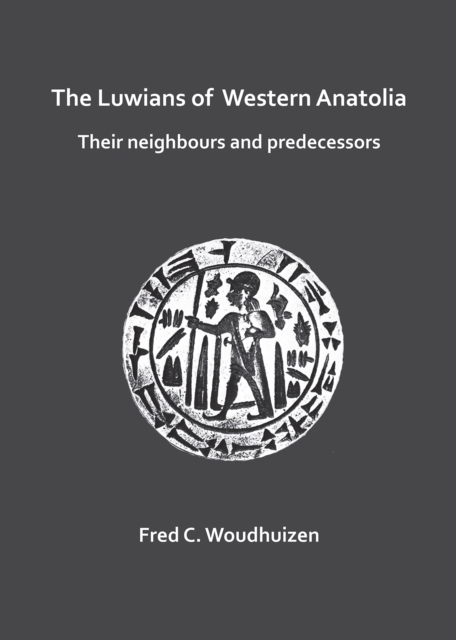
The Luwians of western Anatolia: their neighbours and predecessors
A study focusing on the Luwians of Western Anatolia, the geography of their habitat, and their neighbours and predecessors in the region. A reconstruction of western Luwian history and a sketch of their language is presented, based on linguistic data taken from hieroglyphic inscriptions and cuneiform script.
eBook

Iron Age Hieroglyphic Luwian Inscriptions
Hieroglyphic Luwian belongs to the Anatolian group of ancient languages and was inscribed primarily on stone, using an indigenous Anatolian pictorial writing system. These Hieroglyphic Luwian inscriptions were written over a period of centuries in the region of Anatolia and northern Syria. Their authors were primarily the rulers of the so-called Neo-Hittite states, contemporaries and neighbors of early Israel. This volume collects some of the most important and representative of the inscriptions in transliteration and translation, organized by genre. Each text is accompanied by relevant information on provenance, dating, and other points of interest that will engage specialist and nonspecialist alike.
eBook