
Catalogue Search | MBRL


Are you sure you want to remove the book from the shelf?

{{itemTitle}}
16
result(s) for
"Lyn Carson"
Sort by:
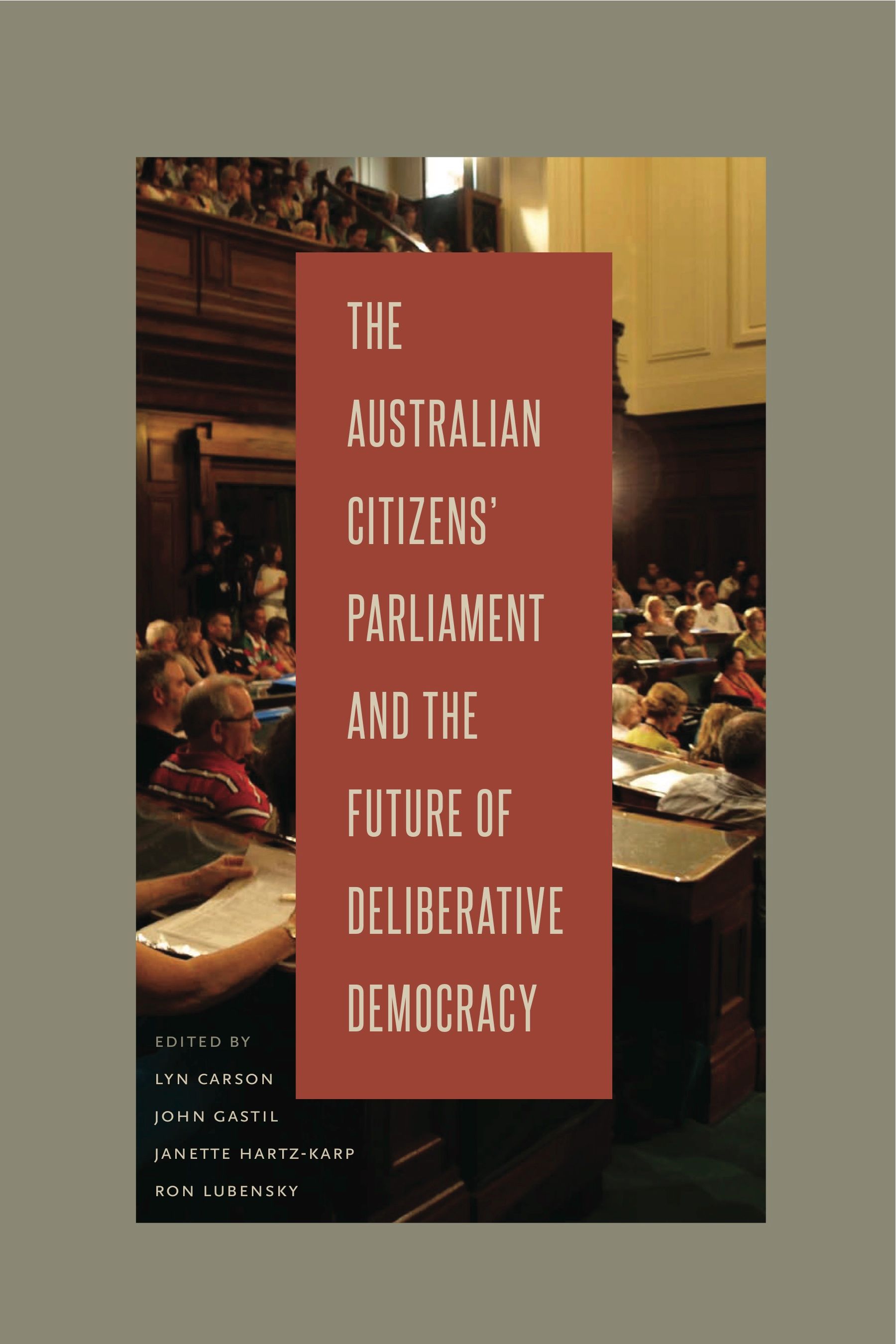
The Australian Citizens’ Parliament and the Future of Deliberative Democracy
Growing numbers of scholars, practitioners, politicians, and citizens recognize the value of deliberative civic engagement processes that enable citizens and governments to come together in public spaces and engage in constructive dialogue, informed discussion, and decisive deliberation. This book seeks to fill a gap in empirical studies in deliberative democracy by studying the assembly of the Australian Citizens’ Parliament (ACP), which took place in Canberra on February 6–8, 2009. The ACP addressed the question “How can the Australian political system be strengthened to serve us better?” The ACP’s Canberra assembly is the first large-scale, face-to-face deliberative project to be completely audio-recorded and transcribed, enabling an unprecedented level of qualitative and quantitative assessment of participants’ actual spoken discourse. Each chapter reports on different research questions for different purposes to benefit different audiences. Combined, they exhibit how diverse modes of research focused on a single event can enhance both theoretical and practical knowledge about deliberative democracy.
eBook

The Australian Citizens' Parliament and the Future of Deliberative Democracy
Growing numbers of scholars, practitioners, politicians, and citizens recognize the value of deliberative civic engagement processes that enable citizens and governments to come together in public spaces and engage in constructive dialogue, informed discussion, and decisive deliberation. This book seeks to fill a gap in empirical studies in deliberative democracy by studying the assembly of the Australian Citizens’ parliament (ACP), which took place in Canberra on February 6–8, 2009. The ACP addressed the question, “How can the Australian political system be strengthened to serve us better?” The ACP’s Canberra assembly is the first large-scale, face-to-face deliberative project to be completely audio-recorded and transcribed, enabling an unprecedented level of qualitative and quantitative assessment of participants’ actual spoken discourse. Each chapter reports on different research questions for different purposes to benefit different audiences. Combined, they exhibit how diverse modes of research focused on a single event can enhance both theoretical and practical knowledge about deliberative democracy,
eBook
Random selection could 'improve democracy'
Their model relied on four categories of people in the parliament. These were: 'intelligent' people (actions serve both personal and social interests), 'helpless or naive' (loss for self, but gain for others), 'bandits' (benefit themselves, but not others), and 'stupid' (actions produce a loss for everyone). \"We do it because it's fair. Everyone has got an equal chance,\" she says. \"It doesn't make sense to exclude parliaments from that.\" \"They'll be asking really naive questions or playing the devil's advocate,\" she says. \"It's all fodder for deliberation.\"
Newsletter
FED:Climate assembly valuable, says expert
Ms [Julia Gillard]'s plan has been criticised by the political left and right, including Greenpeace which branded it a \"smokescreen\" and the Australian Institute which labelled it \"school-yard politics\". Prof [Lyn Carson] co-convened Australia's first citizens' assembly, the Australian Citizens' Parliament, in February 2009.
Newsletter
US Studies Centre opens in Sydney to increase awareness
He's a 22-year-old history teacher who's enrolled at the centre because it's an area he wants to learn more about. [Matt Leeds]: Hopefully I'll be astute enough to figure out if they're trying to just feed me propaganda the whole time, and if pro-American views are continually being held but it'll certainly be interesting to see throughout the course if during the course if America is portrayed in a particular way and if that's actually affecting the teaching of the unit and such like that. Hopefully contrary views will be allowed to be held and expressed throughout the degree. [Michael Turtle]: One academic who isn't at the centre yet, though, is the new CEO Geoffrey Garrett.
Transcript

Language after L=A=N=G=U=A=G=E
This project focuses on the ways poetry can respond in counterpoint to discourses that articulate and justify various power structures—examining the possibilities and the limitations of those poetic, discursive interventions. The first chapter lays out a general, theoretical framework for conceptualizing this engagement. The second chapter explores several schemas through which the field of poetry has been conceptually organized, since the ways the field is framed play a part in delimiting those possibilities for political engagement. In the third chapter, I explore recent poems written through appropriative methods: poems which take a source-text and transpose it into a new context. I consider how the labor of poetic appropriation and the work of reading these poems can make visible, the structural conditions of precarity and marginalization while also drawing particular attention to the ways those inequities are effaced, justified, and/or rendered invisible.
Dissertation

The landscapes were in my arms
This work concerns itself with questions of domesticity, human contact with the present and future tenses, the promise, and the concept of abstraction through ruminations on expressionist and color field painting. It employs both lyric and prose modes and forms in tandem. Its central question is, perhaps: if the subject places themselves in or projects their subjectivity onto the abstract, does it remain abstract? What implications could this transposition of subjectivity have on promises, abstracted by the future tense and yet concrete in terms of the materiality of language? In this work, both the house and paintings are primary sites for investigation.
Dissertation


let go the ghost
The poems in let go the ghost seek to position themselves in the difficult middle-ground between internal and external, between content and form, between poet and poem. They seek the \"in between,\" both literally and metaphorically. To this end, the poems straddle the line between opposites—yes and no, coming and going, you and I. In terms of form, the poems rely heavily on a wide range of sources—Lorine Niedecker, Jack Spicer, and Andy Goldsworthy especially. In terms of content, they rely on the ideas of condensery, accrual, and seriality. In broad strokes, let go the ghost explores the process of letting go the past and moving forward into an unpredictable future.
Dissertation

Smelly job for park protectors; Women walk miles to get rid of predators
\"If it is really wet we won't go up if there are rivers to cross for safety reasons. We keep our eyes on the weather and make a call but generally we go up in most weather,\" Mrs [Joe Carson- Dodunski] said. \"It (the smell) gets quite bad but we have been doing it so long we're used to bad smells and animals that are all maggoty, you just harden up,\" Mrs Carson-Dodunski said. Despite the smells, the pair have been doing the job for the past four years and they love it. \"We are casuals and work one week on and one off a lot of the time but it's great to have a job that you get to be outside all day and because of all the walking we do you don't have to worry about exercise,\" Mrs Carson-Dodunski said.
Newspaper Article