
Catalogue Search | MBRL


Are you sure you want to remove the book from the shelf?

{{itemTitle}}
15,098
result(s) for
"Lynching."
Sort by:


A Deed So Accursed
From the end of Reconstruction to the onset of the civil rights era, lynching was prevalent in developing and frontier regions that had a dynamic and fluid African American population. Focusing on Mississippi and South Carolina because of the high proportion of African Americans in each state during \"the age of lynching,\" Terence Finnegan explains lynching as a consequence of the revolution in social relations-assertiveness, competition, and tension-that resulted from emancipation. A comprehensive study of lynching in Mississippi and South Carolina, A Deed So Accursed reveals the economic and social circumstances that spawned lynching and explores the interplay between extralegal violence and political and civil rights.
Finnegan's research shows that lynching rates depended on factors other than caste conflict and the interaction of race and southern notions of honor. Although lynching supported the ends of white supremacy, many mobs lynched more for private retaliation than for communal motives, which explains why mobs varied greatly in size, organization, behavior, and purpose.
The resistance of African Americans was vigorous and sustained and took on a variety of forms, but depending on the circumstances, black resistance could sometimes provoke rather than deter lynching. Ultimately, Finnegan shows how out of the tragedy of lynching came the triumph of the civil rights movement, which was built upon the organizational efforts of African American anti-lynching campaigns.
eBook

The Ox-Bow incident
A cowboy is unable to prevent three wandering travelers from being unjustly lynched for murder.
BOOK

The End of American Lynching
The End of American Lynchingquestions how we think about the dynamics of lynching, what lynchings mean to the society in which they occur, how lynching is defined, and the circumstances that lead to lynching. Ashraf H. A. Rushdy looks at three lynchings over the course of the twentieth century-one in Coatesville, Pennsylvania, in 1911, one in Marion, Indiana, in 1930, and one in Jasper, Texas, in 1998-to see how Americans developed two distinct ways of thinking and talking about this act before and after the 1930s.
One way takes seriously the legal and moral concept of complicity as a way to understand the dynamics of a lynching; this way of thinking can give us new perceptions into the meaning of mobs and the lynching photographs in which we find them. Another way, which developed in the 1940s and continues to influence us today, uses a strategy of denial to claim that lynchings have ended. Rushdy examines how the denial of lynching emerged and developed, providing insight into how and why we talk about lynching the way we do at the dawn of the twenty-first century. In doing so, he forces us to confront our responsibilities as American citizens and as human beings.
eBook

Popular justice
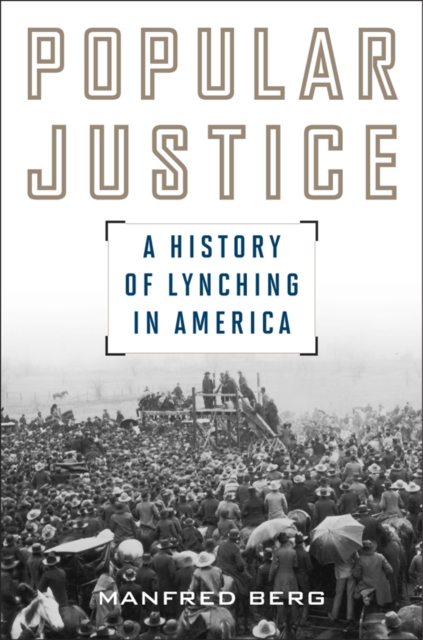
Lynching has often been called \"America's national crime\" that has defined the tradition of extralegal violence in America. Having claimed many thousand victims, \"Judge Lynch\" holds a firm place in the dark recesses of our national memory. In Popular Justice, Manfred Berg explores the history of lynching from the colonial era to the present. American lynch law, he argues, has rested on three pillars: the frontier experience, racism, and the anti-authoritarian spirit of grassroots democracy. Berg looks beyond the familiar story of mob violence against African American victims, who comprised the majority of lynch targets, to include violence targeting other victim groups, such as Mexicans and the Chinese, as well as many of those cases in which race did not play a role. As he nears the modern era, he focuses on the societal changes that ended lynching as a public spectacle. Berg's narrative concludes with an examination of lynching's legacy in American culture. From the colonial era and the American Revolution up to the twenty-first century, lynching has been a part of our nation's history. Manfred Berg provides us with the first comprehensive overview of \"popular justice.\"
eBook

Nadler: Passing Antilynching Act would ‘right great historical wrong’
On Feb. 28, Rep. Jerry Nadler (D-N.Y.) urged the House to pass the Emmett Till Antilynching Act, which would designate the violent act a hate crime.
Streaming Video


Show Time
In Show Time
, Lee Ann Fujii asks why some perpetrators of political
violence, from lynch mobs to genocidal killers, display their acts
of violence so publicly and extravagantly. Closely
examining three horrific and extreme episodes-the murder of a
prominent Tutsi family amidst the genocide in Rwanda, the execution
of Muslim men in a Serb-controlled village in Bosnia during the
Balkan Wars, and the lynching of a twenty-two-year old Black
farmhand on Maryland's Eastern Shore in 1933-Fujii shows how
\"violent displays\" are staged to not merely to kill those perceived
to be enemies or threats, but also to affect and influence
observers, neighbors, and the larger society.
Watching and participating in these violent displays profoundly
transforms those involved, reinforcing political identities, social
hierarchies, and power structures. Such public spectacles of
violence also force members of the community to choose sides-openly
show support for the goals of the violence, or risk becoming
victims, themselves. Tracing the ways in which public displays of
violence unfold, Show Time reveals how the perpetrators
exploit the fluidity of social ties for their own ends.
eBook