
Catalogue Search | MBRL


Are you sure you want to remove the book from the shelf?

{{itemTitle}}
120
result(s) for
"MATH TEXTBOOKS"
Sort by:

Textbooks and school library provision in secondary education in Sub-Saharan Africa
This study is based on research on secondary textbook and school library provision in Botswana, Cameroon, Cote d'Ivoire, Ghana, Kenya, Malawi, Rwanda, Tanzania, and Togo, as well as existing recent country reports on textbook provision and an extensive desk research. Considerable variations exist in Sub-Saharan African textbook requirements needed to meet secondary curriculum specifications just as significant differences exist between and within countries in regard to the average price of recommended textbooks. Some countries have no approved textbooks list. This World Bank Working Paper aims to discuss the textbook situation in Sub-Saharan Africa with a special focus on secondary textbook availability, cost and financing, distribution and publishing, and the status of school libraries. Its objective is to analyze the issues in secondary textbook and school library provision and to provide some options and strategies for improvement.
eBook

Evaluating Three Elementary Mathematics Programs for Presence of Eight Research-Based Instructional Design Principles
The present review builds on earlier research that evaluated the curricular features of core math programs to improve the performances of students with or at risk for mathematics difficulties. In this review, three elementary math programs, at Grades 2 and 4, were evaluated for the presence of eight instructional principles. Math intervention studies have empirically validated these principles for promoting math proficiency of students struggling with mathematics. Data were collected via a researcher-developed scoring rubric. Findings indicate that adherence to the instructional principles varied markedly within and across programs. In addition, the results indicated that the current textbooks contain a general lack of explicit instruction and provide too few practice opportunities to teach material to mastery. Implications for future curricular reviews and enhancing core math instruction are discussed.
Journal Article

Performing Math
Performing Math tells the history of expectations for math communication—and the conversations about math hatred and math anxiety that occurred in response. Focusing on nineteenth-century American colleges, this book analyzes foundational tools and techniques of math communication: the textbooks that supported reading aloud, the burnings that mimicked pedagogical speech, the blackboards that accompanied oral presentations, the plays that proclaimed performers’ identities as math students, and the written tests that redefined “student performance.” Math communication and math anxiety went hand in hand as new rules for oral communication at the blackboard inspired student revolt and as frameworks for testing student performance inspired performance anxiety. With unusual primary sources from over a dozen educational archives, Performing Math argues for a new, performance-oriented history of American math education, one that can explain contemporary math attitudes and provide a way forward to reframing the problem of math anxiety.
eBook

On the Rayleigh-Ritz method
We give a simple proof of the well known fact that the approximate eigenvalues provided by the Rayleigh-Ritz method are increasingly accurate upper bounds to the exact ones. To this end, we resort to the variational principle and to a set of suitable projection operators.
Journal Article

Gender Bias in School Mathematics Textbooks from Grade 1 to 12 in Palestine
This study examines one of the most important social concepts and perspectives in mathematics textbooks from first grade to12 (th) grade in Palestine, which is gender bias. To achieve the goal of this study, the researcher conducted a quantitative and qualitative content analysis of an interval sample of these textbooks. Content analysis is considered an important method for revealing the strengths and weaknesses of curriculum components. The content analysis addressed the use of gender in names, verbs (actions), pictures, pronouns, and professions. The result confirms a male bias in all aspects of the analysis. The same result was confirmed by the qualitative analysis of profession types mentioned in mathematics textbooks for both females and males. In light of these results, the researcher strongly recommends that the curriculum be reformed to improve the gender balance.
Journal Article
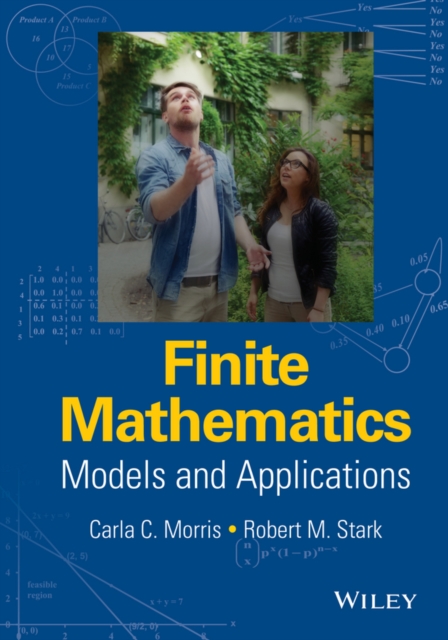
Finite mathematics
Features step-by-step examples based on actual data and connects fundamental mathematical modeling skills and decision making concepts to everyday applicability Featuring key linear programming, matrix, and probability concepts, Finite Mathematics: Models and Applications emphasizes cross-disciplinary applications that relate mathematics to everyday life. The book provides a unique combination of practical mathematical applications to illustrate the wide use of mathematics in fields ranging from business, economics, finance, management, operations research, and the life and social sciences. In order to emphasize the main concepts of each chapter, Finite Mathematics: Models and Applications features plentiful pedagogical elements throughout such as special exercises, end notes, hints, select solutions, biographies of key mathematicians, boxed key principles, a glossary of important terms and topics, and an overview of use of technology. The book encourages the modeling of linear programs and their solutions and uses common computer software programs such as LINDO. In addition to extensive chapters on probability and statistics, principles and applications of matrices are included as well as topics for enrichment such as the Monte Carlo method, game theory, kinship matrices, and dynamic programming. Supplemented with online instructional support materials, the book features coverage including: Algebra Skills Mathematics of Finance Matrix Algebra Geometric Solutions Simplex Methods Application Models Set and Probability Relationships Random Variables and Probability Distributions Markov Chains Mathematical Statistics Enrichment in Finite Mathematics An ideal textbook, Finite Mathematics: Models and Applications is intended for students in fields from entrepreneurial and economic to environmental and social science, including many in the arts and
humanities.
eBook

Culturally Appropriate Math Problem-Solving Instruction With English Language Learners
The purpose of this research study was to examine the effectiveness of culturally appropriate problem-solving instruction (CAPSI) incorporating elements from schema instruction, video modeling, and vocabulary instruction. Culturally relevant information and the students' native language were explicitly incorporated into math problem-solving instruction throughout the duration of intervention implementation. Four second-grade Latinx English language learner (ELL) students attending a P-6 elementary school took part in this study. The primary outcome data for this study were collected using word problem probes consisting of 30 word problems selected from grade-level textbooks. In addition to the word problem probes, the effects of the intervention on general problem solving and vocabulary acquisition were analyzed via pre- and posttest measures. The overall effectiveness of CAPSI was analyzed using a multiple baseline design across participants. Results from this study demonstrated improvements in problem solving and math vocabulary acquisition after the implementation of CAPSI.
Journal Article
Solving Geometric Problems Using a Non-Traditional Form of Teaching
The paper focuses on innovative and creative approaches to teaching geometry in the first year of primary school. Geometry is generally not a popular part of mathematics. The findings are based on several studies investigating how students at different educational levels solve different mathematical problems. The link between geometry and the math trail is an interesting one, as it combines knowledge of geometry in the real world with solving problems directly in the field. Through the MathCityMap portal, first grade students were able to solve geometry problems created by a math trail using different measuring tools. The results of the abovementioned outdoor activity showed that the students had gained a positive attitude towards geometry and that they had broadened their perspective on the connections between mathematics, other school subjects and everyday life.
Journal Article
Introduction to Continuum Mechanics (4th Edition)
Continuum mechanics is a branch of physical mechanics that describes the macroscopic mechanical behavior of solid or fluid materials considered to be continuously distributed. It is fundamental to the fields of civil, mechanical, chemical and bioengineering. This time-tested text has been used for over 35 years to introduce junior and senior-level undergraduate engineering students, as well as graduate students, to the basic principles of continuum mechanics and their applications to real engineering problems. The text begins with a detailed presentation of the coordinate invariant quantity and the tensor, introduced as a linear transformation.
eBook

A Mathematics Course for Political and Social Research
Political science and sociology increasingly rely on
mathematical modeling and sophisticated data analysis, and many
graduate programs in these fields now require students to take a
\"math camp\" or a semester-long or yearlong course to acquire the
necessary skills. The problem is that most available textbooks are
written for mathematics or economics majors, and fail to convey to
students of political science and sociology the reasons for
learning often-abstract mathematical concepts. A Mathematics
Course for Political and Social Research fills this gap,
providing both a primer for math novices and a handy reference for
seasoned researchers.
The book begins with the fundamental building blocks of
mathematics and basic algebra, then goes on to cover essential
subjects such as calculus in one and more than one variable,
including optimization, constrained optimization, and implicit
functions; linear algebra, including Markov chains and
eigenvectors; and probability. It describes the intermediate steps
most other textbooks leave out, features numerous exercises
throughout, and grounds all concepts by illustrating their use and
importance in political science and sociology.
Uniquely designed for students and researchers in political
science and sociology
Uses examples from political science and sociology
Features \"Why Do I Care?\" sections that explain why concepts
are useful to practicing political scientists and sociologists
Includes numerous exercises
Complete online solutions manual (available only to
professors)
Selected solutions available online to students
eBook