
Catalogue Search | MBRL


Are you sure you want to remove the book from the shelf?

{{itemTitle}}
19,327
result(s) for
"MATHEMATICS / Geometry / Algebraic"
Sort by:

A Primer on Mapping Class Groups (PMS-49)
The study of the mapping class group Mod(S) is a classical topic that is experiencing a renaissance. It lies at the juncture of geometry, topology, and group theory. This book explains as many important theorems, examples, and techniques as possible, quickly and directly, while at the same time giving full details and keeping the text nearly self-contained. The book is suitable for graduate students. A Primer on Mapping Class Groups begins by explaining the main group-theoretical properties of Mod(S), from finite generation by Dehn twists and low-dimensional homology to the Dehn-Nielsen-Baer theorem. Along the way, central objects and tools are introduced, such as the Birman exact sequence, the complex of curves, the braid group, the symplectic representation, and the Torelli group. The book then introduces Teichmüller space and its geometry, and uses the action of Mod(S) on it to prove the Nielsen-Thurston classification of surface homeomorphisms. Topics include the topology of the moduli space of Riemann surfaces, the connection with surface bundles, pseudo-Anosov theory, and Thurston's approach to the classification.
eBook
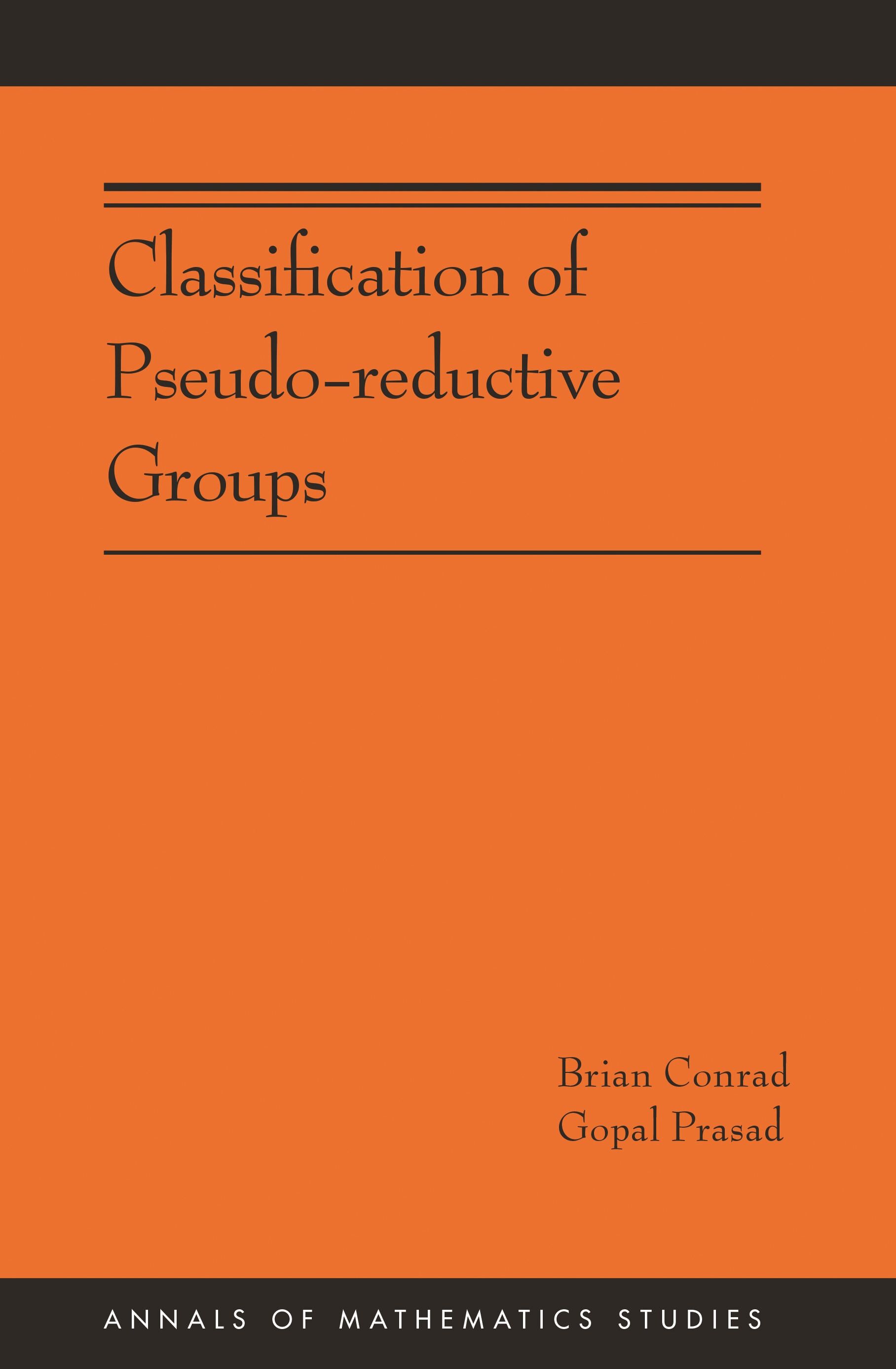
Classification of Pseudo-reductive Groups (AM-191)
In the earlier monograph Pseudo-reductive Groups, Brian Conrad, Ofer Gabber, and Gopal Prasad explored the general structure of pseudo-reductive groups. In this new book, Classification of Pseudo-reductive Groups, Conrad and Prasad go further to study the classification over an arbitrary field. An isomorphism theorem proved here determines the automorphism schemes of these groups. The book also gives a Tits-Witt type classification of isotropic groups and displays a cohomological obstruction to the existence of pseudo-split forms. Constructions based on regular degenerate quadratic forms and new techniques with central extensions provide insight into new phenomena in characteristic 2, which also leads to simplifications of the earlier work. A generalized standard construction is shown to account for all possibilities up to mild central extensions.The results and methods developed in Classification of Pseudo-reductive Groups will interest mathematicians and graduate students who work with algebraic groups in number theory and algebraic geometry in positive characteristic.
eBook
Foundations of algebraic topology
The book description for \"Foundations of Algebraic Topology\" is currently unavailable.
eBook
The asymptotics of the optimal holomorphic extensions of holomorphic jets along submanifolds
We study the asymptotics of the \\(L^2\\)-optimal holomorphic extensions of holomorphic jets associated with high tensor powers of a positive line bundle along submanifolds. More precisely, for a fixed complex submanifold in a complex manifold, we consider the operator which for a given holomorphic jet along the submanifold of a positive line bundle associates the \\(L^2\\)-optimal holomorphic extension of it to the ambient manifold. When the tensor power of the line bundle tends to infinity, we give an explicit asymptotic formula for this extension operator. This is done by a careful study of the Schwartz kernels of the extension operator and related Bergman projectors. It extends our previous results, done for holomorphic sections instead of jets. As an application, we prove the asymptotic isometry between two natural norms on the space of holomorphic jets: one induced from the ambient manifold and another from the submanifold.
Paper
An atlas of K3 surfaces with finite automorphism group
We study the geometry of the K3 surfaces \\(X\\) with a finite number automorphisms and Picard number \\( 3\\). We describe these surfaces classified by Nikulin and Vinberg as double covers of simpler surfaces or embedded in a projective space. We study moreover the configurations of their finite set of \\((-2)\\)-curves.
Paper
Delta Characters and Crystalline Cohomology
The first part of the paper develops the theory of \\(m\\)-shifted \\(\\)-typical Witt vectors which can be viewed as subobjects of the usual \\(\\)-typical Witt vectors. We show that the shifted Witt vectors admit a delta structure that satisfy a canonical identity with the delta structure of the usual \\(\\)-typical Witt vectors. Using this theory, we prove that the generalized kernels of arithmetic jet spaces are jet spaces of the kernel at the first level. This also allows us to interpret the arithmetic Picard-Fuchs operator geometrically. For a \\(\\)-formal group scheme \\(G\\), by a previous construction, one attaches a canonical filtered isocrystal \\(H_(G)\\) associated to the arithmetic jet spaces of \\(G\\). In the second half of our paper, we show that \\(H_(A)\\) is of finite rank if \\(A\\) is an abelian scheme. We also prove a strengthened version of a result of Buium on delta characters on abelian schemes. As an application, for an elliptic curve \\(A\\) defined over \\(Z_p\\), we show that our canonical filtered isocrystal \\(H_(A) Q_p\\) is weakly admissible. In particular, if \\(A\\) does not admit a lift of Frobenius, we show that \\(H_(A) Q_p\\) is isomorphic to the first crystalline cohomology \\(H^1_cris(A) Q_p\\) in the category of filtered isocrystals. On the other hand, if \\(A\\) admits a lift of Frobenius, then \\(H_(A) Q_p\\) is isomorphic to the sub-isocrystal \\(H^0(A,_A) Q_p\\) of \\(H^1_cris(A) Q_p\\).
Paper

Mirror symmetry and elliptic Calabi-Yau manifolds
A
bstract
We find that for many Calabi-Yau threefolds with elliptic or genus one fibrations mirror symmetry factorizes between the fiber and the base of the fibration. In the simplest examples, the generic CY elliptic fibration over any toric base surface
B
that supports an elliptic Calabi-Yau threefold has a mirror that is an elliptic fibration over a dual toric base surface
B
˜
that is related through toric geometry to the line bundle −6
K
B
. The Kreuzer-Skarke database includes all these examples and gives a wide range of other more complicated constructions where mirror symmetry also factorizes. Since recent evidence suggests that most Calabi-Yau threefolds are elliptic or genus one fibered, this points to a new way of understanding mirror symmetry that may apply to a large fraction of smooth Calabi-Yau threefolds. The factorization structure identified here can also apply for CalabiYau manifolds of higher dimension.
Journal Article

Chern classes of crystals
The crystalline Chern classes of the value of a locally free crystal vanish on a smooth variety defined over a perfect field. Out of this we conclude new cases of de Jong’s conjecture relating the geometric étale fundamental group of a smooth projective variety defined over an algebraically closed field and the constancy of its category of isocrystals. We also discuss the case of the Gauß–Manin convergent isocrystal.
Journal Article

Computational Aspects of Modular Forms and Galois Representations
Modular forms are tremendously important in various areas of mathematics, from number theory and algebraic geometry to combinatorics and lattices. Their Fourier coefficients, with Ramanujan's tau-function as a typical example, have deep arithmetic significance. Prior to this book, the fastest known algorithms for computing these Fourier coefficients took exponential time, except in some special cases. The case of elliptic curves (Schoof's algorithm) was at the birth of elliptic curve cryptography around 1985. This book gives an algorithm for computing coefficients of modular forms of level one in polynomial time. For example, Ramanujan's tau of a prime number p can be computed in time bounded by a fixed power of the logarithm of p. Such fast computation of Fourier coefficients is itself based on the main result of the book: the computation, in polynomial time, of Galois representations over finite fields attached to modular forms by the Langlands program. Because these Galois representations typically have a nonsolvable image, this result is a major step forward from explicit class field theory, and it could be described as the start of the explicit Langlands program. The computation of the Galois representations uses their realization, following Shimura and Deligne, in the torsion subgroup of Jacobian varieties of modular curves. The main challenge is then to perform the necessary computations in time polynomial in the dimension of these highly nonlinear algebraic varieties. Exact computations involving systems of polynomial equations in many variables take exponential time. This is avoided by numerical approximations with a precision that suffices to derive exact results from them. Bounds for the required precision--in other words, bounds for the height of the rational numbers that describe the Galois representation to be computed--are obtained from Arakelov theory. Two types of approximations are treated: one using complex uniformization and another one using geometry over finite fields. The book begins with a concise and concrete introduction that makes its accessible to readers without an extensive background in arithmetic geometry. And the book includes a chapter that describes actual computations.
eBook
