
Catalogue Search | MBRL


Are you sure you want to remove the book from the shelf?

{{itemTitle}}
4,481
result(s) for
"MATHEMATICS / Reference."
Sort by:

Symmetric Markov Processes, Time Change, and Boundary Theory (LMS-35)
This book gives a comprehensive and self-contained introduction to the theory of symmetric Markov processes and symmetric quasi-regular Dirichlet forms. In a detailed and accessible manner, Zhen-Qing Chen and Masatoshi Fukushima cover the essential elements and applications of the theory of symmetric Markov processes, including recurrence/transience criteria, probabilistic potential theory, additive functional theory, and time change theory. The authors develop the theory in a general framework of symmetric quasi-regular Dirichlet forms in a unified manner with that of regular Dirichlet forms, emphasizing the role of extended Dirichlet spaces and the rich interplay between the probabilistic and analytic aspects of the theory. Chen and Fukushima then address the latest advances in the theory, presented here for the first time in any book. Topics include the characterization of time-changed Markov processes in terms of Douglas integrals and a systematic account of reflected Dirichlet spaces, and the important roles such advances play in the boundary theory of symmetric Markov processes.
This volume is an ideal resource for researchers and practitioners, and can also serve as a textbook for advanced graduate students. It includes examples, appendixes, and exercises with solutions.
eBook

When Computers Were Human
Before Palm Pilots and iPods, PCs and laptops, the term \"computer\" referred to the people who did scientific calculations by hand. These workers were neither calculating geniuses nor idiot savants but knowledgeable people who, in other circumstances, might have become scientists in their own right. When Computers Were Human represents the first in-depth account of this little-known, 200-year epoch in the history of science and technology. Beginning with the story of his own grandmother, who was trained as a human computer, David Alan Grier provides a poignant introduction to the wider world of women and men who did the hard computational labor of science. His grandmother's casual remark, \"I wish I'd used my calculus,\" hinted at a career deferred and an education forgotten, a secret life unappreciated; like many highly educated women of her generation, she studied to become a human computer because nothing else would offer her a place in the scientific world. The book begins with the return of Halley's comet in 1758 and the effort of three French astronomers to compute its orbit. It ends four cycles later, with a UNIVAC electronic computer projecting the 1986 orbit. In between, Grier tells us about the surveyors of the French Revolution, describes the calculating machines of Charles Babbage, and guides the reader through the Great Depression to marvel at the giant computing room of the Works Progress Administration. When Computers Were Human is the sad but lyrical story of workers who gladly did the hard labor of research calculation in the hope that they might be part of the scientific community. In the end, they were rewarded by a new electronic machine that took the place and the name of those who were, once, the computers.
eBook

Numbers Rule
Since the very birth of democracy in ancient Greece, the simple act of voting has given rise to mathematical paradoxes that have puzzled some of the greatest philosophers, statesmen, and mathematicians.Numbers Ruletraces the epic quest by these thinkers to create a more perfect democracy and adapt to the ever-changing demands that each new generation places on our democratic institutions.
In a sweeping narrative that combines history, biography, and mathematics, George Szpiro details the fascinating lives and big ideas of great minds such as Plato, Pliny the Younger, Ramon Llull, Pierre Simon Laplace, Thomas Jefferson, Alexander Hamilton, John von Neumann, and Kenneth Arrow, among many others. Each chapter in this riveting book tells the story of one or more of these visionaries and the problem they sought to overcome, like the Marquis de Condorcet, the eighteenth-century French nobleman who demonstrated that a majority vote in an election might not necessarily result in a clear winner. Szpiro takes readers from ancient Greece and Rome to medieval Europe, from the founding of the American republic and the French Revolution to today's high-stakes elective politics. He explains how mathematical paradoxes and enigmas can crop up in virtually any voting arena, from electing a class president, a pope, or prime minister to the apportionment of seats in Congress.
Numbers Ruledescribes the trials and triumphs of the thinkers down through the ages who have dared the odds in pursuit of a just and equitable democracy.
eBook
Nature's Patterns and the Fractional Calculus
Complexity increases with increasing system size in everything from organisms to organizations.The nonlinear dependence of a system's functionality on its size, by means of an allometry relation, is argued to be a consequence of their joint dependency on complexity (information).
eBook
Emerging perspectives on gesture and embodiment in mathematics
This book aims to establish a common language for embodiment in mathematical thinking, linking math education research to gesture studies, cognitive linguistics, and embodied cognition. It explores the multimodal nature of mathematical knowing, covering early knowledge, arithmetic, algebra, functions, graphing, geometry, and calculus.
eBook
The School Leader's Guide to Building and Sustaining Math Success
The pressure is on. Principals, expected to improve math performance at their schools, often don't know where to begin--as they may be uncomfortable with math themselves or believe that their schools are already doing all that they can. How can K-12 school leaders recognize and ensure that their school or district is supporting good math instruction? Marian Small and Doug Duff provide the answer to that and other questions in \"The School Leader's Guide to Building and Sustaining Math Success.\" Drawing on their vast experience working with administrators, Small and Duff provide practical advice and helpful tools for improving math instruction. They guide you through the initial steps of establishing a strong math culture, developing common tasks, and getting buy-in, and then offer specific suggestions for monitoring, supporting, and sustaining improvement. You'll learn what sort of data to collect, what to look for in the classroom, what to listen for in conversations with teachers and students, and how to deal with reluctant staff or parents. With its real-world examples and insights, this book is essential reading for any principal who wants to bring about positive change and real growth in the teaching and learning of math in their school.
eBook
Principles of mathematics
Presents a uniquely balanced approach that bridges introductory and advanced topics in modern mathematics
An accessible treatment of the fundamentals of modern mathematics, Principles of Mathematics: A Primer provides a unique approach to introductory andadvanced mathematical topics. The book features six main subjects, whichcan be studied independently or in conjunction with each other including: settheory; mathematical logic; proof theory; group theory; theory of functions; andlinear algebra.
The author begins with comprehensive coverage of the necessary building blocks in mathematics and emphasizes the need to think abstractly and develop an appreciation for mathematical thinking. Maintaining a useful balance of introductory coverage and mathematical rigor, Principles of Mathematics: A Primer features:
* Detailed explanations of important theorems and their applications
* Hundreds of completely solved problems throughout each chapter
* Numerous exercises at the end of each chapter to encourage further exploration
* Discussions of interesting and provocative issues that spark readers' curiosity and facilitate a better understanding and appreciation of the field of mathematics
Principles of Mathematics: A Primer is an ideal textbook for upper-undergraduate courses in the foundations of mathematics and mathematical logic as well as for graduate-level courses related to physics, engineering, and computer science. The book is also a useful reference for readers interested in pursuing careers in mathematics and the sciences.
eBook
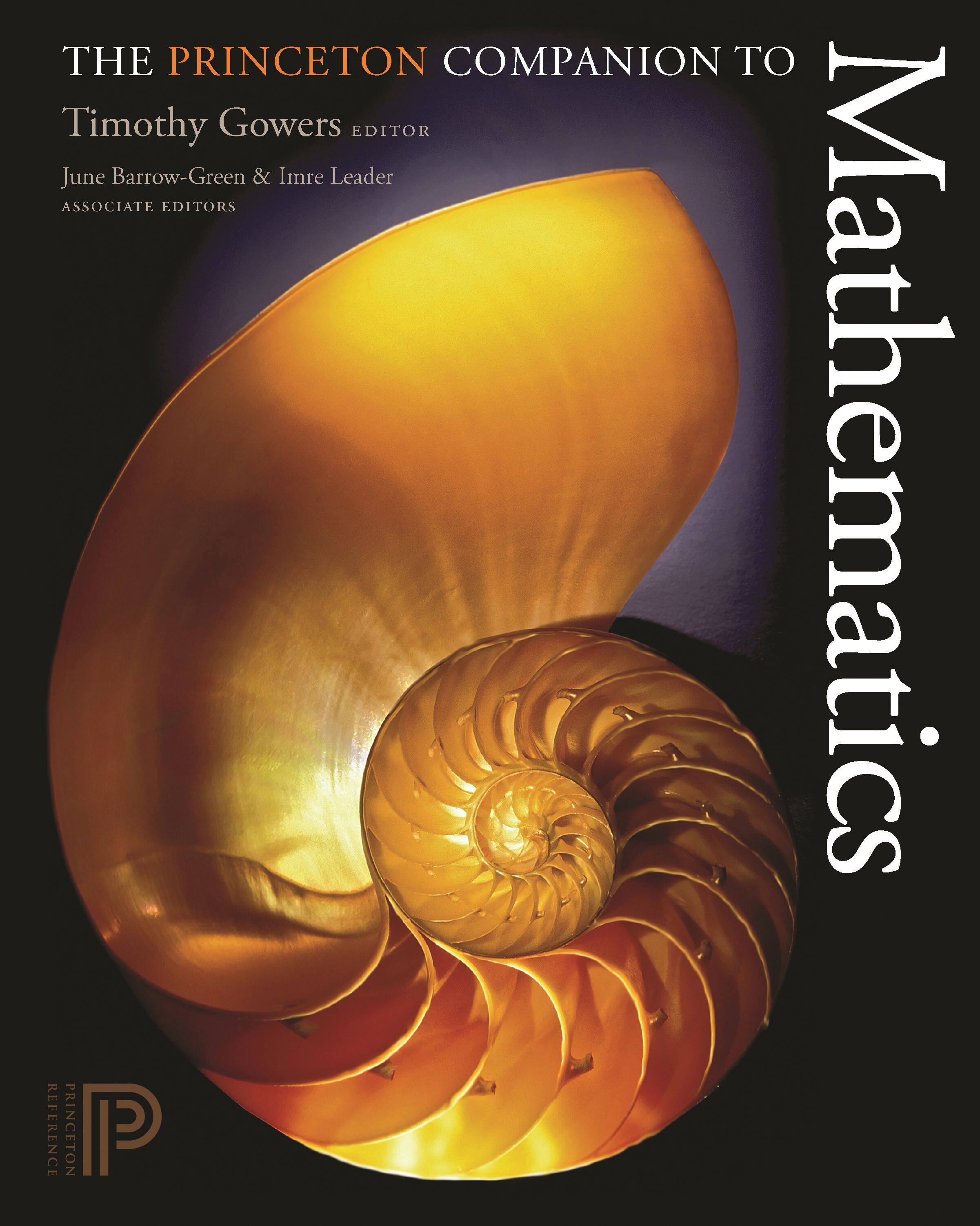
The Princeton Companion to Mathematics
This is a one-of-a-kind reference for anyone with a serious interest in mathematics. Edited by Timothy Gowers, a recipient of the Fields Medal, it presents nearly two hundred entries, written especially for this book by some of the world's leading mathematicians, that introduce basic mathematical tools and vocabulary; trace the development of modern mathematics; explain essential terms and concepts; examine core ideas in major areas of mathematics; describe the achievements of scores of famous mathematicians; explore the impact of mathematics on other disciplines such as biology, finance, and music--and much, much more.
eBook

The Mathematical Sciences in 2025
The mathematical sciences are part of nearly all aspects of everyday life-the discipline has underpinned such beneficial modern capabilities as Internet search, medical imaging, computer animation, numerical weather predictions, and all types of digital communications. The Mathematical Sciences in 2025 examines the current state of the mathematical sciences and explores the changes needed for the discipline to be in a strong position and able to maximize its contribution to the nation in 2025. It finds the vitality of the discipline excellent and that it contributes in expanding ways to most areas of science and engineering, as well as to the nation as a whole, and recommends that training for future generations of mathematical scientists should be re-assessed in light of the increasingly cross-disciplinary nature of the mathematical sciences. In addition, because of the valuable interplay between ideas and people from all parts of the mathematical sciences, the report emphasizes that universities and the government need to continue to invest in the full spectrum of the mathematical sciences in order for the whole enterprise to continue to flourish long-term.
eBook