
Catalogue Search | MBRL


Are you sure you want to remove the book from the shelf?

{{itemTitle}}
41,004
result(s) for
"MINIMUM INCOME"
Sort by:


Safety net of last resort: the evolution, determinants and adequacy of Dutch minimum income support
Dutch minimum income support provides a generous social safety net compared to most other European Union (EU) member states but has not been able to structurally reduce poverty. This inadequacy did not come about overnight but is the result of six decades of policy decisions. In this article, we aim to explain the current income shortfalls of people on minimum income support by studying the historical evolution and determinants of the Dutch minimum income scheme. We demonstrate that it has on average maintained a constant level of purchasing power over the period 1980–2023. This fits well with the notion that poverty is of an absolute nature, and that a social minimum should guarantee a stable level of purchasing power. It fits less well with relative or contextual approaches to poverty, and the view that a social minimum should adapt to changing norms when a society grows richer. To uncover the reasons for the growing gap between general prosperity and the minimum income benefit, we decompose it into smaller gaps by illustrating the evolution of prosperity, labour productivity, gross wages, collectively agreed wages, the minimum wage and the minimum income benefit. We show that each of these gaps matters and argue that this provides valuable insights into the structural, institutional and political forces that have shaped Dutch minimum income support since its introduction in 1965. Based on these results, we argue against the current ad hoc measures of the government and in favour of a more structural approach to supporting low-income households.
Journal Article

The Erosion of the Portuguese Minimum Income Protection Scheme
While minimum income protection (MIP) is central on a European level, as demonstrated by the European Pillar of Social Rights, national policies display huge variations, reflecting different domestic guidelines and political and socio‐economic dynamics. The literature has shown that the adequacy of MIPs and their role in social protection systems varies significantly, not only between countries but also over time. However, as most studies adopt large-N comparative perspectives, it is not possible to identify whether policy changes affect the programs’ generosity or how. This article bridges this gap by taking Portugal as a specific case study and examining the degree of generosity of its MIP—the Guaranteed Minimum Income (GMI), later renamed Social Insertion Income (SII). GMI/SII has outlasted other schemes and is unique within the Southern European welfare regime, partly because, since it started, it has undergone several transformations, which have impacted its ability to provide adequate coverage. The article applies a hypothetical simulation approach to assess the impact of policy change on the generosity of GMI/SII over time. The results demonstrate that alterations introduced over time have had negative effects on different aspects of the adequacy of GMI/SII—and to varying degrees.
Journal Article
Navigating Independence: Minimum Income Schemes and Youth Transitions in Southern European Welfare States
This article examines the interplay between decommodification and defamilisation within minimum income schemes (MIS) in two Southern European countries: Spain and Italy. While decommodification highlights the degree to which individuals can sustain a socially acceptable standard of living independently of market participation, defamilisation emphasises the extent to which individuals can achieve autonomy and well‐being independently of support from their families. Both concepts are critical in understanding youth transitions to adulthood in societies where living with one’s parents until one’s thirties and delayed family formation are prevalent. In Southern Europe, where the average age of leaving the parental household is significantly higher than the European average, the family functions as a filter of conditionality, mediating access to social protection and reinforcing intergenerational dependencies. Our research investigates how the design and implementation of MIS shape the ability of young people to achieve financial independence and self‐sufficiency, particularly during critical life transitions. Young individuals in these contexts face heightened exposure to socioeconomic risks, delayed independence, and limited access to adequate social protection. Using a qualitative approach, we analyse 21 biographical interviews with young people across the two countries who are beneficiaries of the benefit, have applied for it, or have been refused it. This enables us to examine how MIS frameworks influence young people’s independence, perpetuate intergenerational imbalances, and exacerbate age‐related vulnerabilities. Using defamilisation as a lens, we provide new insights into how social policy interacts with familial structures, shaping the trajectories and experiences of Southern European youth.
Journal Article
Accessibility and Capabilities: (Non-)Take-Up of Benefits in the Welfare Production of Poor Households
Studies of accessibility mainly focus on state welfare benefits and services. Yet, civil society actors may also provide material benefits for various needs. Drawing on the capability approach, this article examines accessibility for both state and non-state benefits from the perspective of people living in poverty. The (non-)take-up of particular benefits must be understood within the overall context of people's welfare production, i.e., their practices of accessing, combining, and transforming resources from state, market, civil society, family, and social networks to achieve the kind of life they value. The article draws on a qualitative study examining the welfare production of 40 households living below or near the poverty line in Switzerland. It is based on three waves of semi-structured interviews, complemented by financial diaries documenting household income and expenditures. Our analysis shows how configurations of individual factors such as self-image, the endowment with social and cultural capital, and subjective cost-benefit calculations interact with institutional entitlements, conceptions of deservingness, and administrative procedures. The article identifies three ideal-typical configurations: deliberate non-take-up, extensive use of different benefits, or sporadic use of mostly small non-state benefits. Households without access to benefits are more likely to face material and social deprivation, whereas those who use both state and non-state resources enhance their capabilities.
Journal Article
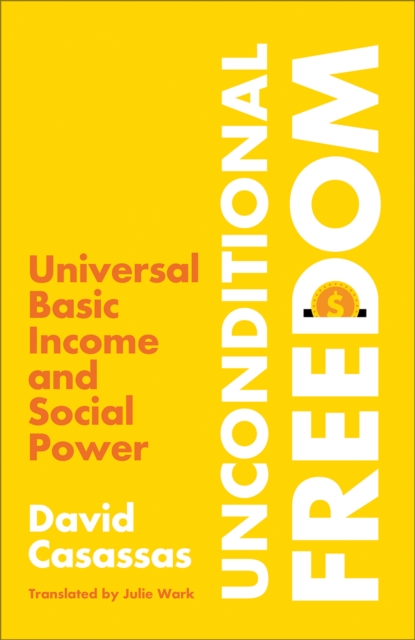
Unconditional Freedom
'A carefully argued case for basic income as central to a democratic transformation of society' Carole Pateman, Distinguished Professor Emeritus, UCLA 'This path-breaking work throws new light on how we understand work, freedom, and emancipation in today's highly precariatised and insecure world... A must-read' Sarath Davala, Chair, Basic Income Earth Network As the rich get richer and take more of our wealth, our democratic freedoms are also in danger. The elite are gaining large profits without contributing back to society, hollowing out our public services and institutions and preventing the vast majority of us from living our lives to the fullest. In Unconditional Freedom, David Casassas argues that for us to live freely, we need unconditional resources such as Universal Basic Income. In a sharp and lucid analysis, he shows that UBI would not only liberate us from the nightmare of social exclusion and precarious employment, it would also increase our bargaining power as individuals and collectives, opening doors to democratise our lives.
eBook

The politics of minimum income reform in Spain: explaining unexpected and consensual path departure
Southern European welfare states have historically been characterised by the absence of national safety nets. However, these countries have witnessed a succession of policy reforms over the past three decades. In 2020, the Spanish Parliament unanimously approved the ‘Ingreso Mínimo Vital’ to finally cease being the only European country without a minimum income scheme at the national level. This article investigates the political and institutional mechanisms that enabled this policy reform, which was particularly unexpected due to the fragmentation of the party system along both ideological and territorial dimensions. To solve this puzzle, I employ the ‘explaining-outcome’ process tracing method and rely on qualitative data from official documents, party manifestos and parliamentary interventions spanning from 2015 to 2020. In addition, I build on ten expert interviews with relevant actors directly involved in the reform, conducted between 2022 and 2024. Findings illustrate that inclusive path departure was possible through two political stages. First, left-wing party competition and strong socio-political demand (2014–2020) allowed for the introduction of the scheme into the political agenda. Second, territorial politics and the external shock of the coronavirus disease 2019 (COVID-19) pandemic ultimately contributed to mitigating expected political cleavages during the parliamentary process.
Journal Article
Universal Basic Income is affordable and feasible: evidence from UK economic microsimulation modelling
Critics of Universal Basic Income (UBI) have claimed that it would be either unaffordable or inadequate. This discussion paper tests this claim by examining the distributional impacts of three UBI schemes broadly designed to provide pathways to attainment of the Minimum Income Standard (MIS). We use microsimulation of data from the Family Resources Survey to outline the static distributional impacts and costs of the schemes. Our key finding is that even the fiscally neutral starter scheme would reduce child poverty to the lowest level achieved since 1961 and achieve more than the anti-poverty interventions of the New Labour Governments from 2000. The more generous schemes would make further inroads into the UK’s high levels of poverty and inequality, but at greater cost. We conclude by assessing fiscal strategies to reduce the up-front deficit of higher schemes, providing a more positive assessment of affordability and impact than critics have assumed.
Journal Article

Worlds of last-resort safety nets? A proposed typology of minimum income schemes in Europe
Over the past twenty years, minimum income schemes (MIS) have undergone major transformations in their functions and role. From mainly residual instruments that aimed to guarantee minimum income support and to prevent extreme marginality, in most countries they now have an ambiguous function of providing income support and favouring social and labour market inclusion. Against this background, this article provides an analytical grid that allows describing the different features of last-resort safety nets across Europe, building on the definition of key main dimensions of variation of MISs in Europe – generosity, eligibility and conditionality requirements, institutional configuration, active inclusion profiles. Then, it introduces a new typology of MIS in Europe, building on a new dataset with data on expenditures and coverage collected from National Statistical Offices.
Journal Article

Social assistance in the new EU member states : strengthening performance and labor market incentives
This study analyzes the performance of social assistance and family benefit programs in eight new member states of the European Union from the perspective of fiscal impact and effectiveness. It is based on household survey data for six of the countries, as well as budget data and information on program design collected at the national level. The paper finds that, although social assistance programs in the new member states are small in terms of coverage and expenditure levels (reaching 2 to 5 percent of the population), the programs are an important safety net for the poor. Programs are relatively well targeted, with between 30 and 60 percent of resources going to the poorest quintile of the population. For those who receive them, benefits can make up as much as 37 percent of average consumption of the poor.
eBook