
Catalogue Search | MBRL


Are you sure you want to remove the book from the shelf?

{{itemTitle}}
12,255
result(s) for
"MUSIC / General."
Sort by:

Ubiquitous listening
How does the constant presence of music in modern life - on iPods, in shops and elevators, on television - affect the way we listen? In this title, the author investigates many sounds that surround us and argues that this ubiquity has led to different kinds of listening.
eBook

Banding together
Why do some music styles gain mass popularity while others thrive in small niches?Banding Togetherexplores this question and reveals the attributes that together explain the growth of twentieth-century American popular music. Drawing on a vast array of examples from sixty musical styles--ranging from rap and bluegrass to death metal and South Texas polka, and including several created outside the United States--Jennifer Lena uncovers the shared grammar that allows us to understand the cultural language and evolution of popular music.
What are the common economic, organizational, ideological, and aesthetic traits among contemporary genres? Do genres follow patterns in their development? Lena discovers four dominant forms--Avant-garde, Scene-based, Industry-based, and Traditionalist--and two dominant trajectories that describe how American pop music genres develop. Outside the United States there exists a fifth form: the Government-purposed genre, which she examines in the music of China, Serbia, Nigeria, and Chile. Offering a rare analysis of how music communities operate, she looks at the shared obstacles and opportunities creative people face and reveals the ways in which people collaborate around ideas, artworks, individuals, and organizations that support their work.
eBook

Connecting sounds
Crossley argues that music is a form of social interaction, interwoven in the fabric of society and in constant interplay with its other threads. Musical interactions are often also economic interactions, for example, and sometimes political interactions. They can be forms of identity work, for both individuals and collectives, contributing to the reproduction or bridging of social divisions. Successive chapters of the book track and explore these interplays, in each case combining a critical consideration of existing literature with the development of an original, ‘relational’ approach to music sociology. The result is a grand sociological vision of music which captures not only music’s context but ‘the music itself’. The book will appeal to social scientists, musicologists and cultural scholars more widely.
eBook

Music Is Power
Honorable Mention, 2019 Foreword INDIES Awards - Performing Arts MusicHonorable Mention, Graphis 2021 Design Annual CompetitionPopular music has long been a powerful force for social change. Protest songs have served as anthems regarding war, racism, sexism, ecological destruction and so many other crucial issues. Music Is Power takes us on a guided tour through the past 100 years of politically-conscious music, from Pete Seeger and Woody Guthrie to Green Day and NWA. Covering a wide variety of genres, including reggae, country, metal, psychedelia, rap, punk, folk and soul, Brad Schreiber demonstrates how musicians can take a variety of approaches- angry rallying cries, mournful elegies to the victims of injustice, or even humorous mockeries of authority-to fight for a fairer world. While shining a spotlight on Phil Ochs, Gil Scott-Heron, The Dead Kennedys and other seminal, politicized artists, he also gives readers a new appreciation of classic acts such as Lesley Gore, James Brown, and Black Sabbath, who overcame limitations in their industry to create politically potent music Music Is Power tells fascinating stories about the origins and the impact of dozens of world-changing songs, while revealing political context and the personal challenges of legendary artists from Bob Dylan to Bob Marley.Supplemental material (Artist and Title List): https://d3tto5i5w9ogdd.cloudfront.net/wp-content/uploads/2020/07/24001955/Music_Is_Power_Supplementary_Artist_Title_List.doc
eBook

Rednecks, queers, and country music
In Hubbs's view, the popular phrase “I'll listen to anything but country” allows middle-class Americans to declare inclusive “omnivore” musical tastes with one crucial exclusion: country, a music linked to low-status whites. Throughout Rednecks, Queers, and Country Music, Hubbs dissects this gesture, examining how provincial white working people have emerged since the 1970s as the face of American bigotry, particularly homophobia, with country music their audible emblem. Bringing together the redneck and the queer, Hubbs challenges the conventional wisdom and historical amnesia that frame white working folk as a perpetual bigot class. With a powerful combination of music criticism, cultural critique, and sociological analysis of contemporary class formation, Nadine Hubbs zeroes in on flawed assumptions about how country music models and mirrors white working-class identities. She particularly shows how dismissive, politically loaded middle-class discourses devalue country's manifestations of working-class culture, politics, and values, and render working-class acceptance of queerness invisible. Lucid, important, and thought-provoking, this book is essential reading for students and scholars of American music, gender and sexuality, class, and pop culture.
eBook

English Pastoral Music
Covering works by popular figures like Ralph Vaughan Williams and Gustav Holst as well as less familiar English composers, Eric Saylor's pioneering book examines pastoral music's critical, theoretical, and stylistic foundations alongside its creative manifestations in the contexts of Arcadia, war, landscape, and the Utopian imagination. As Saylor shows, pastoral music adapted and transformed established musical and aesthetic conventions that reflected the experiences of British composers and audiences during the early twentieth century. By approaching pastoral music as a cultural phenomenon dependent on time and place, Saylor forcefully challenges the body of critical opinion that has long dismissed it as antiquated, insular, and reactionary.
eBook

Spirituals and the Birth of a Black Entertainment Industry
Spirituals performed by jubilee troupes became a sensation in post-Civil War America. First brought to the stage by choral ensembles like the Fisk Jubilee Singers, spirituals anchored a wide range of late nineteenth-century entertainments, including minstrelsy, variety, and plays by both black and white companies. In the first book-length treatment of postbellum spirituals in theatrical entertainments, Sandra Jean Graham mines a trove of resources to chart the spiritual's journey from the private lives of slaves to the concert stage. Graham navigates the conflicting agendas of those who, in adapting spirituals for their own ends, sold conceptions of racial identity to their patrons. In so doing they lay the foundation for a black entertainment industry whose artistic, financial, and cultural practices extended into the twentieth century. A companion website contains jubilee troupe personnel, recordings, and profiles of 85 jubilee groups. Please go to: http://www.press.uillinois.edu/books/graham/spirituals/
eBook
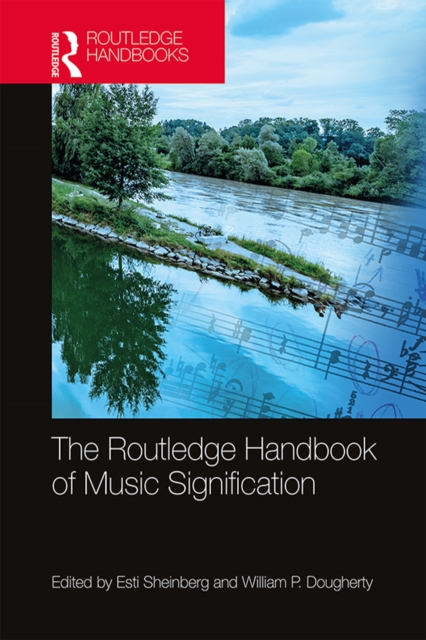
The Routledge Handbook of Music Signification
The Routledge Handbook of Music Signification captures the richness and complexity of the field, presenting 30 essays by recognized international experts that reflect current interdisciplinary and cross-disciplinary approaches to the subject.
Examinations of music signification have been an essential component in thinking about music for millennia, but it is only in the last few decades that music signification has been established as an independent area of study. During this time, the field has grown exponentially, incorporating a vast array of methodologies that seek to ground how music means and to explore what it may mean. Research in music signification typically embraces concepts and practices imported from semiotics, literary criticism, linguistics, the visual arts, philosophy, sociology, history, and psychology, among others. By bringing together such approaches in transparent groupings that reflect the various contexts in which music is created and experienced, and by encouraging critical dialogues, this volume provides an authoritative survey of the discipline and a significant advance in inquiries into music signification.
This book addresses a wide array of readers, from scholars who specialize in this and related areas, to the general reader who is curious to learn more about the ways in which music makes sense.
eBook

Song Means: Analysing and Interpreting Recorded Popular Song
The musicological study of popular music has developed, particularly over the past twenty years, into an established aspect of the discipline. The academic community is now well placed to discuss exactly what is going on in any example of popular music and the theoretical foundation for such analytical work has also been laid, although there is as yet no general agreement over all the details of popular music theory. However, this focus on the what of musical detail has left largely untouched the larger question - so what? What are the consequences of such theorization and analysis? Scholars from outside musicology have often argued that too close a focus on musicological detail has left untouched what they consider to be more urgent questions related to reception and meaning. Scholars from inside musicology have responded by importing into musicological discussion various aspects of cultural theory. It is in that tradition that this book lies, although its focus is slightly different. What is missing from the field, at present, is a coherent development of the what into the so what of music theory and analysis into questions of interpretation and hermeneutics. It is that fundamental gap that this book seeks to fill. Allan F. Moore presents a study of recorded popular song, from the recordings of the 1920s through to the present day. Analysis and interpretation are treated as separable but interdependent approaches to song. Analytical theory is revisited, covering conventional domains such as harmony, melody and rhythm, but does not privilege these at the expense of domains such as texture, the soundbox, vocal tone, and lyrics. These latter areas are highly significant in the experience of many listeners, but are frequently ignored or poorly treated in analytical work. Moore continues by developing a range of hermeneutic strategies largely drawn from outside the field (strategies originating, in the most part, within psychology and philosophy) but still deeply r
eBook
Sound souvenirs
In recent decades, the importance of sound for remembering the past and for creating a sense of belonging has been increasingly acknowledged. We keep \"sound souvenirs\" such as cassette tapes and long play albums in our attics because we want to be able to recreate the music and everyday sounds we once cherished. Artists and ordinary listeners deploy the newest digital audio technologies to recycle past sounds into present tunes. Sound and memory are inextricably intertwined, not just through the commercially exploited nostalgia on oldies radio stations, but through the exchange of valued songs by means of pristine recordings and cultural practices such as collecting, archiving and listing. This book explores several types of cultural practices involving the remembrance and restoration of past sounds. At the same time, it theorizes the cultural meaning of collecting, recycling, reciting, and remembering sound and music.
Herinneringen halen we niet alleen op aan de hand van beelden, maar ook met behulp van geluid. We koesteren onze versleten bandrecorderspoelen, cassettebandjes en langspeelplaten - onze \"sound souvenirs\" - om de muziek van vroeger nog eens te horen. Radioprogramma's als de Top2000 houden oude nummers eindeloos in de lucht. In geluidsarchieven bewaren we de redes van beroemde politici. In de auto nemen we voortdurend onze persoonlijke muziekbestanden met ons mee. En een enkele keer worden we herinnerd aan geluiden die we liever vergeten, zoals die van bombardementen. Dit boek verkent de verschillende culturele praktijken waarin we het geluid van het verleden gewenst en ongewenst terughalen en probeert de culturele betekenis van het verzamelen, citeren en herinneren van geluid en muziek te begrijpen. Met bijdragen van Ruth Benschop, Carolyn Birdsall, Hans-Joachim Braun, Michael Bull, Karin Bijsterveld & Annelies Jacobs, José van Dijck, Andreas Fickers, Bas Jansen, Trevor Pinch & David Reinecke, Jonathan Sterne, Tim Taylor en Heike Weber.
eBook