
Catalogue Search | MBRL


Are you sure you want to remove the book from the shelf?

{{itemTitle}}
4,210
result(s) for
"Madrigals"
Sort by:

Monteverdi's voices : a poetics of the Madrigal
\"Claudio Monteverdi (1567-1643) was the leading composer in late Renaissance and early Baroque Italy. In addition to operas and sacred music, he wrote a large corpus of madrigals throughout his long career in Cremona, Mantua, and Venice. These settings for vocal ensemble (later, plus instruments) of Italian lyric, epic, and dramatic poetry were intended for chamber performance. They are microcosms of Italian musical and literary culture of the late sixteenth and early seventeenth centuries, an integral part of the intellectual, artistic, and practical worlds of creation and performance at the time. Their poets included the major figures of the day-Torquato Tasso, Battista Guarini, and Giambattista Marino-as well as the classics, not least Petrarch. Their music embraces a wide range of contemporary styles both responding to, and reacting against, trends of the time. Each poem set by Monteverdi posed a number of challenges, forcing him to make choices about how to represent its poetic voice or voices with a group of singers that might not match them in terms of number or gender. How did Monteverdi play with poetry, sound, and time, and with the performers with whom he worked so closely? And what impact do the various answers to these questions have on our own efforts to bring these stunning works alive to modern ears?\"-- Provided by publisher.
BOOK
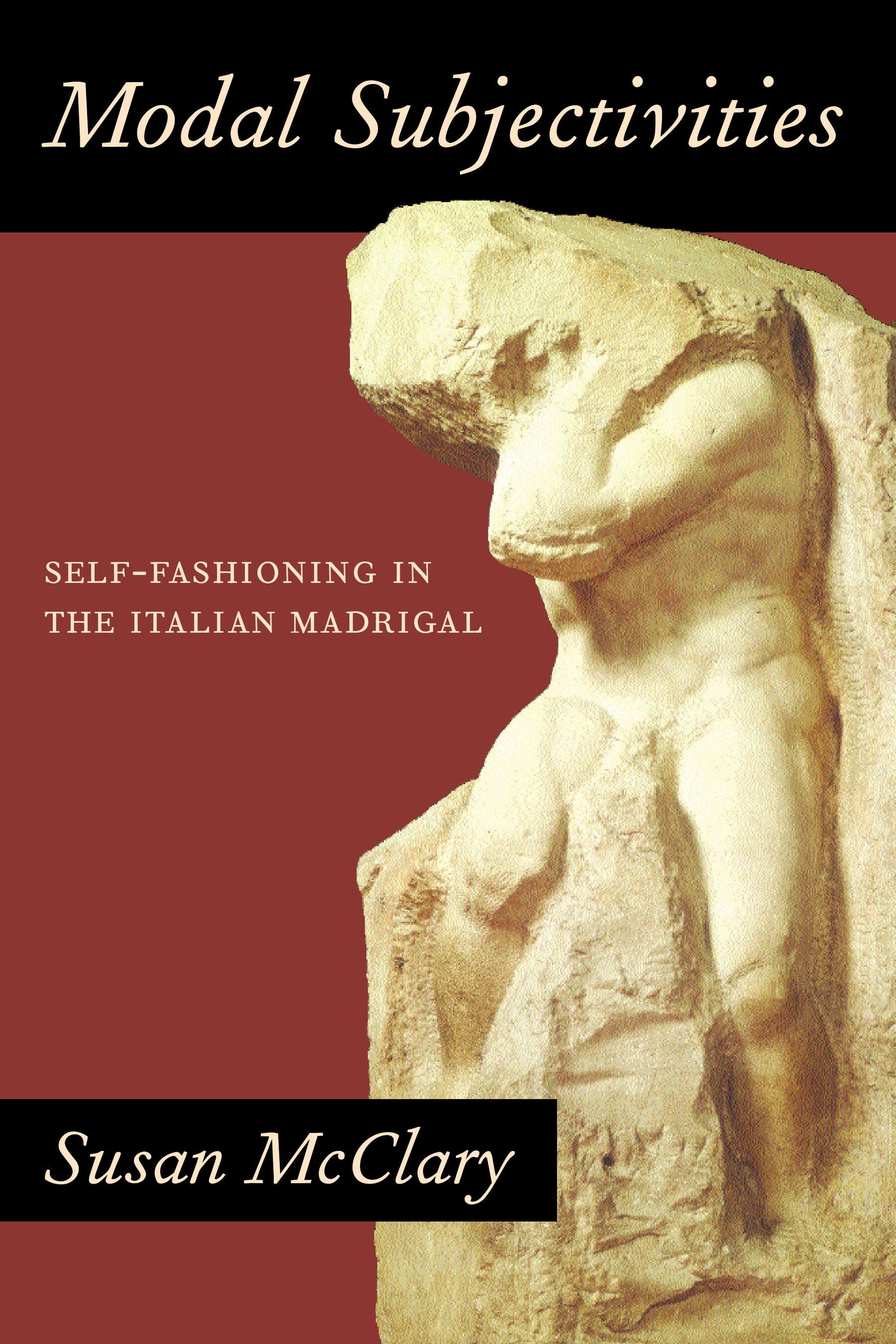
Modal Subjectivities
In this boldly innovative book, renowned musicologist Susan McClary presents an illuminating cultural interpretation of the Italian madrigal, one of the most influential repertories of the Renaissance. A genre that sought to produce simulations in sound of complex interiorities, the madrigal introduced into music a vast range of new signifying practices: musical representations of emotions, desire, gender stereotypes, reason, madness, tensions between mind and body, and much more. In doing so, it not only greatly expanded the expressive agendas of European music but also recorded certain assumptions of the time concerning selfhood, making it an invaluable resource for understanding the history of Western subjectivity.Modal Subjectivitiescovers the span of the sixteenth-century polyphonic madrigal, from its early manifestations in Philippe Verdelot's settings of Machiavelli in the 1520s through the tortured chromatic experiments of Carlo Gesualdo. Although McClary takes the lyrics into account in shaping her readings, she focuses particularly on the details of the music itself-the principal site of the genre's self-fashionings. In order to work effectively with musical meanings in this pretonal repertory, she also develops an analytical method that allows her to unravel the sophisticated allegorical structures characteristic of the madrigal. This pathbreaking book demonstrates how we might glean insights into a culture on the basis of its nonverbal artistic enterprises.
eBook

Adrian Willaert and the Theory of Interval Affect
In the writings of Nicola Vicentino (1555) and Gioseffo Zarlino (1558) is found, for the first time, a systematic means of explaining music's expressive power based upon the specific melodic and harmonic intervals from which it is constructed. This \"theory of interval affect\" originates not with these theorists, however, but with their teacher, influential Venetian composer Adrian Willaert (1490-1562). Because Willaert left no theoretical writings of his own, Timothy McKinney uses Willaert's music to reconstruct his innovative theories concerning how music might communicate extramusical ideas. For Willaert, the appellations \"major\" and \"minor\" no longer signified merely the larger and smaller of a pair of like-numbered intervals; rather, they became categories of sonic character, the members of which are related by a shared sounding property of \"majorness\" or \"minorness\" that could be manipulated for expressive purposes. This book engages with the madrigals of Willaert's landmark Musica nova collection and demonstrates that they articulate a theory of musical affect more complex and forward-looking than recognized currently. The book also traces the origins of one of the most widespread musical associations in Western culture: the notion that major intervals, chords and scales are suitable for the expression of happy affections, and minor for sad ones. McKinney concludes by discussing the influence of Willaert's theory on the madrigals of composers such as Vicentino, Zarlino, Cipriano de Rore, Girolamo Parabosco, Perissone Cambio, Francesco dalla Viola, and Baldassare Donato, and describes the eventual transformation of the theory of interval affect from the Renaissance view based upon individual intervals measured from the bass, to the Baroque view based upon invertible triadic entities.
eBook

From madrigal to opera
This pathbreaking study links two traditionally separate genres as their stars crossed to explore the emergence of multiple selves in early modern Italian culture and society. Mauro Calcagno focuses on the works of Claudio Monteverdi, a master of both genres, to investigate how they reflect changing ideas about performance and role-playing by singers. Calcagno traces the roots of dialogic subjectivity to Petrarch's love poetry arguing that Petrarchism exerted a powerful influence not only on late Renaissance literature and art, but also on music. Covering more than a century of music and cultural history, the book demonstrates that the birth of opera relied on an important feature of the madrigalian tradition: the role of the composer as a narrative agent enabling performers to become characters and hold a specific point of view.
eBook

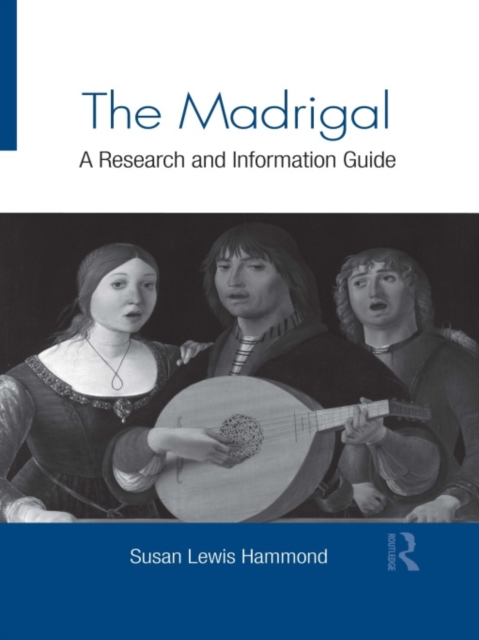
The Madrigal
The Madrigal: A Research and Information Guide is the first comprehensive annotated bibliography of scholarship on virtually all aspects of madrigal composition, production, and consumption. It contains 1,237 entries for items in English, French, German, and Italian. Scholars, students, teachers, librarians, and performers now have access to this rich literature in a single volume.
eBook

Willaert’s Elusive Counterpoint Explained
Willaert’s contrapuntal idiom in Musica Nova (1559) has been characterized as “elusive” because it “largely eschews imitative textures, clear cadential articulations, distinctive rhythmic patterns and tuneful melodic ideas ( soggetti )” (Fromson 2001). The present study aims to elucidate Willaert’s contrapuntal techniques in a late madrigal, “Io mi rivolgo.” Here, Willaert distinguishes sections by applying a different contrapuntal technique to each. In the absence of cadences and changes of texture, these switches of technique neatly articulate the structural members (verses, quatrains, etc.) of Petrarch’s sonnet. The analysis of the madrigal is based on melodic repetition, and relies in part on breaking long melodies into tiny fragments, using Rifkin’s principle of “motivicity” (1998).
Journal Article

Affective Intensity and Sponsor Identification
This study focuses on the accurate identification of corporate sponsors among consumers attending a NASCAR event. The results of this study support prior experimental work (e.g., Johar and Pham 1999), indicating that consumers are more likely to correctly identify prominent and related sponsors. Importantly, the findings indicate that a reason for such recall is that the best-performing properties attract prominent and related sponsors, and affective intensity (either strong positive or negative feelings) toward a property activates or enhances the cognitive processing by consumers of sponsors of highly competitive properties.
Journal Article

Beyond Drama
Monteverdi’s Il sesto libro de madrigali a cinque voci (1614) is often viewed as an outlier in his secular output. His Fourth and Fifth Books (1603, 1605) were firmly embroiled in the controversy with Artusi over the seconda pratica, while his Seventh (1619) sees him shifting style in favor of the new trends that were starting to dominate music in early seventeenth-century Italy: the Sixth Book falls between the cracks. But it also suffers—in modern eyes, at least—for the fact that it reflects the composer’s first encounters with the poetry of Giambattista Marino, marking what many see as the start of a fundamental reorientation, if not downward spiral, in his secular vocal music. The problems are exposed by one of the Marino settings in the Sixth Book, “Batto, qui pianse Ergasto: ecco la riva,” in which an unnamed speaker tells Batto how Ergasto has been abandoned by Clori. The text has often been misunderstood. Uncovering the sources for the story—and the literary identities of Batto, Ergasto, and Clori—forces a new reading of the poetry and more particularly of Monteverdi’s music. It also answers some profound questions in terms of how best to address issues of narration and representation, and of diegesis and mimesis, in this complex repertory.
Journal Article

Licks, polemics, and the viola bastarda
‘Ahi, lasso!’ cry the five voices in Monteverdi’s Cruda Amarilli (1605). The exclamation has long been a central focus of madrigal scholars’ work on Monteverdi’s Fifth Book, and of the debate with Artusi on account of the Canto’s celebrated yet improper dissonances and the controversy they provoked. Little has been said, however, of the unusual bass runs that precede and follow these dissonances, and what these runs (and their divergences from the basso continuo part) might intimate about the larger role of the bass in the madrigal book as a whole. This article peers between the cracks in the extensive literature on Monteverdi’s compositional language and the Fifth Book to explore several idiosyncrasies of the collection, from the bass’s anomalous display in Cruda Amarilli and the book’s restriction to modes on G and D, to the puzzling change of system only four bars from the end of Ch’io t’ami, e t’ami più de la mia vita. Through this analysis, the Fifth Book becomes a snapshot of Monteverdi’s activities at the Mantuan court around 1600, not only as a composer, but also as an instrumentalist—as a performer on the viola bastarda.
Journal Article