
Catalogue Search | MBRL


Are you sure you want to remove the book from the shelf?

{{itemTitle}}
12
result(s) for
"Mafia Drama"
Sort by:
Gangsters and G-men on screen
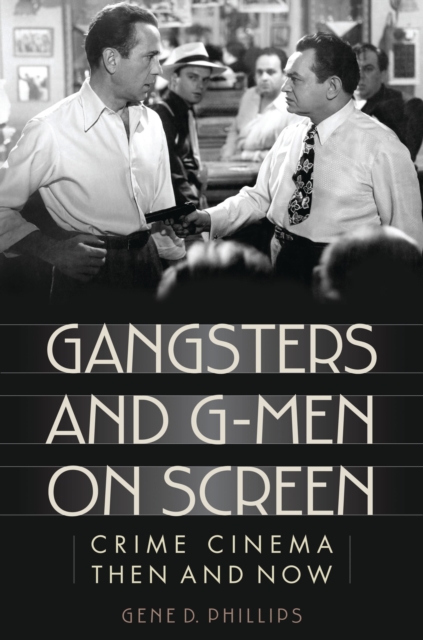
While the gangster film may have enjoyed its heyday in the 1930s and ’40s, it has remained a movie staple for almost as long as cinema has existed. From the early films of Humphrey Bogart, James Cagney, and Edward G. Robinson to modern versions like Bugsy, Public Enemies, and Gangster Squad, such films capture the brutality of mobs and their leaders. In Gangsters and G-Men on Screen: Crime Cinema Then and Now, Gene D. Phillips revisits some of the most popular and iconic representations of the genre. While this volume offers new perspectives on some established classics—usual suspects like Little Caesar, Bonnie and Clyde, and The Godfather Part II—Phillips also calls attention to some of the unheralded but no less worthy films and filmmakers that represent the genre. Expanding the viewer’s notion of what constitutes a gangster film, Phillips offers such unusual choices as You Only Live Once, Key Largo, The Lady from Shanghai, and even the 1949 version of The Great Gatsby. Also included in this examination are more recent ventures, such as modern classics The Grifters and Martin Scorsese’s The Departed. In his analyses, Phillips draws on a number of sources, including personal interviews with directors and other artists and technicians associated with the films he discusses. Of interest to film historians and scholars, Gangsters and G-Men on Screen will also appeal to anyone who wants to better understand the films that represent an important contribution to crime cinema.
eBook

A World of Gangs
John Hagedorn explores the international proliferation of the urban gang as a consequence of the ravages of globalization. Looking closely at gang formation in Chicago, Rio de Janeiro, and Capetown he discovers that gangs have institutionalized as a strategy to confront a hopeless cycle of poverty, racism, and oppression and provides vital insights into the ideology and persistence of gangs around the world._x000B_
eBook
Les triplettes de Belleville
Adopted by his grandmother, Madame Souza, Champion is a lonely little boy. Noticing that the lad is never happier than on a bicycle, Madame Souza puts him through a rigorous training process. Years go by and Champion becomes worthy of his name. Now he is ready to enter the world-famous cycling race, the Tour de France. However during this cycling contest two mysterious men in black kidnap Champion. Madame Souza and her faithful dog Bruno set out to rescue him. Their quest takes them across the ocean to a giant megalopolis called Belleville where they encounter the renowned \"Triplets of Belleville\", three eccentric female music-hall stars from the '30s who decide to take Madame Souza and Bruno under their wing. Thanks to Bruno's brilliant sense of smell, the brave duo are soon on to Champion's trail. But will they succeed in beating the devilish plans of the evil French mafia?
Streaming Video

Dreams and Dead Ends
The second edition of this classic study provides a reintroduction to some of the major films and theoretical considerations of film noir and gangster films in twentieth-century America. Ranging from Little Caesar (1930) to Things to Do in Denver When You’re Dead (1995), Shadoian guides the reader through twenty classic movies of the genre. His approach is to use brief introductions to introduce distinct eras of the gangster films in each of seven chapters. Moving chronologically, he offers plot synopses and close readings of such definitive examples as Bonnie and Clyde, The Public Enemy, D.O.A. and The Godfather, each accompanied by photographs and author’s critiques. Compenendia of facts on each film are also provided. This updated version looks a newer films as well as how the genre has moved into the new century. Appendices look at the movie Criss Cross as an epitome of the genre while others offer different lists of gangster films, including the author’s top fourteen alltime, fifty post-Godfather films worth seeing, and fifty vintage films.
eBook
Public enemies, public heroes
In this study of Hollywood gangster films, Jonathan Munby examines their controversial content and how it was subjected to continual moral and political censure. Beginning in the early 1930s, these films told compelling stories about ethnic urban lower-class desires to \"make it\" in an America dominated by Anglo-Saxon Protestant ideals and devastated by the Great Depression. By the late 1940s, however, their focus shifted to the problems of a culture maladjusting to a new peacetime sociopolitical order governed by corporate capitalism. The gangster no longer challenged the establishment; the issue was not \"making it,\" but simply \"making do.\" Combining film analysis with archival material from the Production Code Administration (Hollywood's self-censoring authority), Munby shows how the industry circumvented censure, and how its altered gangsters (influenced by European filmmakers) fueled the infamous inquisitions of Hollywood in the postwar '40s and '50s by the House Committee on Un-American Activities. Ultimately, this provocative study suggests that we rethink our ideas about crime and violence in depictions of Americans fighting against the status quo.
eBook
Everyman
Produced in conjunction with medieval literature scholar Howard Schless of Columbia University, this program presents a production of the morality play Everyman staged in period costume. The DVD highlights the aspects of the medieval drama that appealed to 15th- and 16th-century audiences.
Streaming Video

Crime Films
This book surveys the entire range of crime films, including important subgenres such as the gangster film, the private eye film, film noir, as well as the victim film, the erotic thriller, and the crime comedy. Focusing on ten films that span the range of the twentieth century, Thomas Leitch traces the transformation of the three leading figures that are common to all crime films: the criminal, the victim and the avenger. Analyzing how each of the subgenres establishes oppositions among its ritual antagonists, he shows how the distinctions among them become blurred throughout the course of the century. This blurring, Leitch maintains, reflects and fosters a deep social ambivalence towards crime and criminals, while the criminal, victim and avenger characters effectively map the shifting relations between subgenres, such as the erotic thriller and the police film, within the larger genre of crime film that informs them all.
eBook

British Crime Cinema
This is the first substantial study of British cinema's most neglected genre. Bringing together original work from some of the leading writers on British popular film, this book includes interviews with key directors Mike Hodges ( Get Carter ) and Donald Cammel ( Performance ). It discusses an abundance of films including: * acclaimed recent crime films such as Shallow Grave , Shopping , and Face . * early classics like They Made Me A Fugitive * acknowledged classics such as Brighton Rock and The Long Good Friday * 50s seminal works including The Lavender Hill Mob and The Ladykillers .
Steve Chibnall is Senior Lecturer in Media Studies at de Montfort University, Leicester. Robert Murphy is senior Research Fellow at de Montfort University.
eBook

Ideology, Rhetoric, and Blood-Ties: From \The Oresteia\ to \The Godfather\
Using a comparative analytical approach to the phenomena of honor, guilt, and absolution in The Oresteia and The Godfather trilogies, this essay investigates both ideology's compelling force in determining social relations and the distinct rhetorical strategies used in two different cultures to support these relations.
Journal Article