
Catalogue Search | MBRL


Are you sure you want to remove the book from the shelf?

{{itemTitle}}
532
result(s) for
"Magic, Jewish"
Sort by:

Jewish Magic Before the Rise of Kabbalah
A comprehensive study of Jewish magic in the late antiquity and the early Islamic period—the phenomenon, the sources, and method for its research, and the history of scholarly investigation into its nature and origin.
\"Magic culture is certainly fascinating. But what is it? What, in fact, are magic writings, magic artifacts?\" Originally published in Hebrew in 2010, Jewish Magic Before the Rise of Kabbalah is a comprehensive study of early Jewish magic focusing on three major topics: Jewish magic inventiveness, the conflict with the culture it reflects, and the scientific study of both.
The first part of the book analyzes the essence of magic in general and Jewish magic in particular. The book begins with theories addressing the relationship of magic and religion in fields like comparative study of religion, sociology of religion, history, and cultural anthropology, and considers the implications of the paradigm shift in the interdisciplinary understanding of magic for the study of Jewish magic. The second part of the book focuses on Jewish magic culture in late antiquity and in the early Islamic period. This section highlights the artifacts left behind by the magic practitioners—amulets, bowls, precious stones, and human skulls—as well as manuals that include hundreds of recipes. Jewish Magic before the Rise of Kabbalah also reports on the culture that is reflected in the magic evidence from the perspective of external non-magic contemporary Jewish sources.
Issues of magic and religion, magical mysticism, and magic and social power are dealt with in length in this thorough investigation. Scholars interested in early Jewish history and comparative religions will find great value in this text.
eBook

Jewish Aramaic Curse Texts from Late-Antique Mesopotamia
In this book, Dan Levene analyses a corpus of Jewish Babylonian Aramaic incantation bowls from Mesopotamia, whose purpose was to curse or return curses against human adversaries. He presents new editions of thirty texts, with an introduction, commentary and glossaries.
eBook

Geniza Magical Documents
The Cairo Geniza has proved to be a fascinating trove of information about all aspects of Jewish life in the medieval and early modern period, magic being one of them. Hundreds of manuscripts, in different states of conservation, testify to the interest of Jews in composing and copying magical manuals as well as producing amulets and curses and otherwise attempting to harness the supernatural in order to achieve earthly aims. This essay introduces the reader to Geniza magical texts and provides some guidelines for reading these documents.
Journal Article
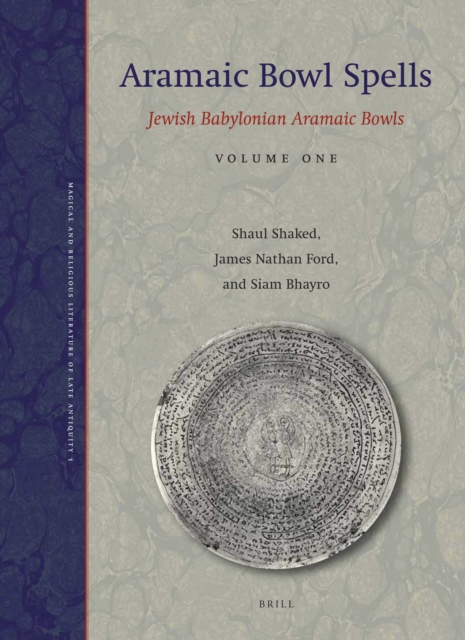
Aramaic bowl spells: Jewish Babylonian Aramaic bowls
The corpus of Aramaic incantation bowls from Sasanian Mesopotamia is perhaps the most important source we have for studying the everyday beliefs and practices of the Jewish, Christian, Mandaean, Manichaean, Zoroastrian and Pagan communities on the eve of the Islamic conquests. The bowls are from the Schøyen Collection, which has some 650 texts in different varieties of Aramaic: Jewish Aramaic, Mandaic and Syriac, and forms the largest collection of its kind anywhere in the world. This volume presents editions of sixty-four Jewish Aramaic incantation bowls, with accompanying introductions, translations, philological notes, photographs and indices. The themes covered include the magical divorce and the accounts of the wonder-working sages ?anina ben Dosa and Joshua bar Pera?ia. It is the first of a multi-volume project that aims to publish the entire Schøyen Collection of Aramaic incantation bowls.
eBook

Studies on Astral Magic in Medieval Jewish Thought
Astral magic is shown to be a major influence in Jewish medieval thought. The book traces its winding course in the work of such figures as Judah Halevi, Nahmanides and others, and provides a new perspective on medieval Jewish rationalism.
eBook
Officina magica : essays on the practice of magic in antiquity
This book of essays deals with magical phenomena in Mesopotamian, Zoroastrian, Greek and Jewish cultures. The topics discussed include Mesopotamian magic, its impact on the Aramaic magic bowls, Jewish magical literature, magical gems, Zoroastrian omens, and methods of research.
eBook

Aramaic Bowl Spells
This volume presents editions of sixty-four Jewish Aramaic incantation bowls from the Schøyen Collection, with accompanying introductions, translations, philological notes, photographs and indices, relating to the magical divorce and the wonder-working sages Ḥanina ben Dosa and Joshua bar Peraḥia.
eBook

The Besht
Now available in English, a provocative new biography of the founder of Hasidism
Founded in Eastern Europe in the eighteenth century, the Hasidic movement and its religious thinking have dramatically transformed modern Judaism. The figure of the Ba’al Shem Tov (known in acronym form as the BeSHT)—the purported founder of the Hasidic movement—has fascinated scholars, Jewish philosophers, and laypeople interested in popular Jewish mysticism in general and the contemporary Hasidic movement in all its variety.
In this volume, Etkes enters a rich and heated debate over the origins of the movement, as well as the historicity of its mythic founder, Rabbi Israel Ba’al Shem Tov, who lived much of his life as a miracle worker. The eighteenth century, as Etkes vividly portrays, was the heyday of the kabbalists, who dabbled in the magical power of letters and words to solve personal and communal problems—and to earn a living. Etkes sheds light on the personality of the Besht, on his mysticism, and on his close circle of followers. But equally important, he challenges the popular myth of the Besht as a childlike mystic, wandering the fields in prayer, seeing visions and engaging in acts of godliness and piety. Although Etkes shows great empathy for his subject, the Besht who emerges in these pages is much more down to earth, much more a man of his times. Indeed, according to Etkes, it was never the intention of the Besht to found a religious movement.
Etkes looks at the Besht’s mystical roots, examining him not only from the vantage point of a social historian, but as a religious figure. Moshe Rosman, author of Founder of Hasidism, a biography of the Besht, claims that In Praise of the Besht—a volume published about the Besht in 1814, many years after his death, which portrayed his character by means of stories told by his close followers—could not be a reliable source. Etkes, disputing this claim, shows definitively that this well-known text (translated and interpreted by, among others, Martin Buber) may indeed offer trustworthy accounts of the Besht’s life and thinking.
eBook

Jewish Magic and Superstition
Alongside the formal development of Judaism from the eleventh through the sixteenth centuries, a robust Jewish folk religion flourished-ideas and practices that never met with wholehearted approval by religious leaders yet enjoyed such wide popularity that they could not be altogether excluded from the religion. According to Joshua Trachtenberg, it is not possible truly to understand the experience and history of the Jewish people without attempting to recover their folklife and beliefs from centuries past.Jewish Magic and Superstitionis a masterful and utterly fascinating exploration of religious forms that have all but disappeared yet persist in the imagination. The volume begins with legends of Jewish sorcery and proceeds to discuss beliefs about the evil eye, spirits of the dead, powers of good, the famous legend of the golem, procedures for casting spells, the use of gems and amulets, how to battle spirits, the ritual of circumcision, herbal folk remedies, fortune telling, astrology, and the interpretation of dreams. First published more than sixty years ago, Trachtenberg's study remains the foundational scholarship on magical practices in the Jewish world and offers an understanding of folk beliefs that expressed most eloquently the everyday religion of the Jewish people.
eBook
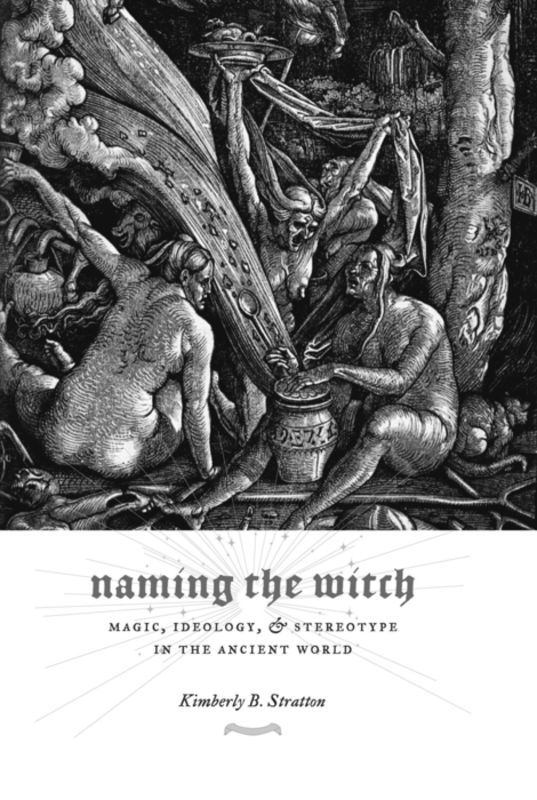
Naming the Witch
Kimberly B. Stratton investigates the cultural and ideological motivations behind early imaginings of the magician, the sorceress, and the witch in the ancient world. Accusations of magic could carry the death penalty or, at the very least, marginalize the person or group they targeted. But Stratton moves beyond the popular view of these accusations as mere slander. In her view, representations and accusations of sorcery mirror the complex struggle of ancient societies to define authority, legitimacy, and Otherness. Stratton argues that the concept \"magic\" first emerged as a discourse in ancient Athens where it operated part and parcel of the struggle to define Greek identity in opposition to the uncivilized \"barbarian\" following the Persian Wars. The idea of magic then spread throughout the Hellenized world and Rome, reflecting and adapting to political forces, values, and social concerns in each society. Stratton considers the portrayal of witches and magicians in the literature of four related periods and cultures: classical Athens, early imperial Rome, pre-Constantine Christianity, and rabbinic Judaism. She compares patterns in their representations of magic and analyzes the relationship between these stereotypes and the social factors that shaped them. Stratton's comparative approach illuminates the degree to which magic was (and still is) a cultural construct that depended upon and reflected particular social contexts. Unlike most previous studies of magic, which treated the classical world separately from antique Judaism, Naming the Witch highlights the degree to which these ancient cultures shared ideas about power and legitimate authority, even while constructing and deploying those ideas in different ways. The book also interrogates the common association of women with magic, denaturalizing the gendered stereotype in the process. Drawing on Michel Foucault's notion of discourse as well as the work of other contemporary theorists, such as Homi K. Bhabha and Bruce Lincoln, Stratton's bewitching study presents a more nuanced, ideologically sensitive approach to understanding the witch in Western history.
eBook