
Catalogue Search | MBRL


Are you sure you want to remove the book from the shelf?

{{itemTitle}}
17
result(s) for
"Magic -- England -- History -- 16th century"
Sort by:

Magic and Masculinity
In early modern England, the practice of ritual or ceremonial magic - the attempted communication with angels and demons - both reinforced and subverted existing concepts of gender. The majority of male magicians acted from a position of control and command commensurate with their social position in a patriarchal society; other men, however, used the notion of magic to subvert gender ideals while still aiming to attain hegemony. Whilst women who claimed to perform magic were usually more submissive in their attempted dealings with the spirit world, some female practitioners employed magic to undermine the patriarchal culture and further their own agenda. Frances Timbers studies the practice of ritual magic in the sixteenth and seventeenth centuries focusing especially on gender and sexual perspectives. Using the examples of well-known individuals who set themselves up as magicians (including John Dee, Simon Forman and William Lilly), as well as unpublished diaries and journals, literature and legal records, this book provides a unique analysis of early modern ceremonial magic from a gender perspective.
eBook

The sorcerer's tale : faith and fraud in Tudor England
An earl’s son, plotting murder by witchcraft; conjuring spirits to find buried treasure; a stolen coat embroidered with pure silver; crooked gaming-houses and brothels; a terrifying new disease, and the self-trained surgeon who claims he can treat it. This is the world of Gregory Wisdom, a physician, magician, and consummate con-man at work in sixteenth-century London. In this book, Alec Ryrie uses previously unknown documents to reconstruct this extraordinary man’s career. The journey takes us through the cut-throat business of early modern medicine, down to Tudor London’s gangland of fraud and organized crime; from the world of Renaissance magi and Kabbalistic conjurers to street-corner wizards; and into the chaotic, exhilarating religious upheavals of the Reformation. On the way, we learn how Tudor England’s dignified public face and its rapacious underworld were intimately connected to each other. Gregory Wisdom’s career is an object lesson in how to conjure up wealth and respectability from nothing in a turbulent age. And it provides a unique glimpse into a world intoxicated with new ideas, where it was impossible to know quite what to believe - or who to trust.
eBook

Making Magic in Elizabethan England
This volume presents editions of two fascinating anonymous and untitled manuscripts of magic produced in Elizabethan England: the Antiphoner Notebook and the Boxgrove Manual. Frank Klaassen uses these texts, which he argues are representative of the overwhelming majority of magical practitioners, to explain how magic changed during this period and why these developments were crucial to the formation of modern magic.
The Boxgrove Manual is a work of learned ritual magic that synthesizes material from Henry Cornelius Agrippa, the Fourth Book of Occult Philosophy , Heptameron , and various medieval conjuring works. The Antiphoner Notebook concerns the common magic of treasure hunting, healing, and protection, blending medieval conjuring and charm literature with materials drawn from Reginald Scot’s famous anti-magic work, Discoverie of Witchcraft . Klaassen painstakingly traces how the scribes who created these two manuscripts adapted and transformed their original sources. In so doing, he demonstrates the varied and subtle ways in which the Renaissance, the Reformation, new currents in science, the birth of printing, and vernacularization changed the practice of magic.
Illuminating the processes by which two sixteenth-century English scribes went about making a book of magic, this volume provides insight into the wider intellectual culture surrounding the practice of magic in the early modern period.
eBook

Medicine, Religion, and Magic in Early Stuart England
The astrologer-physician Richard Napier (1559-1634) was not only a man of practical science and medicine but also a master of occult arts and a devout parish rector who purportedly held conversations with angels. This new interpretation of Napier reveals him to be a coherent and methodical man whose burning desire for certain, true knowledge contributed to the contemporary venture of putting existing knowledge to useful ends. Originally trained in theology and ordained as an Anglican priest, Napier later studied astrological medicine and combined astrology, religious thought, and image and ritual magic in his medical work. Ofer Hadass draws on a remarkable archive of Napier's medical cases and religious writings—including the interviews he claimed to have held with angels—to show how Napier's seemingly inconsistent approaches were rooted in an inclusive and coherent worldview, combining equal respect for ancient authority and for experientially derived knowledge. Napier's endeavors exemplify the fruitful relationship between religion and science that offered a well-founded alternative to the rising mechanistic explanation of nature at the time. Carefully researched and compellingly told, Medicine, Religion, and Magic in Early Stuart England is an insightful exploration of one of the most fascinating figures at the intersection of medicine, magic, and theology in early modern England and of the healing methods employed by physicians of the era.
eBook

Making Magic in Elizabethan England
This volume presents editions of two fascinating anonymous and
untitled manuscripts of magic produced in Elizabethan England: the
Antiphoner Notebook and the Boxgrove Manual. Frank Klaassen uses
these texts, which he argues are representative of the overwhelming
majority of magical practitioners, to explain how magic changed
during this period and why these developments were crucial to the
formation of modern magic.
The Boxgrove Manual is a work of learned ritual magic that
synthesizes material from Henry Cornelius Agrippa, the Fourth
Book of Occult Philosophy , Heptameron , and various
medieval conjuring works. The Antiphoner Notebook concerns the
common magic of treasure hunting, healing, and protection, blending
medieval conjuring and charm literature with materials drawn from
Reginald Scot's famous anti-magic work, Discoverie of
Witchcraft . Klaassen painstakingly traces how the scribes who
created these two manuscripts adapted and transformed their
original sources. In so doing, he demonstrates the varied and
subtle ways in which the Renaissance, the Reformation, new currents
in science, the birth of printing, and vernacularization changed
the practice of magic.
Illuminating the processes by which two sixteenth-century
English scribes went about making a book of magic, this volume
provides insight into the wider intellectual culture surrounding
the practice of magic in the early modern period.
eBook
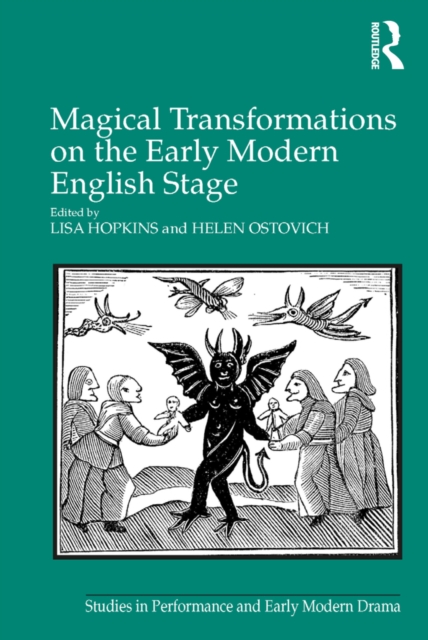
Magical Transformations on the Early Modern English Stage
Considering a variety of questions centering on magic and, or in, performance, this volume furthers the debate about the cultural work performed by representations of magic on the early modern English stage. Collectively the essays show that the idea of transformation applies not only to the objects and subjects of magic, but that the plays themselves can be seen as working to effect transformation in the ways that they challenge contemporary assumptions and stereotypes.
eBook

William Harvey, Aristotle and astrology
In this paper I argue that William Harvey believed in a form of astrology. It has long been known that Harvey employed a macrocosm–microcosm analogy and used alchemical terminology in describing how the two types of blood change into one another. This paper then seeks to examine a further aspect of Harvey in relation to the magical tradition. There is an important corollary to this line of thought, however. This is that while Harvey does have a belief in astrology, it is strongly related to Aristotle's views in this area and is quite restricted and attenuated relative to some contemporary beliefs in astrology. This suggests a more general thesis. While Harvey was amenable to ideas which we associate with the natural magic tradition, those ideas had a very broad range of formulation and there was a limit to how far he would accept them. This limit was largely determined by Harvey's adherence to Aristotle's natural philosophy and his Christian beliefs. I argue that this is also the case in relation to Harvey's use of the macrocosm–microcosm analogy and of alchemical terminology, and, as far as we can rely on the evidence, this informs his attitudes towards witches as well. Understanding Harvey's influences and motives here is important in placing him properly in the context of early seventeenth-century thought.
Journal Article
Early Modern Witches
This collection of pamphlets describes fifteen English witchcraft cases in detail, vividly recreating events to give the reader the illusion of actually being present at witchcraft accusations, trials and hangings. But how much are we victims of literary manipulation by these texts? The pamphlets are presented in annotated format, to allow the reader to decide. Some of the texts appear in print for the first time in three centuries, whilst others are newly edited to give a clearer picture of sources.
'Gibson is to be congratulated on bringing together these materials together, and on the skill, scholarship and insights she has brought to bear on them.' - James Sharpe, Continuity and Change, vol. 17 2, 2002
eBook

Medicine, Religion, and Magic in Early Stuart England
The astrologer-physician Richard Napier (1559-1634) was not only
a man of practical science and medicine but also a master of occult
arts and a devout parish rector who purportedly held conversations
with angels. This new interpretation of Napier reveals him to be a
coherent and methodical man whose burning desire for certain, true
knowledge contributed to the contemporary venture of putting
existing knowledge to useful ends.
Originally trained in theology and ordained as an Anglican
priest, Napier later studied astrological medicine and combined
astrology, religious thought, and image and ritual magic in his
medical work. Ofer Hadass draws on a remarkable archive of Napier's
medical cases and religious writings-including the interviews he
claimed to have held with angels-to show how Napier's seemingly
inconsistent approaches were rooted in an inclusive and coherent
worldview, combining equal respect for ancient authority and for
experientially derived knowledge. Napier's endeavors exemplify the
fruitful relationship between religion and science that offered a
well-founded alternative to the rising mechanistic explanation of
nature at the time.
Carefully researched and compellingly told, Medicine,
Religion, and Magic in Early Stuart England is an insightful
exploration of one of the most fascinating figures at the
intersection of medicine, magic, and theology in early modern
England and of the healing methods employed by physicians of the
era.
eBook
