
Catalogue Search | MBRL


Are you sure you want to remove the book from the shelf?

{{itemTitle}}
133
result(s) for
"Mammals, Fossil North America."
Sort by:

Atlas of a lost world : travels in ice age America
\"Scientists squabble over the locations and dates for human arrival in the New World. The first explorers were few, encampments fleeting. At some point in time, between twenty and forty thousand years ago, sea levels were low enough that a vast land bridge was exposed between Asia and North America. But the land bridge was not the only way across. This book upends our notions of where these people came from and who they were. The unpeopled continent they reached was inhabited by megafauna--mastodons, sloths, mammoths, saber-toothed cats, lions, bison, and bears. The First People were not docile--Paleolithic spear points are still encrusted with the protein of their prey--but they were wildly outnumbered and many were prey to the much larger animals. This is a chronicle of the last millennia of the Ice Age, the gradual oscillations and retreat of glaciers, the clues and traces that document the first encounters of early humans, and the animals whose presence governed the humans' chances for survival\"-- Provided by publisher.
Book
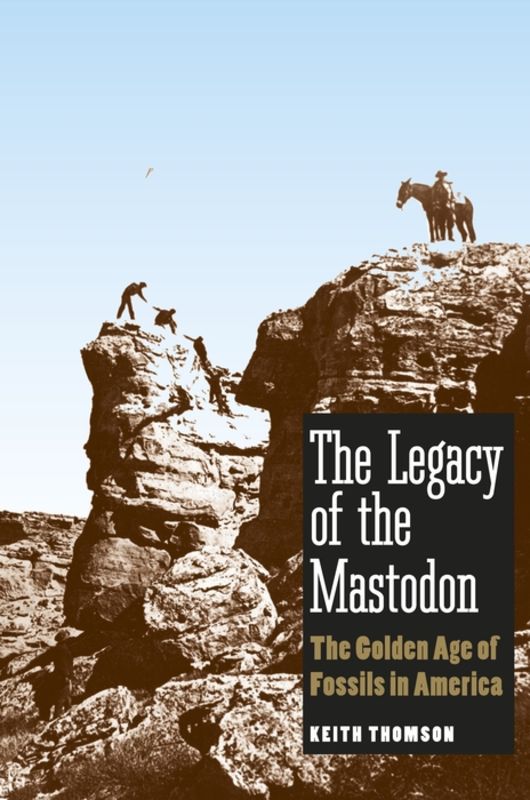
The Legacy of the Mastodon
The uncovering in the mid-1700s of fossilized mastodon bones and teeth at Big Bone Lick, Kentucky, signaled the beginning of a great American adventure. The West was opening up and unexplored lands beckoned. Unimagined paleontological treasures awaited discovery: strange horned mammals, birds with teeth, flying reptiles, gigantic fish, diminutive ancestors of horses and camels, and more than a hundred different kinds of dinosaurs. This exciting book tells the story of the grandest period of fossil discovery in American history, the years from 1750 to 1890.
The volume begins with Thomas Jefferson, whose keen interest in the American mastodon led him to champion the study of fossil vertebrates. The book continues with vivid descriptions of the actual work of prospecting for fossils--a pick in one hand, a rifle in the other--and enthralling portraits of Joseph Leidy, Ferdinand Hayden, Edward Cope, and Othniel Marsh among other major figures in the development of the science of paleontology. Shedding new light on these scientists' feuds and rivalries, on the connections between fossil studies in Europe and America, and on paleontology's contributions to America's developing national identity,The Legacy of the Mastodonis itself a fabulous discovery for every reader to treasure.
eBook
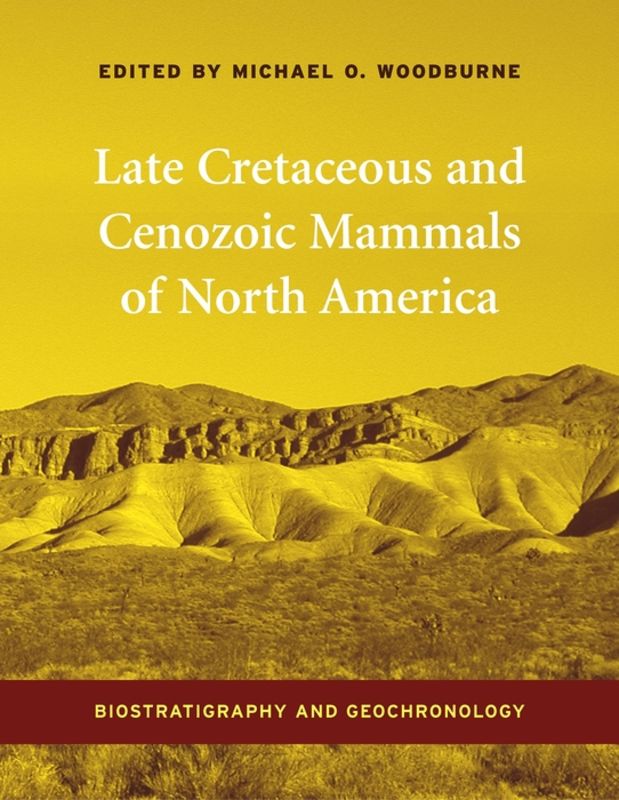
Late Cretaceous and Cenozoic mammals of North America
This book places into modern context the information by which North American mammalian paleontologists recognize, divide, calibrate, and discuss intervals of mammalian evolution known as North American Land Mammal Ages. It incorporates new information on the systematic biology of the fossil record and utilizes the many recent advances in geochronologic methods and their results. The book describes the increasingly highly resolved stratigraphy into which all available temporally significant data and applications are integrated. Extensive temporal coverage includes the Lancian part of the Late Cretaceous, and geographical coverage includes information from Mexico, an integral part of the North American fauna, past and present.
eBook
Late cretaceous and cenozoic mammals of North America: biostratigraphy and geochronology
'Late Cretaceous and Cenozoic Mammals of North America' places into modern context the information by which North American mammalian paleontologists recognize, divide, calibrate, discuss intervals of mammalian evolution known as North American Land Mammals Ages.
eBook
Evolution of Tertiary Mammals of North America
This second volume completes the unique survey of North American Tertiary mammals, and covers all the remaining taxa not contained in Volume 1. It provides a complete listing of mammalian diversity over time and space, and evaluates the effect of biogeography and climatic change on evolutionary patterns and faunal transitions, with the distribution in time and space of each taxon laid out in a standardized format. It contains six summary chapters that integrate systematic and biogeographic information for higher taxa, and provides a detailed account of the patterns of occurrence for different species at hundreds of different fossil localities, with the inclusion of many more localities than were contained in the first volume. With over thirty chapters, each written by leading authorities, and an addendum that updates the occurrence and systematics of all of the groups covered in Volume 1, this will be a valuable reference for paleontologists and zoologists.
eBook


Biological evidence supports an early and complex emergence of the Isthmus of Panama
The linking of North and South America by the Isthmus of Panama had major impacts on global climate, oceanic and atmospheric currents, and biodiversity, yet the timing of this critical event remains contentious. The Isthmus is traditionally understood to have fully closed by ca. 3.5 million years ago (Ma), and this date has been used as a benchmark for oceanographic, climatic, and evolutionary research, but recent evidence suggests a more complex geological formation. Here, we analyze both molecular and fossil data to evaluate the tempo of biotic exchange across the Americas in light of geological evidence. We demonstrate significant waves of dispersal of terrestrial organisms at approximately ca. 20 and 6 Ma and corresponding events separating marine organisms in the Atlantic and Pacific oceans at ca. 23 and 7 Ma. The direction of dispersal and their rates were symmetrical until the last ca. 6 Ma, when northern migration of South American lineages increased significantly. Variability among taxa in their timing of dispersal or vicariance across the Isthmus is not explained by the ecological factors tested in these analyses, including biome type, dispersal ability, and elevation preference. Migration was therefore not generally regulated by intrinsic traits but more likely reflects the presence of emergent terrain several millions of years earlier than commonly assumed. These results indicate that the dramatic biotic turnover associated with the Great American Biotic Interchange was a long and complex process that began as early as the Oligocene–Miocene transition.
Significance The formation of the Isthmus of Panama, which linked North and South America, is key to understanding the biodiversity, oceanography, atmosphere, and climate in the region. Despite its importance across multiple disciplines, the timing of formation and emergence of the Isthmus and the biological patterns it created have been controversial. Here, we analyze molecular and fossil data, including terrestrial and marine organisms, to show that biotic migrations across the Isthmus of Panama began several million years earlier than commonly assumed. An earlier evolution of the Isthmus has broad implications for the mechanisms driving global climate (e.g., Pleistocene glaciations, thermohaline circulation) as well as the rich biodiversity of the Americas.
Journal Article

The post-cranial anatomy and functional morphology of Conoryctes comma (Mammalia: Taeniodonta) from the Paleocene of North America
Conoryctes comma is a member of the enigmatic group Taeniodonta, Paleogene mammals that have been found only in North America. Taeniodonts were part of the first wave of placental mammal diversification after the end-Cretaceous extinction. The lack of postcranial elements has limited the understanding of the anatomy and locomotion of Conoryctes , and how it compared to other taeniodonts. We here describe the postcranial anatomy and functional morphology of Conoryctes , based largely on nine new specimens found in the San Juan Basin, New Mexico, USA. The specimens include elements of the axial column, such as the axis, sacrum, and ribs; the humerus, ulna, radius, and part of the manus; the innominate, femur, tibia, and part of the pes, including the tarsals. Conoryctes was a medium-sized mammal, with a robust humerus, radius, and femur, and with anatomical similarities to other conoryctid taeniodonts and Onychodectes . The tarsal elements of Conoryctes show characteristics of the “leptictimorph astragalocalcaneal morphology” as seen in other Paleogene mammals, such as Escavadodon , Palaeanodon , and Procerberus . Anatomical features of the forelimb and hindlimb of Conoryctes indicate that it was a scratch-digging animal with powerful forearm muscles and well-stabilized digits, features that may have helped it adapt to the subtropical forests of the San Juan Basin, approximately 63 million years ago. This corroborates the previous hypothesis that digging adaptations are seen in all members of Taeniodonta for which the postcranial elements are known, and that digging ability was present in the common ancestor of the clade and potentially central to their radiation after the environmental destruction of the end-Cretaceous extinction.
Journal Article

role of clade competition in the diversification of North American canids
The history of biodiversity is characterized by a continual replacement of branches in the tree of life. The rise and demise of these branches (clades) are ultimately determined by changes in speciation and extinction rates, often interpreted as a response to varying abiotic and biotic factors. However, understanding the relative importance of these factors remains a major challenge in evolutionary biology. Here we analyze the rich North American fossil record of the dog family Canidae and of other carnivores to tease apart the roles of competition, body size evolution, and climate change on the sequential replacement of three canid subfamilies (two of which have gone extinct). We develop a novel Bayesian analytic framework to show that competition from multiple carnivore clades successively drove the demise and replacement of the two extinct canid subfamilies by increasing their extinction rates and suppressing their speciation. Competitive effects have likely come from ecologically similar species from both canid and felid clades. These results imply that competition among entire clades, generally considered a rare process, can play a more substantial role than climate change and body size evolution in determining the sequential rise and decline of clades.
Extinction is a ubiquitous feature of biodiversity history, and although many lineages increase in diversity through time, most of them eventually decline and get replaced. Dinosaurs and mammals represent an extreme and iconic example of such replacement. Here we investigate the causes of the sequential wax and wane of three subfamilies in the dog family Canidae. Contrary to current expectation, we find that competition from phylogenetically distant, but ecologically similar, clades played a more substantial role in canid diversification than climate change and body size evolution. Our results provide novel quantitative evidence indicating that competition from multiple clades can actively drive the displacement and extinction of entire lineages.
Journal Article

Continuity of mammalian fauna over the last 200,000 y in the Indian subcontinent
Mammalian extinction worldwide during the Late Pleistocene has been a major focus for Quaternary biochronology and paleoecology. These extinctions have been variably attributed to the impacts of climate change and human interference. However, until relatively recently, research has been largely restricted to the Americas, Europe, and Australasia. We present the oldest Middle–Late Pleistocene stratified and numerically dated faunal succession for the Indian subcontinent from the Billasurgam cave complex. Our data demonstrate continuity of 20 of 21 identified mammalian taxa from at least 100,000 y ago to the present, and in some cases up to 200,000 y ago. Comparison of this fossil record to contemporary faunal ranges indicates some geographical redistribution of mammalian taxa within India. We suggest that, although local extirpations occurred, the majority of taxa survived or adapted to substantial ecological pressures in fragmented habitats. Comparison of the Indian record with faunal records from Southeast and Southwest Asia demonstrates the importance of interconnected mosaic habitats to long-term faunal persistence across the Asian tropics. The data presented here have implications for mammalian conservation in India today, where increasing ecological circumscription may leave certain taxa increasingly endangered in the most densely populated region of the world.
Journal Article