
Catalogue Search | MBRL


Are you sure you want to remove the book from the shelf?

{{itemTitle}}
1,198
result(s) for
"Mammals North America."
Sort by:


Mammals of North America
The best-selling field guide that \"sets new standards\" (New Scientist) and \"makes all other field guides for mammals of the United States. . . and Canada obsolete\" (Journal of Mammalogy) is now even better. Covering 20 species recognized since 2002 and including 13 new color plates, this fully revised edition ofMammals of North Americaillustrates all 462 known mammal species in the United States and Canada--each in beautiful color and accurate detail. With a more up-to-date species list than any other guide, improved facing-page descriptions, easier-to-read distribution maps, updated common and scientific names, and track and scat illustrations, this slim, light, and easy-to-use volume is the must-have source for identifying North American mammals.
Roland Kays and Don Wilson have scoured the technical literature to pull out the key differences between similar species, and illustrated these whenever possible, making the guide useful to amateur naturalists and professional zoologists alike. Casual animal watchers will appreciate the overview of mammal diversity and the tips on identifying animals they can spy in their binoculars, while scientists will appreciate the exacting detail needed to distinguish similar species, including illustrations of shrew teeth, bat toes, and whale dorsal fins.
The best-illustrated and easiest-to-use field guide to North American mammalsBeautiful and accurate color illustrations of all 462 mammals found in the United States and Canada--including 20 species recognized since 2002112 color plates--including 13 new onesKey identification information--fully revised--on facing pagesThe most current taxonomy/species listFully revised, easy-to-read range mapsIllustrations of tracks, scat, and whale and dolphin dive sequences
eBook

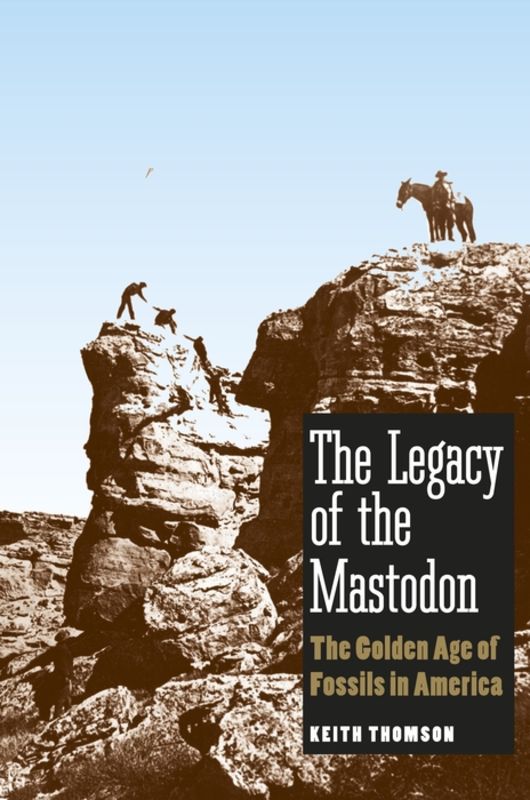
The Legacy of the Mastodon
The uncovering in the mid-1700s of fossilized mastodon bones and teeth at Big Bone Lick, Kentucky, signaled the beginning of a great American adventure. The West was opening up and unexplored lands beckoned. Unimagined paleontological treasures awaited discovery: strange horned mammals, birds with teeth, flying reptiles, gigantic fish, diminutive ancestors of horses and camels, and more than a hundred different kinds of dinosaurs. This exciting book tells the story of the grandest period of fossil discovery in American history, the years from 1750 to 1890.
The volume begins with Thomas Jefferson, whose keen interest in the American mastodon led him to champion the study of fossil vertebrates. The book continues with vivid descriptions of the actual work of prospecting for fossils--a pick in one hand, a rifle in the other--and enthralling portraits of Joseph Leidy, Ferdinand Hayden, Edward Cope, and Othniel Marsh among other major figures in the development of the science of paleontology. Shedding new light on these scientists' feuds and rivalries, on the connections between fossil studies in Europe and America, and on paleontology's contributions to America's developing national identity,The Legacy of the Mastodonis itself a fabulous discovery for every reader to treasure.
eBook

Atlas of a lost world : travels in ice age America
\"Scientists squabble over the locations and dates for human arrival in the New World. The first explorers were few, encampments fleeting. At some point in time, between twenty and forty thousand years ago, sea levels were low enough that a vast land bridge was exposed between Asia and North America. But the land bridge was not the only way across. This book upends our notions of where these people came from and who they were. The unpeopled continent they reached was inhabited by megafauna--mastodons, sloths, mammoths, saber-toothed cats, lions, bison, and bears. The First People were not docile--Paleolithic spear points are still encrusted with the protein of their prey--but they were wildly outnumbered and many were prey to the much larger animals. This is a chronicle of the last millennia of the Ice Age, the gradual oscillations and retreat of glaciers, the clues and traces that document the first encounters of early humans, and the animals whose presence governed the humans' chances for survival\"-- Provided by publisher.
Book

John Bachman
John Bachman (1790-1874) was an internationally renowned naturalist and a prominent Lutheran minister. This is the first collection of his writings, containing selections from his three major books, his letters, and his articles on plants and animals, education, religion, agriculture, and the human species. Bachman was the leading authority on North American mammals. He was responsible for the descriptions of the 147 mammal species included in Viviparous Quadrupeds of North America, a massive work produced in collaboration with John James Audubon. Bachman relied entirely on scientific evidence in his work and was exceptional among his fellow naturalists for studying the whole of natural history. Bachman also relied on scientific evidence in his Doctrine of the Unity of the Human Race. He showed that human beings constitute a single species that developed as varieties equivalent to the varieties of domesticated animals. In this work, perhaps his most significant accomplishment, Bachman stood nearly alone in challenging the polygenetic views of Louis Agassiz and others that white and black people descended from different progenitors. Bachman was also an important figure in the establishment of Lutheranism in the Southeast. He wrote the first American monograph on the doctrines of Martin Luther and the history of the Reformation. Bachman served for fifty-six years as minister of St. John's Lutheran Church in Charleston, South Carolina, and was one of the founders of Newberry College.
eBook


Noninvasive survey methods for carnivores
Presented in a straightforward and readable style, Noninvasive Survey Methods for Carnivores is a comprehensive guide for wildlife researchers who seek to conduct carnivore surveys using the most up-to-date scientific approaches. Twenty-five experts from across North America discuss strategies for implementing surveys across a broad range of habitats, providing input on survey design, sample collection, DNA and endocrine analyses, and data analysis. Photographs from the field, line drawings, and detailed case studies further illustrate the on-the-ground application of the survey methods discussed.
eBook


Human impacts on seals, sea lions, and sea otters
For more than ten thousand years, Native Americans from Alaska to southern California relied on aquatic animals such as seals, sea lions, and sea otters for food and raw materials. Archaeological research on the interactions between people and these marine mammals has made great advances recently and provides a unique lens for understanding the human and ecological past. Archaeological research is also emerging as a crucial source of information on contemporary environmental issues as we improve our understanding of the ancient abundance, ecology, and natural history of these species. This groundbreaking interdisciplinary volume brings together archaeologists, biologists, and other scientists to consider how archaeology can inform the conservation and management of pinnipeds and other marine mammals along the Pacific Coast.
eBook