
Catalogue Search | MBRL


Are you sure you want to remove the book from the shelf?

{{itemTitle}}
3,662
result(s) for
"Management Religious aspects."
Sort by:

Servant leader human resource management : a moral and spiritual perspective
Servant Leader Human Resource Management provides a comprehensive conceptual framework based on a dignity-enhancing stewardship model that integrates and balances mission achievement with motive, means, and ends integrity from both a line manager and human resource department perspective. The foundation is the development of a strategic and tactical collaborative partnership between the human resource department and line managers and employees. This book is a welcome guide for improving the leadership skills of its academic and professional readers.
Book

Atone
The relationship between religion and conflict has generated considerable academic and political debate. Although the majority of religions and spiritual traditions are replete with wisdom that propagates a broader unity among human beings, these same examples have been used to legitimize hatred and fear. While some studies claim that religion facilitates peacebuilding, reconciliation, and healing, others argue that religion exacerbates hostility, instigates vengeance-seeking behaviors, and heightens conflict. But religion does not act by itself, human beings are responsible for acts of peace or conflict, of division or reconciliation, in the name of religion. This book addresses these rather complex issues from the perspective of reconciliation, or atonement, to advance both the frontiers of knowledge and the global search for alternative paths to peace. The contributions in the volume focus in three areas: (1) Reconciling Religious Conflicts, (2) Reconciling Conflict through Religion, and (3) Religious Reconciliations. In each of these sections scholars, practitioners, and religious leaders address specific examples that highlight the complex intersections of religious practices with global conflict and reconciliation efforts. This informative and provocative book is relevant for students and faculty in peace and conflict studies, religious studies, humanities, social sciences, and provides insights useful to practitioners and professionals working in peacebuilding and international development seeking to promote effective resolution and reconciliation efforts.
eBook

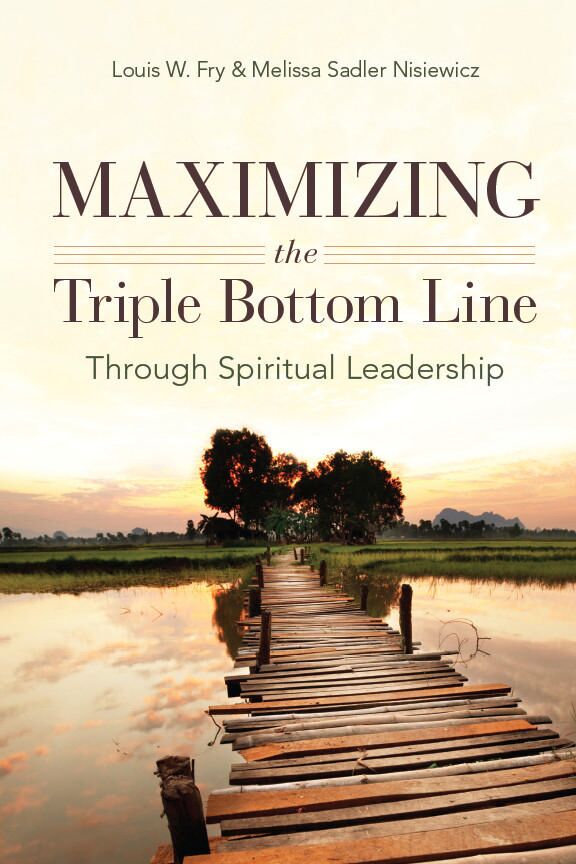
Maximizing the Triple Bottom Line Through Spiritual Leadership
Maximizing the Triple Bottom Line through Spiritual Leadership draws on the emerging fields of workplace spirituality and spiritual leadership to teach leaders and their constituencies how to develop business models that address issues of ethical leadership, employee well-being, sustainability, and social responsibility without sacrificing profitability, growth, and other metrics of performance excellence. While this text identifies and discusses the characteristics necessary to be a leader, its major focus is on leadership—engaging stakeholders and enabling groups of people to work together in the most meaningful ways. The authors offer real-world examples of for-profit and non-profit organizations that have spiritual leaders and which have implemented organizational spiritual leadership. These cases are based on over ten years of research, supported by the International Institute of Spiritual Leadership, that demonstrates the value of the Spiritual Leadership Balanced Scorecard Business Model presented in the book. \"Pracademic\" in its orientation, the book presents a general process and tools for implementing the model.
eBook


To make the earth whole
To Make the Earth Whole studies the art of citizen diplomacy—a process that can address clashes of religion and culture across regional lines even when traditional negotiations between governments can fail. While faith and regional differences have been sources of division around the world in recent decades, millions of citizens are also creating bonds of friendship and collaboration that are forming the basis of a global community. Drawing on the experiences gleaned from years practicing citizen diplomacy in some of the world's most politically charged climates, scholar-practitioner of conflict resolution and rabbi Marc Gopin describes his work in Syria as a central case study of the book. The author outlines the strategic basis for creating community across lines of enmity, the social network theory to explain how this happens, and the long term vision required for a progressive but inclusive global community that respects religious communities even as it limits their coercive power over others. This powerful and practical book outlines an incremental and evolutionary strategy of positive change that stands a strong chance of success, even in today's most conservative and repressive religious and political contexts. To Make the Earth Whole also examines the ethical challenges of citizen diplomacy from the perspectives of both Western and Eastern philosophies and religions. The world's wisdom traditions are essential in devising a way for citizens to develop the foundations for global community.
eBook

Bold followership : a biblical cure for organizational toxicity
This book uses biblical writings to examine how to build wise and moral boardroom boldness to mitigate executive ethical mishaps. The author uses the story of King David to explore the possible perplexities followers experience when their leaders suddenly make a toxic choice. Introducing a boardroom boldness language model (BBLM), Buford presents five boardroom languages to use when dealing with toxic leaders. How well organizations brace, respond, and proactively navigate the uncharted terrain of uncertainty could play a pivotal role in the success of the firm. Calling into question traditional constructs affiliated with power and trust, this book will advance the greater discussion by integrating spirituality, case studies, and leadership principles to measure the culture to cultivate boardroom boldness.
Book

Religion and peacebuilding
In the wake of September 11, 2001 religion is often seen as the motivating force behind terrorism and other acts of violence. Religion and Peacebuilding looks beyond headlines concerning violence perpetrated in the name of religion to examine how world religions have also inspired social welfare and peacemaking activism. Leading scholars from the Aboriginal, Hindu, Buddhist, Confucian, Jewish, Muslim, and Christian traditions provide detailed analyses of the spiritual resources for fostering peace within their respective religions. The contributors discuss the formidable obstacles to nonviolent conflict transformation found within sacred texts and living traditions. Case studies of Northern Ireland, Bosnia, Cambodia, and South Africa are also examined as practical applications of spiritual resources for peace.
eBook

Peace on earth
Peace on Earth: The Role of Religion in Peace and Conflict Studies provides a critical analysis of faith and religious institutions in peacebuilding practice and pedagogy. The work captures the synergistic relationships among faith traditions and how multiple approaches to conflict transformation and peacebuilding result in a creative process that has the potential to achieve a more detailed view of peace on earth, containing breadth as well as depth. Library and bookstore shelves are filled with critiques of the negative impacts of religion in conflict scenarios. Peace on Earth: The Role of Religion in Peace and Conflict Studies offers an alternate view that suggests religious organizations play a more complex role in conflict than a simply negative one. Faith-based organizations, and their workers, are often found on the frontlines of conflict throughout the world, conducting conflict management and resolution activities as well as advancing peacebuilding initiatives.
eBook