
Catalogue Search | MBRL


Are you sure you want to remove the book from the shelf?

{{itemTitle}}
128
result(s) for
"Manhattan (New York, N.Y.)"
Sort by:


Creating the Hudson River Park
The 4-mile-long, 550-acre Hudson River Park is nearing completion and is the largest park built in Manhattan since Central Park opened more than 150 years ago. It has transformed a derelict waterfront, protected the Hudson River estuary, preserved commercial maritime activities, created new recreational opportunities for millions of New Yorkers, enhanced tourism, stimulated redevelopment in adjacent neighborhoods, and set a precedent for waterfront redevelopment. The Park attracts seventeen million visitors annually. Creating the Hudson River Park is a first-person story of how this park came to be. Working together over three decades, community groups, civic and environmental organizations, labor, the real estate and business community, government agencies, and elected officials won a historic victory for environmental preservation, the use and enjoyment of the Hudson River, and urban redevelopment. However, the park is also the embodiment of a troubling trend toward the commercialization of America's public parks. After the defeat of the $2.4 billion Westway plan to fill 234 acres of the Hudson in 1985, the stage was set for the revitalization of Manhattan's West Side waterfront. Between 1986 and 1998 the process focused on the basics like designing an appropriate roadway, removing noncompliant municipal and commercial activities from the waterfront, implementing temporary improvements, developing the Park's first revenue-producing commercial area at Chelsea Piers, completing the public planning and environmental review processes, and negotiating the 1998 Hudson River Park Act that officially created the Park. From 1999 to 2009 planning and construction were funded with public money and focused on creating active and passive recreation opportunities on the Tribeca, Greenwich Village, Chelsea, and Hell's Kitchen waterfronts. However, initial recommendations to secure long term financial support for the Park from the increase in adjacent real estate values that resulted from the Park's creation were ignored. City and state politicians had other priorities and public funding for the Park dwindled. The recent phase of the project, from 2010 to 2021, focused on \"development\" both in and adjacent to the Park. Changes in leadership, and new challenges provide an opportunity to return to a transparent public planning process and complete the redevelopment of the waterfront for the remainder of the 21st-century. Fox's first-person perspective helps to document the history of the Hudson River Park, recognizes those who made it happen and those who made it difficult, and provides lessons that may help private citizens and public servants expand and protect the public parks and natural systems that are so critical to urban well-being.
eBook


New York City Politics
Most experts consider economic development to be the dominant factor influencing urban politics. They point to the importance of the finance and real estate industries, the need to improve the tax base, and the push to create jobs. Bruce F. Berg maintains that there are three forces which are equally important in explaining New York City politics: economic development; the city's relationships with the state and federal governments, which influence taxation, revenue and public policy responsibilities; and New York City's racial and ethnic diversity, resulting in demands for more equitable representation and greater equity in the delivery of public goods and services.
New York City Politics focuses on the impact of these three forces on the governance of New York City's political system including the need to promote democratic accountability, service delivery equity, as well as the maintenance of civil harmony. This second edition updates the discussion with examples from the Bloomberg and de Blasio administrations as well as current public policy issues including infrastructure, housing and homelessness, land use regulations, and education.
eBook

The Manhattan nobody knows : an urban walking guide
Bill Helmreich walked every block of New York City -- six-thousand miles in all -- to write the award-winning The New York Nobody Knows. Now he has re-walked most of Manhattan -- 721 miles -- to write this new, one-of-a-kind walking guide to the heart of one of the world's greatest cities. Drawing on hundreds of conversations he had with residents during his block-by-block journey, The Manhattan Nobody Knows captures the unique magic and excitement of the island and highlights hundreds of facts, places, and points of interest that you won't find in any other guide. The guide covers every one of Manhattan's thirty-one distinct neighborhoods, from Marble Hill to the Financial District, providing a colorful portrait of each area's most interesting, unusual, and unfamiliar people, places, and things. Along the way you'll be introduced to an elderly Inwood man who lives in a cave; a Greenwich Village townhouse where Weathermen terrorists set up a bomb factory; a Harlem apartment building whose residents included W.E.B. DuBois and Thurgood Marshall; a tiny community garden attached to the Lincoln Tunnel; a Washington Heights pizza joint that sells some of the biggest slices in town; the story behind the \"Birdman\" of Washington Square Park; and much, much more. An unforgettably vivid chronicle of today's Manhattan, the book can also be enjoyed without ever leaving home -- but it's almost guaranteed to inspire you to get out and explore this fascinating metropolis.
Book

Unfriendly to Liberty
In Unfriendly to
Liberty , Christopher F. Minty explores the
origins of loyalism in New York City between 1768 and 1776, and
revises our understanding of the coming of the American
Revolution.
Through detailed analyses of those who became loyalists, Minty
argues that would-be loyalists came together long before Lexington
and Concord to form an organized, politically motivated, and
inclusive political group that was centered around the DeLancey
faction. Following the DeLanceys' election to the New York Assembly
in 1768, these men, elite and nonelite, championed an inclusive
political economy that advanced the public good, and they strongly
protested Parliament's reorientation of the British Empire.
For New York loyalists, it was local politics, factions,
institutions, and behaviors that governed their political
activities in the build up to the American Revolution. By focusing
on political culture, organization, and patterns of allegiance,
Unfriendly to Liberty shows how the contending allegiances
of loyalists and patriots were all but locked in place by 1775 when
British troops marched out of Boston to seize caches of weapons in
neighboring villages.
Indeed, local political alignments that were formed in the
imperial crises of the 1760s and 1770s provided a critical platform
for the divide between loyalists and patriots in New York City.
Political and social disputes coming out of the Seven Years' War,
more than republican radicalization in the 1770s, forged the united
force that would make New York City a center of loyalism throughout
the American Revolution.
eBook

Manhattan : mapping the story of an island
\"An innovative look back through time, [this book] follows the history of Manhattan Island from its natural formation to the bustling city today. It explores the ways in which nature and people are connected, tracking the people who lived on Manhattan from the Lenape Indians to Dutch settlers hunting for beaver pelts to early Americans and beyond, and how they've (literally) shaped the island (and vice versa). Jen Thermes highlights watershed moments where nature demanded action of New Yorkers--the Great Fire of 1835, the Great Blizzard of 1888, and Hurricane Sandy in 2012. In special sidebars, she closely traces specific threads of history and their lasting impact today--New York as a hub for immigration and the slave trade, for example. An epic volume that chronicles the rise of Manhattan through the lenses of geography, city planning, sociology, historiography, and more, Manhattan Maps is a groundbreaking format that will fascinate curious readers of all ages\"-- Provided by publisher.
P_MAP


Dry Manhattan
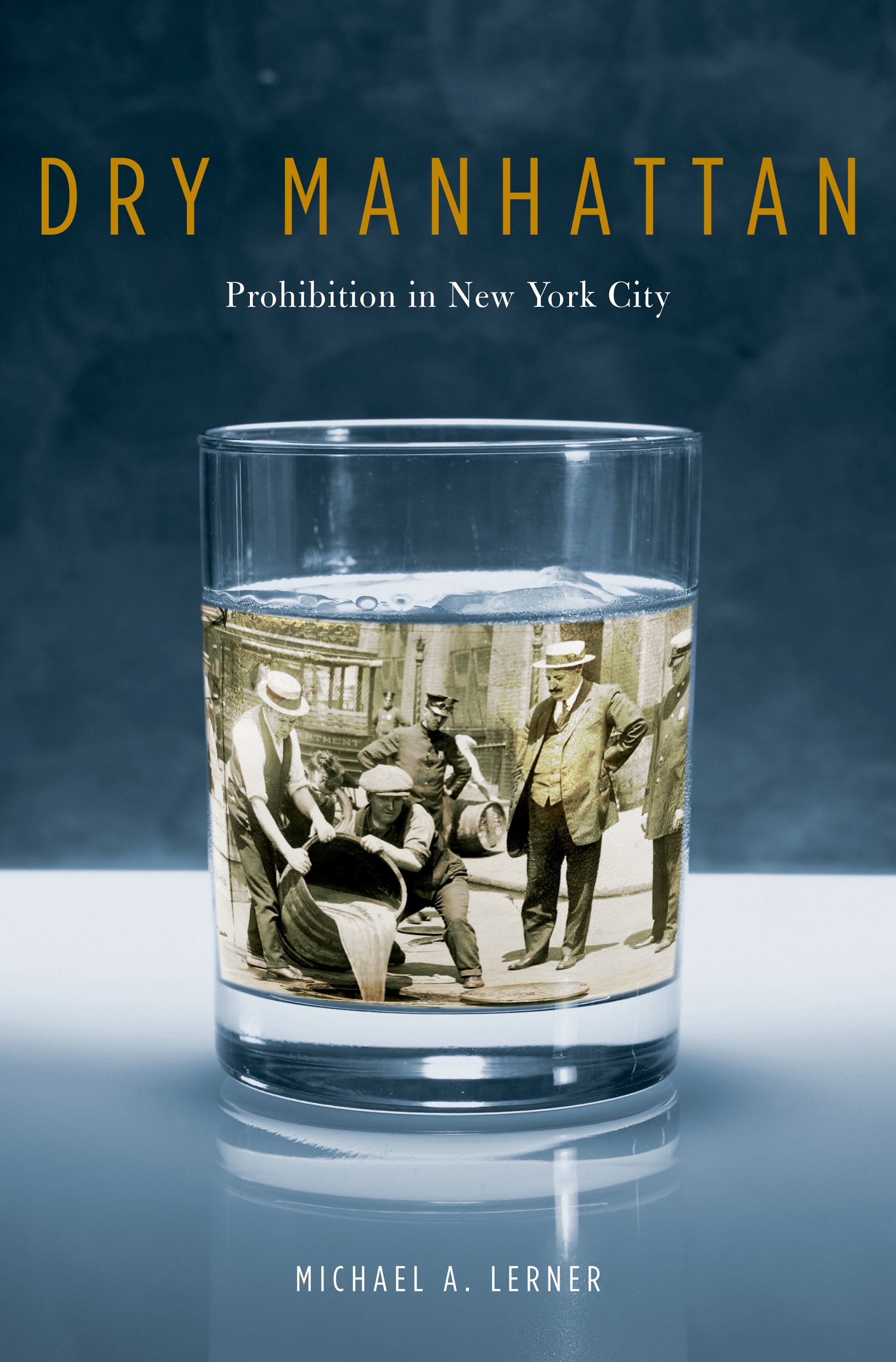
In 1919, the United States embarked on the country's boldest attempt at moral and social reform: Prohibition. The 18th Amendment to the Constitution prohibited the manufacture, transportation, and sale of alcohol around the country. This \"noble experiment,\" as President Hoover called it, was intended to usher in a healthier, more moral, and more efficient society. Nowhere was such reform needed more, proponents argued, than in New York City—and nowhere did Prohibition fail more spectacularly. Dry Manhattan is the first major work on Prohibition in nearly a quarter century, and the only full history of Prohibition in the era's most vibrant city.
Though New Yorkers were cautiously optimistic at first, Prohibition quickly degenerated into a deeply felt clash of cultures that utterly transformed life in the city. Impossible to enforce, the ban created vibrant new markets for illegal alcohol, spawned corruption and crime, fostered an exhilarating culture of speakeasies and nightclubs, and exposed the nation's deep prejudices. Writ large, the conflict over Prohibition, Michael Lerner demonstrates, was about much more than the freedom to drink. It was a battle between competing visions of the United States, pitting wets against drys, immigrants against old stock Americans, Catholics and Jews against Protestants, and proponents of personal liberty against advocates of societal reform.
In his evocative history, Lerner reveals Prohibition to be the defining issue of the era, the first major \"culture war\" of the twentieth century, and a harbinger of the social and moral debates that divide America even today.
eBook