
Catalogue Search | MBRL


Are you sure you want to remove the book from the shelf?

{{itemTitle}}
2,446
result(s) for
"Mann, Thomas"
Sort by:

The Doctor Faustus dossier : Arnold Schoenberg, Thomas Mann, and their contemporaries, 1930-1951
\"This complete edition of letters and documents between Arnold Schoenberg and Thomas Mann brings together two towering figures of twentieth-century music and literature, both of whom found refuge in Los Angeles during the Nazi era. Culminating in the famous dispute over Mann's novel Doctor Faustus, the correspondence, diary entries, and related articles provide a glimpse inside the private and public lives of these two great artists, the outstanding figures of the German-exile community in California. In the thicket of the controversy was Theodor Adorno, then a budding philosopher, whose contribution to the Faustus affair would make enemies of both families. Gathered here for the first time in English, the letters in this essential volume are complemented by rich primary source materials and an introduction by Germanic scholar Adrian Daub that contextualizes the impact the artists had on twentieth-century thought and culture\"--Provided by publisher.
BOOK

Overturning 'Dr. Faustus'
Thomas Mann's last major novel, 'Doktor Faustus', revolves around the transformation of traditional German culture into Hitler's fascist Germany, a process that intrigues and confounds thinking people still today. Mann has always been considered an exemplary and authoritative portrayer of German culture, and his opinion on the rise of fascism carries considerable weight. Unfortunately, the novel has always been interpreted as saying the opposite of what it does in fact say. Frances Lee provides a radically new interpretation by relating in a detailed manner to the text of Doktor Faustus the arguments expressed by Mann in his 'Observations of a Non-Political Man' -- a book of political essays published in 1918. This approach resolves many of the features that have been seen by critics as flaws or contradictions in the novel. Lee establishes what is actually happening in the novel in its historical setting, showing Mann's view of how the acceptance of fascism occurred and the determining role he attributed to the academic community in bringing about the disaster. Her book will be of interest to both amateur and professional students of Mann, particularly because it points to rich new directions for study. Frances Ann Ray Lee received the Ph.D. in German literature from the University of Toronto in 2005.
eBook


Thomas Mann’s Retreat from Irony in Politics
Thomas Mann developed one of the most subtle theories of irony during World War I, concluding that the best irony was irony against both sides of any issue. Such irony was not inconsistent with love for humanity, and even for both sides. He may well have been justified in using irony against both sides in that war. But with the rise of the Nazis, he abandoned two-sided irony and used his irony mostly against them. One the one hand, this meant a better political position, but on the other hand irony was almost absent from many of his wartime essays and declarations. That may have been justified in such a time of danger, but it meant less art and subtlety in his political writings.
Journal Article

The Cambridge introduction to Thomas Mann
\"Nobel Prize-winner Thomas Mann (1875-1955) is not only one of the leading German novelists of the twentieth century, but also one of the few to transcend national and language boundaries to achieve major stature in the English-speaking world. Famous from the time that he published his first novel in 1901, Mann became an iconic figure, seen as the living embodiment of German national culture. Leading scholar Todd Kontje provides a succinct introduction to Mann's life and work, discussing key moments in Mann's personal life and his career as a public intellectual, and giving readers a sense of why he is considered such an important - and controversial - writer. At the heart of the book is an informed appreciation of Mann's great literary achievements, including the novel The Magic Mountain and the haunting short story Death in Venice\"-- Provided by publisher.
BOOK
Zwischen Mythos und Moderne : Thomas Manns Josephs-Tetralogie
Die Josephs-Tetralogie steht – gewaltiger noch als Der Zauberberg – wie ein Zentralmassiv in der literarischen Landschaft des 20. Jahrhunderts, das viele nur ehrfurchtsvoll aus der Ferne bestaunen, was angesichts des Bildungs- und Unterhaltungswertes gerades dieses Erzählwerkes höchst bedauerlich ist. Diejenigen, die sich diesem Werk nähern und den Versuch unternehmen, die Bedeutungstiefe der von Thomas Mann aufgeschichteten Stoffmassen zu durchdringen, sind gut beraten, sich an die Selbstauskünfte des Autors zu halten: Er hat in Tagebüchern, Briefen und Reden die Sedimente der Fach- und Sachbücher zur antiken Welt, zur Ägyptologie und zur Religionsgeschichte freigelegt, die von ihm im Schreibprozess konsultiert worden waren, und immer wieder auf die zeitgeschichtlichen Bezüge seines Werkes verwiesen. Der vorliegende Band folgt diesen Spuren des Dichters in Beiträgen von Alexander Honold, Iulia-Karin Patrut, Matthias Bauer, Markus Pohlmeyer, Martina Schönbächler und Vikica Matić.
eBook


A Reader's Guide to Thomas Mann's Doctor Faustus
Provides the English-speaking reader with the tools needed to appreciate Thomas Mann's most ambitious novel, one of the greatest literary works of the twentieth century, now timely once again. In 1938, the great German author and Nobel Prize winner Thomas Mann emigrated to the United States. There, he became a figurehead for the intellectual opposition to Nazism, giving more than 150 public lectures and recording more than fifty anti-Nazi radio addresses that the BBC broadcast into Germany. His political activities also left a profound mark on his fiction, most importantly on the 1947 novel Doctor Faustus: The Life of the German Composer Adrian Leverkühn as Told by a Friend. Ostensibly the biography of a fictional modern composer, Doctor Faustus also serves as a post-mortem of Nazism and a reckoning with five centuries of cultural history that led to dazzling heights but failed to prevent Germany's ultimate fall. Doctor Faustus is an astonishingly complex novel, both because of the range of its intellectual references and because of its stylistic inventiveness, which has provoked comparisons with Joyce. And yet, at a time when democracy around the world once again seems in retreat and the forces of irrationalism are in advance, it is also an extremely timely book. This guide will equip English-speaking readers with all the tools necessary to appreciate one of the greatest literary works of the twentieth century. On publication this book is available as an Open Access ebook under the Creative Commons license CC BY-NC-ND.
eBook
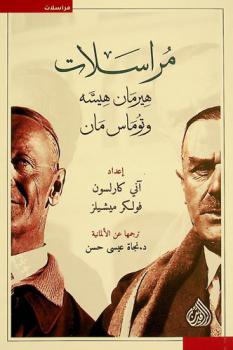
مراسلات هيرمان هيسه وتوماس مان
يضم هذا الكتاب مراسلات عملاقي الأدب الخالدين \"هيرمان هيسه\"، السويسري الألماني والأديب الألماني \"توماس مان\"، وكلاهما حاصل على جائزة نوبل. عبر هذه الرسائل نتعرف على أفكار الأديبين الكبيرين، قناعاتهما وتأملاتهما. وقد بدأت المراسلات بينهم بتاريخ الأول من إبريل لعام 1910 م. ويقع الكتاب في حوالي (414) صفحة من القطع الوسط من إصدار دار الرافدين للطباعة والنشر والتوزيع.
Book

The Cambridge Introduction to Thomas Mann
Nobel Prize-winner Thomas Mann (1875–1955) is not only one of the leading German novelists of the twentieth century, but also one of the few to transcend national and language boundaries to achieve major stature in the English-speaking world. Famous from the time that he published his first novel in 1901, Mann became an iconic figure, seen as the living embodiment of German national culture. Leading scholar Todd Kontje provides a succinct introduction to Mann's life and work, discussing key moments in Mann's personal life and his career as a public intellectual, and giving readers a sense of why he is considered such an important - and controversial - writer. At the heart of the book is an informed appreciation of Mann's great literary achievements, including the novel The Magic Mountain and the haunting short story Death in Venice.
eBook