
Catalogue Search | MBRL


Are you sure you want to remove the book from the shelf?

{{itemTitle}}
16
result(s) for
"Maori (New Zealand people) Origin."
Sort by:


Maori Origins and Migrations
Since Europeans first set foot in New Zealand they have speculated about where the Maori people came from, how they made their way to New Zealand and how they lived when they arrived here. Theories have abounded: some of them have hardened into accepted truth. The result has been an accumulation of Pakeha myths about Maori origins. The process of this mythmaking is the subject of Sorrenson's book: 'It is not an attempt to find an original or even a Pacific homeland for the Maori. I leave that task to the many others who are happily engaged on it.' But as a study of the development of ideas, this book is both fascinating and salutary.
eBook
Maori Origins and Migrations
Since Europeans first set foot in New Zealand they have speculated about where the MÄori people came from, how they made their way to New Zealand and how they lived when they arrived here.Theories have abounded: some of them have hardened into accepted truth.The result has been an accumulation of Pakeha myths about MÄori origins.
eBook

Archaeological science meets Māori knowledge to model pre-Columbian sweet potato (Ipomoea batatas) dispersal to Polynesia’s southernmost habitable margins
Most scholars of the subject consider that a pre-Columbian transpacific transfer accounts for the historical role of American sweet potato Ipomoea batatas as the kūmara staple of Indigenous New Zealand/Aotearoa Māori in cooler southwestern Polynesia. Archaeologists have recorded evidence of ancient Polynesian I . batatas cultivation from warmer parts of generally temperate-climate Aotearoa, while assuming that the archipelago’s traditional Murihiku region in southern South Island/Te Waipounamu was too cold to grow and store live Polynesian crops, including relatively hardy kūmara . However, archaeological pits in the form of seasonal Māori kūmara stores ( rua kūmara ) have been discovered unexpectedly at Pūrākaunui on eastern Murihuku’s Otago coast, over 200 km south of the current Polynesian limit of record for premodern I . batatas production. Secure pit deposits that incorporate starch granules with I . batatas characteristics are radiocarbon-dated within the decadal range 1430–1460 CE at 95% probability in a Bayesian age model, about 150 years after Polynesians first settled Te Waipounamu. These archaeological data become relevant to a body of Māori oral history accounts and traditional knowledge ( mātauranga ) concerning southern kūmara , incorporating names, memories, landscape features and seemingly enigmatic references to an ancient Murihiku crop presence. Selected components of this lore are interpreted through comparative exegesis for correlation with archaeological science results in testable models of change. In a transfer and adaptation model, crop stores if not seasonal production technologies also were introduced from a warmer, agricultural Aotearoa region into dune microclimates of 15th-century coastal Otago to mitigate megafaunal loss, and perhaps to support Polynesia’s southernmost residential chiefdom in its earliest phase. A crop loss model proposes that cooler seasonal temperatures of the post-1450 Little Ice Age and (or) political change constrained kūmara supply and storage options in Murihiku. The loss model allows for the disappearance of kūmara largely, but not entirely, as a traditional Otago crop presence in Māori social memory.
Journal Article
Evidence of a Strong Domestication Bottleneck in the Recently Cultivated New Zealand Endemic Root Crop, Arthropodium cirratum (Asparagaceae)
Uses chloroplast DNA sequencing to examine the extent of the domestication bottleneck and other genetic aspects of the pre-European Māori cultivation of an endemic NZ root crop, Arthropodium cirratum (rengarenga). Looks at the diversity at four chloroplast loci for A. cirratum in its natural and translocated range to address the chloroplast diversity and structuring in the natural populations of A. cirratum, how many times A. cirratum was independently brought into cultivation and how much genetic diversity has been retained in the translocated sites, where the locations of the initial source populations are, and what the relationships among translocated plants are and whether these reflect Māori settlement routes and mobility. Source: National Library of New Zealand Te Puna Matauranga o Aotearoa, licensed by the Department of Internal Affairs for re-use under the Creative Commons Attribution 3.0 New Zealand Licence.
Journal Article
The First New Zealanders? An Alternative Interpretation of Stable Isotope Data from Wairau Bar, New Zealand
Critiques an earlier article in which the authors propose that burial groups within the settlement phase site of Wairau Bar differ in terms of dietary stable isotopes and 87Sr/86Sr and argue that the difference is probably due to one group being a founding population while the other burials are later. Presents an alternative analysis and interpretation of the isotopic data by treating the isotope data independently from cultural and biological factors. Asserts that sex best explains dietary variation. Confirms the authors' original finding of high mobility of early New Zealanders but suggests a larger range of individuals should be considered 'non-local' on current evidence. Source: National Library of New Zealand Te Puna Matauranga o Aotearoa, licensed by the Department of Internal Affairs for re-use under the Creative Commons Attribution 3.0 New Zealand Licence.
Journal Article
Made in Taiwan
Two Polynesian broadcasters use their own DNA to retrace the path through the Pacific that their voyaging ancestors followed from Asia.
Streaming Video
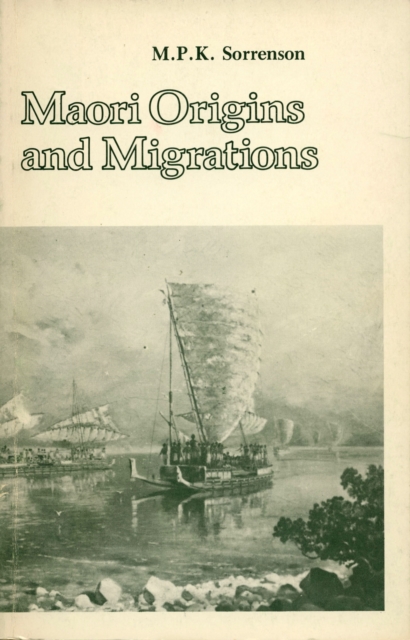
Maori Origins and Migrations
Since Europeans first set foot in New Zealand they have speculated about where the M?ori people came from, how they made their way to New Zealand and how they lived when they arrived here. Theories have abounded: some of them have hardened into accepted truth. The result has been an accumulation of Pakeha myths about M?ori origins. The process of this mythmaking is the subject of Sorrenson's book: 'It is not an attempt to find an original or even a Pacific homeland for the M?ori. I leave that task to the many others who are happily engaged on it.' But as a study of the development of ideas, this book is both fascinating and salutary.
eBook
Māori origins and migrations
Source: National Library of New Zealand Te Puna Matauranga o Aotearoa, licensed by the Department of Internal Affairs for re-use under the Creative Commons Attribution 3.0 New Zealand Licence.
Book