
Catalogue Search | MBRL


Are you sure you want to remove the book from the shelf?

{{itemTitle}}
606
result(s) for
"Mapuche"
Sort by:

Monuments, empires, and resistance : the Araucanian polity and ritual narratives
Both theoretically and empirically informed, this book provides an account of the only indigenous ethnic group to successfully resist outsiders for more than three centuries and to flourish under these conditions.
Book

Race and the Chilean Miracle
The economic reforms imposed by Augusto Pinochet's regime (1973-1990) are often credited with transforming Chile into a global economy and setting the stage for a peaceful transition to democracy, individual liberty, and the recognition of cultural diversity. The famed economist Milton Friedman would later describe the transition as the \"Miracle of Chile.\" Yet, as Patricia Richards reveals, beneath this veneer of progress lies a reality of social conflict and inequity that has been perpetuated by many of the same neoliberal programs.InRace and the Chilean Miracle,Richards examines conflicts between Mapuche indigenous people and state and private actors over natural resources, territorial claims, and collective rights in the Araucanía region. Through ground-level fieldwork, extensive interviews with local Mapuche and Chileans, and analysis of contemporary race and governance theory, Richards exposes the ways that local, regional, and transnational realities are shaped by systemic racism in the context of neoliberal multiculturalism..Richards demonstrates how state programs and policies run counter to Mapuche claims for autonomy and cultural recognition. The Mapuche, whose ancestral lands have been appropriated for timber and farming, have been branded as terrorists for their activism and sometimes-violent responses to state and private sector interventions. Through their interviews, many Mapuche cite the perpetuation of colonialism under the guise of development projects, multicultural policies, and assimilationist narratives. Many Chilean locals and political elites see the continued defiance of the Mapuche in their tenacious connection to the land, resistance to integration, and insistence on their rights as a people. These diametrically opposed worldviews form the basis of the racial dichotomy that continues to pervade Chilean society.In her study, Richards traces systemic racism that follows both a top-down path (global, state, and regional) as well as a bottom-up one (local agencies and actors), detailing their historic roots. Richards also describes potential positive outcomes in the form of intercultural coalitions or indigenous autonomy. Her compelling analysis offers new perspectives on indigenous rights, race, and neoliberal multiculturalism in Latin America and globally.
eBook


Becoming Mapuche
Magnus Course blends convincing historical analysis with sophisticated contemporary theory in this superb ethnography of the Mapuche people of southern Chile. Based on many years of ethnographic fieldwork, Becoming Mapuche takes readers to the indigenous reserves where many Mapuche have been forced to live since the beginning of the twentieth century. Exploring their way of life, the book situates the Mapuche within broader anthropological debates about indigenous peoples in South America._x000B__x000B_Comprising around 10 percent of the Chilean population, the Mapuche are one of the largest indigenous groups in the Americas. Despite increasing social and political marginalization, the Mapuche remain a distinct presence within Chilean society, giving rise to the burgeoning Mapuche political movement and holding on to their traditional language of Mapundungun, their religion, and their theory of self-creation. In addition to accounts of the intimacies of everyday kinship and friendship, Course also offers the first complete ethnographic analyses of the major social events of contemporary rural Mapuche life--eluwün funerals, the ritual sport of palin, and the great ngillatun fertility ritual. The volume includes a glossary of terms in Mapudungun.
eBook

Negotiating autonomy : Mapuche territorial demands and Chilean land policy
\"The 1980s and 1990s saw Latin American governments recognize the property rights of Indigenous and Afro-descendant communities as part of a broader territorial policy policy shift. But the resulting reforms were not applied consistently, more often extending neoliberal governance than recognizing Indigenous peoples' rights. In Negotiaing Autonomy, Kelly Bauer explores the inconsistencies by which the Chilean government transfers land in response to Mapuche territorial demands. Interviews with community and government leaders, statistical analysis of an original dataset of Mapuche mobilization and land transfers, and analysis of policy documents reveal that many assumptions about postdictatorship Chilean politics as technocratic and depoliticized do not apply to Indigenous policy. Rather, state officials often work to preserve the hegemony of political and economic elites in the region, effectively protecting existing market interests over efforts to extend the neoliberal project to the governance of Mapuche territorial demands. In addition to complicating understandings of Chilean governance, these hidden patterns of policy implementation reveal the numerous ways these governance strategies threaten the recognition of Indigenous rights and create limited space for communities to negotiate autonomy.\" -- From the book jacket.
BOOK
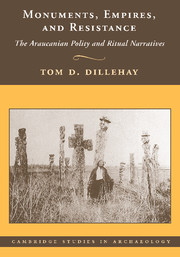
Monuments, Empires, and Resistance
From AD 1550 to 1850, the Araucanian polity in southern Chile was a center of political resistance to the intruding Spanish empire. In this 2007 book, Tom D. Dillehay examines the resistance strategies of the Araucanians and how they used mound building and other sacred monuments to reorganize their political and culture life in order to unite against the Spanish. Drawing on anthropological research conducted over three decades, Dillehay focuses on the development of leadership, shamanism, ritual, and power relations. His study combines developments in social theory with the archaeological, ethnographic, and historical records. Both theoretically and empirically informed, this book is a fascinating account of the only indigenous ethnic group to successfully resist outsiders for more than three centuries and to flourish under these conditions.
eBook

Shamans of the foye tree : gender, power, and healing among Chilean Mapuche
Drawing on anthropologist Ana Mariella Bacigalupo's fifteen years of field research, Shamans of the Foye Tree: Gender, Power, and Healing among Chilean Mapuche is the first study to follow shamans' gender identities and performance in a variety of ritual, social, sexual, and political contexts. To Mapuche shamans, or machi, the foye tree is of special importance, not only for its medicinal qualities but also because of its hermaphroditic flowers, which reflect the gender-shifting components of machi healing practices. Framed by the cultural constructions of gender and identity, Bacigalupo's fascinating findings span the ways in which the Chilean state stigmatizes the machi as witches and sexual deviants; how shamans use paradoxical discourses about gender to legitimatize themselves as healers and, at the same time, as modern men and women; the tree's political use as a symbol of resistance to national ideologies; and other components of these rich traditions. The first comprehensive study on Mapuche shamans' gendered practices, Shamans of the Foye Tree offers new perspectives on this crucial intersection of spiritual, social, and political power.
eBook

This Incurable Evil
Documents how initial Mapuche-Spanish alliances were
built and how they were destroyed by increasingly powerful
slave-trading elites operating like organized crime
families The history of Spanish presence in the Americas
is usually viewed as a one-sided conquest. In
This Incurable Evil: Mapuche Resistance to Spanish
Enslavement, 1598–1687 , Eugene C. Berger provides a
major corrective in the case of Chile. For example, in the south,
indigenous populations were persistent in their resistance
against Spanish settlement. By the end of the sixteenth century,
Spanish aspirations to conquer the entire Pacific Coast were
dashed at least twice by armed resistance from the Mapuche
peoples. By 1600, the Mapuche had killed two Spanish governors
and occupied more than a dozen Spanish towns. Chile’s
colonial future was quite uncertain. As Berger documents, for
much of the seventeenth century it seemed that there could be
peace along the Spanish-Mapuche frontier. Through trade,
intermarriage, and even mutual distrust of Dutch and English
pirates, the Mapuche and the Spanish began to construct a
colonial entente. However, this growing alliance was obliterated
by the “incurable evil,” an ever-expanding
enslavement of Mapuches, and one which prompted a new generation
of Mapuche resistance. This trade saw Mapuche rivals, neutrals,
and even friends placed in irons and forced to board ships in
Valdivia and Concepción or to march northward along the
Andes. The Mapuche labored in the gold mines of La Serena, in
urban workshops in Lima, in the silver mines of Potosí, or
on the thousands of haciendas in between and would never return
to their homes. With this tragic betrayal, Chile was left a more
corrupt, violent, and polarized place, which would cause deep
wounds for centuries.
eBook

The Mapuche in Modern Chile
The Mapuche are the most numerous, most vocal and most politically involved indigenous people in modern Chile. Their ongoing struggles against oppression have led to increasing national and international visibility, but few books provide deep historical perspective on their engagement with contemporary political developments.
Building on widespread scholarly debates about identity, history and memory, Joanna Crow traces the complex, dynamic relationship between the Mapuche and the Chilean state from the military occupation of Mapuche territory during the second half of the nineteenth century through to the present day. She maps out key shifts in this relationship as well as the intriguing continuities.
Presenting the Mapuche as more than mere victims, this book seeks to better understand the lived experiences of Mapuche people in all their diversity. Drawing upon a wide range of primary documents, including published literary and academic texts, Mapuche testimonies, art and music, newspapers, and parliamentary debates, Crow gives voice to political activists from both the left and the right. She also highlights the growing urban Mapuche population.
Crow's focus on cultural and intellectual production allows her to lead the reader far beyond the standard narrative of repression and resistance, revealing just how contested Mapuche and Chilean histories are. This ambitious and revisionist work provides fresh information and perspectives that will change how we view indigenous-state relations in Chile.
eBook

“¿Cuáles son los espacios que se deben abrir?”: Escenarios de comunicación entre pacientes mapuche y áreas biomédicas en la Patagonia norte
This work analyzes the tensions that arise when individuals from the Mapuche Tehuelche people, located in northern Patagonia, Argentina, navigate through biomedical spaces where indigenous belongings, concepts, knowledge, and practices of Mapuche medicine and biomedicine come into play. These itineraries unveil situations of inequality, racism, discrimination, and epistemological and ontological tensions when Mapuche medicine is questioned or silenced by biomedicine. For years, Mapuche Tehuelche organizations, communities, and members have been undertaking collective actions to defend and demand that the State recognize lawen (Mapuche medicine) in health-disease care processes. For this work, I focus on some experiences that occurred during 2022 in the town of San Carlos de Bariloche (Río Negro, Argentina), where I observed certain recurring tensions among those navigating diverse paths in Mapuche medicine and in spaces such as hospitals or primary health care centers. This article is part of a broader anthropological research in which I use a qualitative methodology with an ethnographic and narrative approach based on in-depth interviews, participant observations, and informal conversations conducted with activists, women from Mapuche communities, and health professionals who identify themselves as part of the network of relationships around health. Focusing on these stories and experiences, this study concludes that the lawen has not yet found a receptive audience in certain biomedical spaces based on the frameworks it proposes. The commitment is to continue reflecting on future challenges to co-produce knowledge and health spaces with critical reflection that values the demands of the Mapuche Tehuelche people. El siguiente trabajo analiza las tensiones que emergen cuando personas del pueblo mapuche tehuelche, ubicado en la Patagonia norte de Argentina, circulan por espacios biomédicos en los que se ponen en juego pertenencias indígenas, concepciones, conocimientos y prácticas de la medicina mapuche y la biomedicina. En estos itinerarios se evidencian situaciones de desigualdad, racismo, discriminación y tensiones epistemológicas y ontológicas cuando la medicina mapuche es puesta bajo sospecha o silenciada desde la biomedicina. Desde hace años, organizaciones, comunidades e integrantes mapuche tehuelche vienen llevando a cabo acciones colectivas para defender y exigir al Estado el reconocimiento del lawen (medicina mapuche) en los procesos de atención a la salud-enfermedad y cuidados. Para este trabajo me centro en algunas experiencias ocurridas durante 2022 en la localidad de San Carlos de Bariloche (Río Negro, Argentina), en las que observé ciertas tensiones recurrentes entre quienes transitan itinerarios abigarrados en la medicina mapuche y en espacios como hospitales o centros de atención primaria de la salud. Este artículo es parte de una investigación antropológica más amplia, en la que utilizo una metodología cualitativa con un enfoque etnográfico y narrativo basado en entrevistas en profundidad, observaciones participantes y conversaciones informales, realizadas a algunos militantes y mujeres de comunidades mapuche y profesionales de la salud que se reconocen como pertenecientes a la red de relaciones en salud. Al centrarme en estos relatos y experiencias, este trabajo concluye que aun el lawen no ha podido ser escuchado en determinados espacios biomédicos desde los encuadres que propone. La apuesta es continuar reflexionando sobre los desafíos a futuro para coproducir conocimientos y espacios de salud con reflexión crítica, que pongan en valor los reclamos del pueblo mapuche tehuelche. Neste artigo, são analisadas as tensões que emergem quando pessoas do povo Mapuche Tehuelche, localizado no norte da Patagônia Argentina, circulam por espaços biomédicos nos quais estão em jogo pertencimentos indígenas, concepções, conhecimentos e práticas da medicina Mapuche e da biomedicina. Esses itinerários revelam situações de desigualdade, racismo, discriminação e tensões epistemológicas e ontológicas quando a medicina Mapuche é colocada sob suspeita ou silenciada pela biomedicina. Há anos, organizações, comunidades e membros Mapuche Tehuelche vêm realizando ações coletivas para defender e exigir do Estado o reconhecimento do lawen (medicina Mapuche) nos processos de saúde, doença e cuidados. Para este artigo, concentro-me em algumas experiências ocorridas em 2022 na cidade de San Carlos de Bariloche (Rio Negro, Argentina), nas quais observei certas tensões recorrentes entre aqueles que percorrem itinerários variados na medicina Mapuche e em espaços como hospitais ou centros de atenção primária à saúde. Este artigo é parte de uma pesquisa antropológica mais ampla, na qual utilizo uma metodologia qualitativa com uma abordagem etnográfica e narrativa baseada em entrevistas em profundidade, observações participantes e conversas informais com alguns ativistas e mulheres das comunidades Mapuche, bem como profissionais de saúde que se reconhecem como pertencentes à rede de relações em saúde. Ao enfocar esses relatos e experiências, este artigo conclui que nem mesmo o lawen foi ouvido em determinados espaços biomédicos a partir das estruturas que propõe. O desafio é continuar refletindo sobre os desafios futuros, a fim de coproduzir conhecimentos e espaços de saúde com uma reflexão crítica que valorize as reivindicações do povo Mapuche Tehuelche.
Journal Article