
Catalogue Search | MBRL


Are you sure you want to remove the book from the shelf?

{{itemTitle}}
262
result(s) for
"Marcel, Gabriel"
Sort by:

Courageous Vulnerability
This work develops the ethical attitude of courageous vulnerability through the integration of the phenomenon of involuntary memory in Marcel Proust's work and a variety of closely related themes taken from the philosophies of Henri Bergson, William James, and Gabriel Marcel.
eBook

Aspects of Alterity
Every other is truly other, but no other is wholly other.This is the claim that Aspects of Alterity defends. Taking up the question of otherness that so fascinates contemporary continental philosophy, this book asks what it means for something or someone to be other than the self. Levinas and those influenced by him point out that the philosophical tradition of the West has generally favored the self at the expense of the other. Such a self-centered perspective never encounters the other qua other, however. In response, postmodern thought insists on the absolute otherness of the other, epitomized by the deconstructive claim every other is wholly other.But absolute otherness generates problems and aporias of its own. This has led some thinkers to reevaluate the notion of relative otherness in light of the postmodern critique, arguing for a chiastic account that does justice to both the alterity and the similitude of the other. These latter two positions-absolute otherness and a rehabilitated account of relative otherness-are the main contenders in the contemporary debate.The philosophies of Emmanuel Levinas and Gabriel Marcel provide the point of embarkation for coming to understand the two positions on this question. Levinas and Marcel were contemporaries whose philosophies exhibit remarkably similar concern for the other but nevertheless remain fundamentally incompatible. Thus, these two thinkers provide a striking illustration of both the proximity of and the unbridgeable gap between two accounts of otherness.Aspects of Alterity delves into this debate, first in order understand the issues at stake in these two positions and second to determine which description better accounts for the experience of encountering the other.After a thorough assessment and critique of otherness in Levinas's and Marcel's work, including a discussion of the relationship of ethical alterity to theological assumptions, Aspects of Alterity traces the transmission and development of these two conceptions of otherness. Levinas's version of otherness can be seen in the work of Jacques Derrida and John D. Caputo, while Marcel's understanding of otherness influences the work of Paul Ricoeur and Richard Kearney.Ultimately, Aspects of Alterity makes a case for a hermeneutic account of otherness. Otherness itself is not absolute, but is a chiasm of alterity and similitude. Properly articulated, such an account is capable of addressing the legitimate ethical and epistemological concerns that lead thinkers to construe otherness in absolute terms, but without the absolute aporiasthat accompany such a characterization.
eBook

Jean Wahl’s unassailable heritage
Despite his unassailable heritage, the passionate thinker to whom Levinas dedicated Totalité et infini has today nearly been forgotten outside France. This forgetting is the shared premise of two books published in recent years. The first is William C. Hackett and Jeffrey Hanson’s edition and translation of Wahl’s Existence humaine et transcendance (1944): Human Existence and Transcendence (Notre Dame, IN: University of Notre Dame Press, 2016, pp. 151), and the second is a volume of selections from Wahl’s philosophical writings edited by Alan D. Schrift and Ian Alexander Moore: Jean Wahl: Transcendence and the Concrete Selected Writings (New York: Fordham University Press, Perspectives in Continental Philosophy, 2017, pp. 291).
Journal Article

Hope, Dying and Solidarity
Hope takes on a particularly important role in end of life situations. Sustaining hope can have considerable benefits for the quality of life and any prospect of a good death for the dying. However, it has proved difficult to adequately account for hope when dying, particularly in some of the more extreme end of life situations. Standard secular accounts of hope struggle to establish how the fostering of hope may be possible in such situations. This leads to a practical ethical dilemma for those caring for the dying, the 'paradox of hope', whereby one can either help maintain the welfare of the dying by generating a misleading 'false hope' or maintain truthfulness and concede that hope is not possible. These two problems combine to leave individuals the prospect of dying in terrible circumstances facing only despair. To address this, I argue that we should look beyond standard intentional or dispositional accounts of hope in such cases and treat hope as a cluster concept. Rather than appeal to a unitary conception, what we precisely mean by 'hope' may therefore vary depending on the context of use. I outline an account of hope based on Marcel's account of 'absolute' hope but offering an alternative, secular foundation based on solidarity that can explain how hope when dying in extreme circumstances is possible. Hence, where the more familiar accounts break-down in these circumstances, 'hope talk' may still be possible if it is seen as relying on this conception of hope.
Journal Article
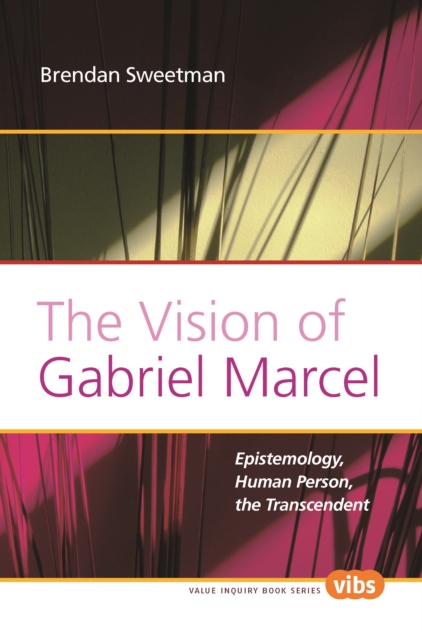
The Vision of Gabriel Marcel
This book illustrates the profound implications of Gabriel Marcel's unique existentialist approach to epistemology not only for traditional themes in his work concerning ethics and the transcendent, but also for epistemological issues, concerning the objectivity of knowledge, the problem of skepticism, and the nature of non-conceptual knowledge, among others. There are also chapters of dialogue with philosophers, Jacques Maritain and Martin Buber. In focusing on these themes, the book makes a distinctive contribution to the literature on Marcel.
eBook
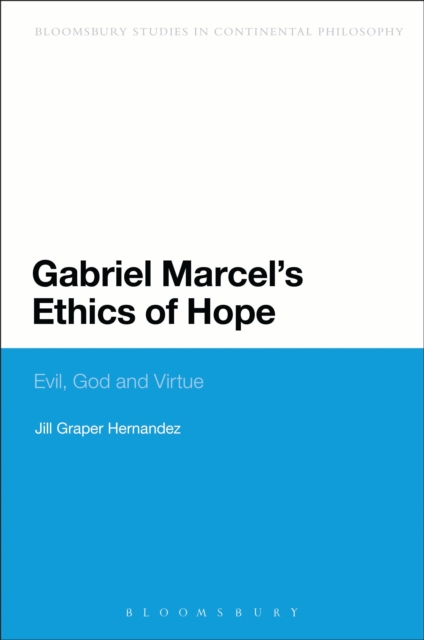
Gabriel Marcel's Ethics of Hope
The idea of 'hope' has received significant attention in the political sphere recently. But is hope just wishful thinking, or can it be something more than a political catch-phrase? This book argues that hope can be understood existentially, or on the basis of what it means to be human. Under this conception of hope, given to us by Gabriel Marcel, hope is not optimism, but the creation of ways for us to flourish. War, poverty and an absolute reliance on technology are real-life evils that can suffocate hope. Marcel's thought provides a way to overcome these negative experiences. An ethics of hope can function as an alternative to isolation, dread, and anguish offered by most existentialists. This book presents Marcel's existentialism as a convincing, relevant moral theory; founded on the creation of hope, interwoven with the individual's response to the death of God. Jill Hernandez argues that today's reader of Marcel can resonate with his belief that the experience of pain can be transcended through a philosophy of hope and an escape from materialism.
eBook

On Educating While Hoping for the Impossible: Gabriel Marcel’s Absolute Hope as a Rejection of Educational Instrumentalism
Over the last 20 years, there has been an increase in philosophical inquiries of hope both in philosophy of mind and of virtue as well as in the philosophy of education. This paper wishes to add to this discussion by presenting the analysis of hope by French existentialist philosopher and theologian Gabriel Marcel and examining its possible contribution to educational practices and beliefs. As one of the very few modern, systematic accounts of hope, Marcel’s provocative conception of it and his critique of its common “technical” use could prove promising when applied to educational theory and practice. Following Marcel, I argue that in hope we find a complex and possibly contradictory view of the future: as a result of planning and technical problem-solving on one hand, and on the other, as an inclination towards the mysterious and radically unexpected. I suggest that maintaining educational hope within the tension between the planned and the unexpected, and specifically rejecting a complete disenchantment of the educational act, could help in securing education from being reduced to instrumental training and socializing, opening it up to new and unimaginable possibilities.
Journal Article

Atheism, religion, and philosophical “availability” in Gabriel Marcel
The dramatic change in the focus and overall project of French philosophy since World War I has become increasingly apparent, with one of the resultant developments being, as Geroulanos (An atheism that is not humanist emerges in French thought, 2010) has identified, the emergence of “an atheism that is not humanist.” This article discusses parallels between the philosophical methodology of Gabriel Marcel (1889–1973) and this new form of atheism. In so doing, it explores connections between Marcel and French philosophy’s more recent “(re)turn to religion,” and uses these to demonstrate how Marcel’s notion of disponibilité or “availability” operates with respect to Marcel’s conception of philosophy itself.
Journal Article

In Search of the Spiritual
Gabriel Marcel (1889-1973), the first French existentialist and phenomenologist, was a world-class Catholic philosopher, an accomplished playwright, drama critic and musician. He wrote brilliantly about many of the classic existential themes associated with Sartre, Heidegger, Jaspers and Buber, prior to the publication of their main works. As a self-described \"philosopher of the threshold\" and \"an awakener,\" his stated goal was to shed some light on the nature of spiritual reality, those moments when one experiences an upsurge of the love of life. In this book, Paul Marcus joins the best of Marcellian and psychoanalytic insights to help the reader develop an inner sensibility that is more receptive, responsive and responsible to the transforming sacred presences that grace everyday life, such as are experienced in selfless love, hoping beyond hope, and maintaining faith in the goodness of the world despite its harsh challenges.
eBook
