
Catalogue Search | MBRL


Are you sure you want to remove the book from the shelf?

{{itemTitle}}
631
result(s) for
"Marginality, Social Developing countries."
Sort by:

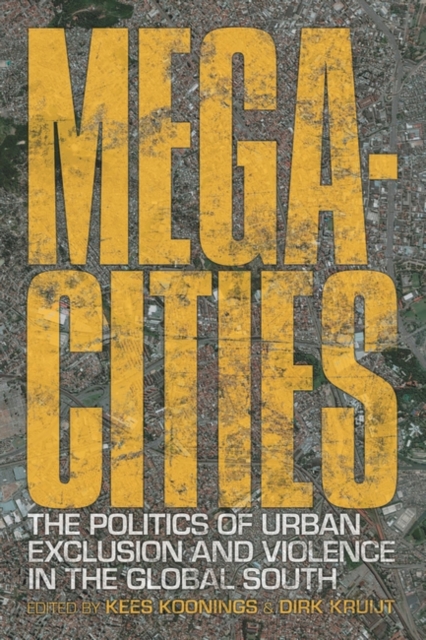
Megacities
For the first time in history, the majority of the world's population lives in cities, the result of a rapid process of urbanization that started in the second half of the twentieth century. 'Megacities' around the world are rapidly becoming the scene for deprivation, especially in the global South, and the urban excluded face the brunt of what in many cases seems like low-intensity warfare. Featuring case studies from across the globe, including Latin America, the Middle East and Africa, Megacities examines recent worldwide trends in poverty and social exclusion, urban violence and politics, and links these to the challenges faced by policy-makers and practitioners.
eBook

Mediated citizenship : the informal politics of speaking for citizens in the global south
\"This book sets out to answer what appears to be a deceptively simple question: how do poor and marginalized citizens engage the state in the global South? Drawing on twelve case studies from the global South, this book explore the politics of 'mediated citizenship' in which citizens are represented to the state through third party intermediaries who 'speak for' the people they represent. These intermediaries include political parties, non-governmental organisations, community-based organisations, social movements, armed non-state actors, networks or individuals. Collectively the cases show that mediation is both widely practiced and multi-directional in relations between states and key groups of citizens in the global South. Furthermore, they show how mediated forms of representation may have an important role to play in deepening democracy in the global South\"-- Provided by publisher.
Book
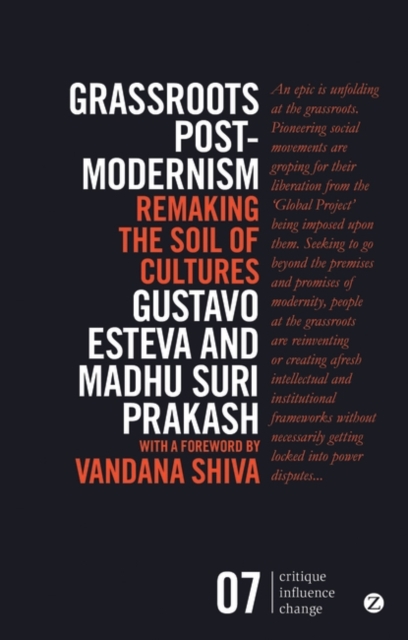
Grassroots post-modernism: remaking the soil of cultures
With the publication of this remarkable book in 1998, Gustavo Esteva and Madhu Suri Prakash instigated a complete epistemological rupture. Grassroots Post-modernism attacks the three sacred cows of modernity: global thinking, the universality of human rights and the self-sufficient individual. Rejecting the constructs of development in all its forms, Esteva and Prakash argue that even alternative development prescriptions deprive the people of control over their own lives, shifting this control to bureaucrats, technocrats and educators. Rather than presuming that human progress fits a predetermined mould, leading towards an increasing homogenization of cultures and lifestyles, the authors argue for a 'radical pluralism' that honours and nurtures distinctive cultural variety and enables many paths to the realization of self-defined aspirations. This classic text is essential reading for those looking beyond neoliberalism, the global project and the individual self.
eBook

Mixed methods research in poverty and vulnerability : sharing ideas and learning lessons
\"The added value of mixed methods research in poverty and vulnerability is now widely recognized. However, despite the expanding volume of literature on the use of mixed methods, gaps and challenges still remain. This edited volume focuses on issues of credibility, usability and complexity, considering how mixed methods approaches can better respond to these issues so as to make research more credible, usable and responsive to complexity. The contributors share experiences and lessons learned from research in developed and developing country contexts in respect of mixed methods in poverty measurement, evaluation research and the translation from research to policy\"-- Provided by publisher.
Book
Does financial inclusion reduce poverty and income inequality in developing countries? A panel data analysis
Financial inclusion is a key element of social inclusion, particularly useful in combating poverty and income inequality by opening blocked advancement opportunities for disadvantaged segments of the population. This study intends to investigate the impact of financial inclusion on reducing poverty and income inequality, and the determinants and conditional effects thereof in 116 developing countries. The analysis is carried out using an unbalanced annual panel data for the period of 2004–2016. For this purpose, we construct a novel index of financial inclusion using a broad set of financial sector outreach indicators, finding that per capita income, ratio of internet users, age dependency ratio, inflation, and income inequality significantly influence the level of financial inclusion in developing countries. Furthermore, the results provide robust evidence that financial inclusion significantly reduces poverty rates and income inequality in developing countries. The findings are in favor of further promoting access to and usage of formal financial services by marginalized segments of the population in order to maximize society’s overall welfare.
Journal Article

Urban marginality: Everyday practice of building resilience to flood in the informal Settlement of Dar es Salaam
Over decades now, urban scholars have highlighted the limitations of floods control measures in facilitating resilience especially in the cities of the global South. In response, studies have researched about how urbanites draw civic engagement, social power, cooperations, collective savings to minimize vulnerability to hazards in cities of the global South. Moreover, the place of mundane practices of marginalized urbanites in the resilience building processes remains understudied. Motivated by the potentials of ordinary practices, we contribute to debates on urban resilience, urban marginality and bottom-up initiatives of urbanites by introducing the everyday practice lens into disaster and risk studies as an alternative way of theorizing urban disaster. Together, we explore the day-to-day acts of marginalized residents in building resilience to flood hazards, by unpacking how residents develop adaptive capacity to flood hazards; recover; and build redundancy of the community sub-systems in the events of floods. We show how the act of building social cohesion and relations in the event of flood works to improve the adaptive capacity of marginalized residents, enable some level of recovery and redundancy of the community sub-systems. The findings suggest that while ordinary social relations and networks may exist loosely among marginalized urban residents in the absence of hazards or disasters, they become constricted bonds that exert influence to foster preliminary recovery from flood hazards. We argue that analyzing ordinary social networks including the (in)visible acts of marginalized urbanites can further understanding about how resilient is built in everyday life in the informal settlements. This paper recommends further studies to pay attention to social differentiations among marginalized groups in fostering resilience to flood hazards and disasters.
Journal Article

The Precariat: a view from the South
The term 'precariat'-a precarious proletariat-has achieved considerable prominence in recent years and is probably now ripe for critical deconstruction. It also needs to be situated in terms of a genealogy that includes the marginality debates of the 1960s, the later informal sector problematic and the 'social exclusion' optic that became dominant in the 1980s. I will argue that the concept is highly questionable both as an adequate sociology of work in the North and insofar as it elides the experience of the South in an openly Eurocentric manner. In terms of political discourse I think we should avoid the language of 'dangerous class', as deployed by Guy Standing to situate workers politically in the policy world as though frightening the ruling classes was a strategy for transformation.
Journal Article
Disability and Poverty: the need for a more nuanced understanding of implications for development policy and practice
The international development community is beginning to recognise that people with disabilities constitute among the poorest and most vulnerable of all groups, and thus must be a core issue in development policies and programmes. Yet the relationship between disability and poverty remains ill-defined and under-researched, with few studies providing robust and verifiable data that examine the intricacies of this relationship. A second, linked issue is the need for-and current lack of-criteria to assess whether and how disability-specific and disability 'mainstreamed' or 'inclusive' programmes work in combating the exclusion, marginalisation and poverty of people with disabilities. This article reviews existing knowledge and theory regarding the disability-poverty nexus. Using both established theoretical constructs and field-based data, it attempts to identify what knowledge gaps exist and need to be addressed with future research.
Journal Article

Policies for Sustainable Agriculture and Livelihood in Marginal Lands: A Review
Despite the substantial improvements in agricultural productivity owing to technological progress, the poor in agriculturally marginal areas are overlooked and left behind. Nearly a billion people still live in poverty, the majority of whom happen to be in developing countries, with a larger share of those who are poor living on marginal lands. Food insecurity is a vicious reality in the everyday lives of these marginalized poor, and the threat of food insecurity and hunger is becoming even more serious and imminent, with increasing trends in population growth. Climate change is expected to add yet more weight to this equation and to pose greater risks for the livelihoods of these communities. In spite of the challenges faced, addressing marginal agriculture systems and poverty is vital to achieving the Sustainable Development Goals (SDGs). In this paper, we investigate the historical policy perspective towards marginal areas to pinpoint potential shortcomings in the policy environment. Subsequently, we present a roadmap to future research engagement and develop a policy framework, with instruments and strategies focusing on the food–poverty–environment nexus, to target poverty reduction, preserve biodiversity, and restore marginal lands. Our analysis of historical policies reveals that conventional policy approaches towards marginal agriculture have been conducive to favorable areas (specific to input-responsive crops only), neglecting marginal areas. Future policies to address the food–poverty–environment nexus within marginal environments must evolve around a framework that is all-inclusive but context-specific. Agricultural and other public investments should be prioritized geographically in accordance with the characteristics of marginality hotspots. Policy instruments should encourage long-term solutions to enhance productivity through regenerative production systems and preserve the environmental resource base.
Journal Article