
Catalogue Search | MBRL


Are you sure you want to remove the book from the shelf?

{{itemTitle}}
15,705
result(s) for
"Marketing ethics"
Sort by:

New insights on trust in business-to-business relationships : a multi-perspective approach
New Insights on Trust in Business-to-Business Relationships provides readers with advanced original insights on trust antecedents, processes and consequences within the B2B marketing context and offers practical tools alongside suggestions for future research.
Book

Direct-to-Consumer Genetic Testing and Its Marketing: Emergent Ethical and Public Policy Implications
This paper provides a marketing ethics analysis that addresses the practice of selling genetic tests (GT) directly to the consumer (DTC). It details the complexity of this emergent sector by articulating the panoply of evolving ethical/social questions raised by this development. It advances the conversation about DTC genetic testing by reviewing the business and healthcare literature concerning this topic and by laying out the inherent ethical complications for consumers, marketers, and regulators. It also points to several possible public and company policy adjustments. Because this area is relatively new and incredibly dynamic, its current discussion is necessarily an exercise in the \"logic of discovery\" rather than the \"protocol of validation\". The paper serves as a primer for the types of GT being promoted. It also calls for a public discourse in the academic and general community to uncover and define the ethical guidelines and systemic adjustments necessary to create fairness in the various DTC transactions occurring between genetic test sellers and the buyers/clients of their services.
Journal Article
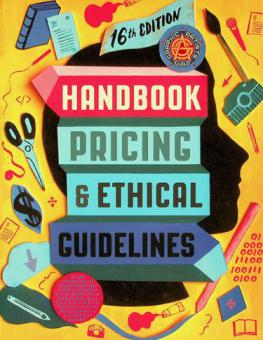
Graphic Artists Guild handbook : pricing & ethical guidelines
Graphic Artists Guild Handbook is the industry bible for communication design and illustration professionals. A comprehensive reference guide, the Handbook helps graphic artists navigate the world of pricing, collecting payment, and protecting their creative work, with essential advice for growing a freelance business to create a sustainable and rewarding livelihood. This sixteenth edition provides excellent, up-to-date guidance, incorporating new information, listings, and pricing guidelines. It offers graphic artists practical tips on how to negotiate the best deals, price their services accurately, and create contracts that protect their rights. Sample contracts and other documents are included.
Book

Sustainable fashion: current and future research directions
Purpose
The sustainable fashion (SF) literature is fragmented across the management discipline, leaving the path to a SF future unclear. As of yet, there has not been an attempt to bring these insights together or to more generally explore the question of “what is known about SF in the management literature and where could the SF field go from there?”. The purpose of this paper is to bring together the field to identify opportunities for societal impact and further research.
Design/methodology/approach
A systematic literature review was conducted from the first appearances of SF in the management literature in 2000 up to papers published in June 2019, which resulted in 465 included papers.
Findings
The results illustrate that SF research is largely defined by two approaches, namely, pragmatic change and radical change. The findings reveal seven research streams that span across the discipline to explore how organisational and consumer habits can be shaped for the future.
Research limitations/implications
What is known about SF is constantly evolving, therefore, the paper aims to provide a representative sample of the state of SF in management literature to date.
Practical implications
This review provides decision makers with insights that have been synthesised from across the management field.
Originality/value
This review identifies knowledge gaps and informs managerial decision making in the field, particularly through serving as a foundation for further research.
Journal Article

Exposing and addressing tobacco industry conduct in low-income and middle-income countries
The tobacco industry's future depends on increasing tobacco use in low-income and middle-income countries (LMICs), which face a growing burden of tobacco-related disease, yet have potential to prevent full-scale escalation of this epidemic. To drive up sales the industry markets its products heavily, deliberately targeting non-smokers and keeps prices low until smoking and local economies are sufficiently established to drive prices and profits up. The industry systematically flaunts existing tobacco control legislation and works aggressively to prevent future policies using its resource advantage to present highly misleading economic arguments, rebrand political activities as corporate social responsibility, and establish and use third parties to make its arguments more palatable. Increasingly it is using domestic litigation and international arbitration to bully LMICs from implementing effective policies and hijacking the problem of tobacco smuggling for policy gain, attempting to put itself in control of an illegal trade in which there is overwhelming historical evidence of its complicity. Progress will not be realised until tobacco industry interference is actively addressed as outlined in Article 5.3 of the Framework Convention on Tobacco Control. Exemplar LMICs show this action can be achieved and indicate that exposing tobacco industry misconduct is an essential first step.
Journal Article
The Role of Ethical Perceptions in Consumers’ Participation and Value Co-creation on Sharing Economy Platforms
Consumers’ participation on sharing economy platforms is crucial for the success of the products, services, and companies on those platforms. The participation of consumers enables companies to not only exist, but also to create value for consumers. The sharing economy has witnessed enormous growth in recent years and consumers’ concerns regarding the ethics surrounding these platforms have also risen considerably. The vast majority of the previous research on this topic is either conceptual and focused on organizational aspects, or only discusses privacy and security issues, thus providing a very limited scope of discussion. Therefore, drawing on the marketing and business ethics literature, the present study takes into account a multidimensional view of ethical issues surrounding consumers’ participation on sharing economy platforms. Findings reveal that privacy, security, shared value, fulfillment/reliability and service recovery are the strongest determinants of consumers’ ethical perceptions. These aspects strongly predict the consumers’ value co-creation intentions. Consumers’ participation also predicts their intention to engage in co-creating value, but this effect is stronger with the mediating role of the consumer’s ethical perceptions. The theoretical and managerial implications are also discussed.
Journal Article
Do Consumers Care About Ethical-Luxury?
This article explores the extent to which consumers consider ethics in luxury goods consumption. In particular, it explores whether there is a significant difference between consumers' propensity to consider ethics in luxury versus commodity purchase and whether consumers are ready to purchase ethical-luxury. Prior research in ethical consumption focuses on low value, commoditized product categories such as food, cosmetics and high street apparel. It is debatable if consumers follow similar ethical consumption patterns in luxury purchases. Findings indicate that consumers' propensity to consider ethics is significantly lower in luxury purchases when compared to commoditized purchases and explores some of the potential reasons for this reduced propensity to identify or act upon ethical issues in luxury consumption.
Journal Article

Pharmaceutical marketing strategies’ influence on physicians' prescribing pattern in Lebanon: ethics, gifts, and samples
Background
Drug companies rely on their marketing activities to influence physicians. Previous studies showed that pharmaceutical companies succeeded to manage physicians prescribing behavior in developed countries. However, very little studies investigated the impact of pharmaceutical marketing strategies on prescribing pattern in developing countries, middle-eastern countries. The objective of this research was to examine the influence of drug companies’ strategies on physicians’ prescription behavior in the Lebanese market concerning physicians’ demographic variables quantitatively. Moreover, this study tested whether Lebanese physicians considered gifts and samples acceptance as an ethical practice.
Methods
Sampling was done by using a non-probability method. An online cross-sectional study was conducted through WhatsApp. A self-administered questionnaire survey was conducted during the months of February and March 2018. Cronbach’s Alpha reliability coefficient was calculated. Data were statistically analyzed by using IBM SPSS statistics version 24 software. Chi-square and Cramer’s v tests were used to finding sign correlation, and Spearman test was used to measure the strength and direction of a relationship between variables.
Results
Results found that pharmaceutical marketing strategies are correlated to physicians’ prescribing behavior. We demonstrated that the majority of the promotional tools tested were mostly or sometimes motivating physicians to prescribe promoted drugs. The major tools that physicians agreed to be mostly motivated by are visits of medical representatives and drug samples while sales calls made by pharmaceutical companies are the less influential tool. Regarding gift acceptance, this study demonstrated that physicians consider gifts’ acceptance as a non-ethical practice. Results showed that most physicians use free samples to treat their patients.
We demonstrated that there is a relationship between physicians’ prescribing pattern and their age, gender and the location of practice.
Conclusions
Findings of this study provided an insightful work, serving as one of the first humble steps in the imminent direction of merging this paper with the previous literature. From a managerial perspective, pharmaceutical marketing managers of drug companies can use the research findings to design better their strategies directed to the Lebanese physicians who can also benefit from the results obtained.
Journal Article
Ethical Environment in the Online Communities by Information Credibility: A Social Media Perspective
With the increasing popularity of social media, a new ethics debate has arisen over marketing and technology in the current digital era. People are using online communities but they have concern about information credibility through word of mouth in these platforms. Social media is becoming increasingly influential in shaping individuals' decision-making as more and better quality information about products is made available. In this research, a social word-of-mouth model proposes using a survey to test the model in a popular travel community. The model highlights the role of social media and social support in social networking sites (SNSs), identifying increasing credibility and information usefulness resulting in an ethical environment to adopt word of mouth. The theoretical and practical implications of the study are both detailed.
Journal Article
Understanding Ethical Luxury Consumption Through Practice Theories: A Study of Fine Jewellery Purchases
This paper builds on existing research investigating CSR and ethical consumption within luxury contexts, and makes several contributions to the literature. First, it addresses existing knowledge gaps by exploring the ways in which consumers perform ethical luxury purchases of fine jewellery through interpretive research. Second, the paper is the first to examine such issues of consumer ethics by extending the application of theories of practice to a luxury product context, and by building on Magaudda's (J Consum Cult 11(1):15-36, 2011) circuit of practice framework. This is significant in that, to date, consumer research using practice theories has focused mainly on routine and habitual practices. Our findings and discussion provide an analysis of intentional and less intentional ethical consumer performances within the interconnected nexus of activities of consumers' fine jewellery consumption practice, where meanings, understandings and intelligibility of social phenomena are worked through the various activities that shape such a practice. Finally, the paper concludes with significant managerial and policyrelated implications, as our extended circuit of practice analysis conveys that if ethics and sustainability dimensions are to be embedded in fine jewellery consumption practice, they must first be made an intrinsic part of the nexus of the social and material environment of trading and consumption places.
Journal Article