
Catalogue Search | MBRL


Are you sure you want to remove the book from the shelf?

{{itemTitle}}
22
result(s) for
"Marriage -- Europe -- History -- To 1500"
Sort by:

Married life in the Middle Ages, 900-1300
Married Life in the Middle Ages, 900-1300 contains an analysis of the experience of married life by men and women in Christian medieval Europe, c. 900-1300. The study focusses on the social and emotional life of the married couple rather than on the institutional history of marriage, breaking it into three parts: Getting Married - the process of getting married and wedding celebrations; Married Life - the married life of lay couples and clergy, their sexuality, and any remarriage; and Alternative Living - which explores concubinage and polygyny, as well as the single life in contrast to monogamous sexual unions. In this volume, van Houts deals with four central themes. First, the tension between patriarchal family strategies and the individual family member's freedom of choice to marry and, if so, to what partner; second, the role played by the married priesthood in their quest to have individual agency and self-determination accepted in their own lives in the face of the growing imposition of clerical celibacy; third, the role played by women in helping society accept some degree of gender equality and self-determination to marry and in shaping the norms for married life incorporating these principles; fourth, the role played by emotion in the establishment of marriage and in married life at a time when sexual and spiritual love feature prominently in medieval literature.
Book

Unmarriages
The Middle Ages are often viewed as a repository of tradition, yet what we think of as traditional marriage was far from the only available alternative to the single state in medieval Europe. Many people lived together in long-term, quasimarital heterosexual relationships, unable to marry if one was in holy orders or if the partners were of different religions. Social norms militated against the marriage of master to slave or between individuals of very different classes, or when the couple was so poor that they could not establish an independent household. Such unions, where the protections that medieval law furnished to wives (and their children) were absent, were fraught with danger for women in particular, but they also provided a degree of flexibility and demonstrate the adaptability of social customs in the face of slowly changing religious doctrine.Unmarriagesdraws on a wide range of sources from across Europe and the entire medieval millennium in order to investigate structures and relations that medieval authors and record keepers did not address directly, either in order to minimize them or because they were so common as not to be worth mentioning. Author Ruth Mazo Karras pays particular attention to the ways women and men experienced forms of opposite-sex union differently and to the implications for power relations between the genders. She treats legal and theological discussions that applied to all of Europe and presents a vivid series of case studies of how unions operated in specific circumstances to illustrate concretely what we can conclude, how far we can speculate, and what we can never know.
eBook

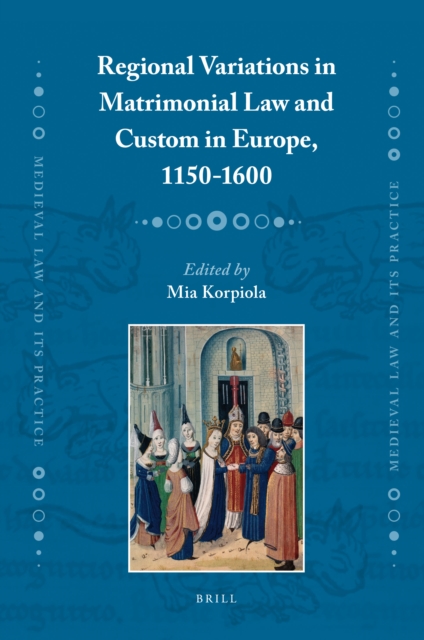
Regional Variations in Matrimonial Law and Custom in Europe, 1150-1600
The book approaches medieval marriage law and custom from a comparative perspective. Although concentrating on source material from one region, some articles discuss the regionality and universality of matrimonial practices and norms. Others compare several regions.
eBook

The merchant of Prato's wife : Margherita Datini and her world, 1360-1423
\"Although the fourteenth-century Italian merchant Francesco Datini has received attention from business historians, there has previously been no full study of his wife, Margherita Datini. Drawing on a sizable trove of Margherita's correspondence held in the Archivio di Stato di Prato, including hundreds of letters she exchanged with Francesco, Ann Crabb investigates the social and economic importance of women's roles as wives and mothers, early modern European views on honor, and the practice of letter writing in Margherita's world. Margherita's often colorful comments demonstrate her attitudes toward her rather unhappy marriage and her inability to have children, along with other aspects of her life. Her letters reveal the pride she felt in carrying out her many responsibilities as a wife and, later, a widow: in scribal letter writing, in business, in household management, and in farming. Crabb emphasizes that the role of a wife was a recognized social position, beyond her individual relations with her husband, and provided opportunities beyond what restrictive laws or restrictive views of female honor would suggest. Further, Crabb considers Margherita's successful efforts, on her own initiative and in her late thirties, to learn to read and write at a literate level. This book will be of interest to both scholars and general readers of women's history. In addition, historians of early modern Italy and, more generally, of early modern Europe will find this book valuable\"-- Provided by publisher.
Book

Marriage, Sex, and Civic Culture in Late Medieval London
Awarded honorable mention for the 2007 Wallace K. Ferguson Prize sponsored by the Canadian Historical Association How were marital and sexual relationships woven into the fabric of late medieval society, and what form did these relationships take? Using extensive documentary evidence from both the ecclesiastical court system and the records of city and royal government, as well as advice manuals, chronicles, moral tales, and liturgical texts, Shannon McSheffrey focuses her study on England's largest city in the second half of the fifteenth century. Marriage was a religious union-one of the seven sacraments of the Catholic Church and imbued with deep spiritual significance-but the marital unit of husband and wife was also the fundamental domestic, social, political, and economic unit of medieval society. As such, marriage created political alliances at all levels, from the arena of international politics to local neighborhoods. Sexual relationships outside marriage were even more complicated. McSheffrey notes that medieval Londoners saw them as variously attributable to female seduction or to male lustfulness, as irrelevant or deeply damaging to society and to the body politic, as economically productive or wasteful of resources. Yet, like marriage, sexual relationships were also subject to control and influence from parents, relatives, neighbors, civic officials, parish priests, and ecclesiastical judges. Although by medieval canon law a marriage was irrevocable from the moment a man and a woman exchanged vows of consent before two witnesses, in practice marriage was usually a socially complicated process involving many people. McSheffrey looks more broadly at sex, governance, and civic morality to show how medieval patriarchy extended a far wider reach than a father's governance over his biological offspring. By focusing on a particular time and place, she not only elucidates the culture of England's metropolitan center but also contributes generally to our understanding of the social mechanisms through which premodern European people negotiated their lives.
eBook

Proving woman
Around the year 1215, female mystics and their sacramental devotion were among orthodoxy's most sophisticated weapons in the fight against heresy. Holy women's claims to be in direct communication with God placed them in positions of unprecedented influence. Yet by the end of the Middle Ages female mystics were frequently mistrusted, derided, and in danger of their lives. The witch hunts were just around the corner.
While studies of sanctity and heresy tend to be undertaken separately,Proving Womanbrings these two avenues of inquiry together by associating the downward trajectory of holy women with medieval society's progressive reliance on the inquisitional procedure. Inquisition was soon used for resolving most questions of proof. It was employed for distinguishing saints and heretics; it underwrote the new emphasis on confession in both sacramental and judicial spheres; and it heralded the reintroduction of torture as a mechanism for extracting proof through confession.
As women were progressively subjected to this screening, they became ensnared in the interlocking web of proofs. No aspect of female spirituality remained untouched. Since inquisition determined the need for tangible proofs, it even may have fostered the kind of excruciating illnesses and extraordinary bodily changes associated with female spirituality. In turn, the physical suffering of holy women became tacit support for all kinds of earthly suffering, even validating temporal mechanisms of justice in their most aggressive forms. The widespread adoption of inquisitional mechanisms for assessing female spirituality eventuated in a growing confusion between the saintly and heretical and the ultimate criminalization of female religious expression.
eBook

Bigamy and Christian Identity in Late Medieval Champagne
The institution of marriage is commonly thought to have fallen into crisis in late medieval northern France. While prior scholarship has identified the pervasiveness of clandestine marriage as the cause, Sara McDougall contends that the pressure came overwhelmingly from the prevalence of remarriage in violation of the Christian ban on divorce, a practice we might call \"bigamy.\" Throughout the fifteenth century in Christian Europe, husbands and wives married to absent or distant spouses found new spouses to wed. In the church courts of northern France, many of the individuals so married were criminally prosecuted.In Bigamy and Christian Identity in Late Medieval Champagne, McDougall traces the history of this conflict in the diocese of Troyes and places it in the larger context of Christian theology and culture. Multiple marriage was both inevitable and repugnant in a Christian world that forbade divorce and associated bigamy with the unchristian practices of Islam or Judaism. The prevalence of bigamy might seem to suggest a failure of Christianization in late medieval northern France, but careful study of the sources shows otherwise: Clergy and laity alike valued marriage highly. Indeed, some members of the laity placed such a high value on the institution that they were willing to risk criminal punishment by entering into illegal remarriage. The risk was great: the Bishop of Troyes's judicial court prosecuted bigamy with unprecedented severity, although this prosecution broke down along gender lines. The court treated male bigamy, and only male bigamy, as a grave crime, while female bigamy was almost completely excluded from harsh punishment. As this suggests, the Church was primarily concerned with imposing a high standard on men as heads of Christian households, responsible for their own behavior and also that of their wives.
eBook


The Fruit of Her Hands
In the thriving urban economies of late thirteenth-century
Catalonia, Jewish and Christian women labored to support their
families and their communities. The Fruit of Her Hands
examines how gender, socioeconomic status, and religious identity
shaped how these women lived and worked.
Sarah Ifft Decker draws on thousands of notarial contracts as
well as legal codes, urban ordinances, and Hebrew responsa
literature to explore the lived experiences of Jewish and Christian
women in the cities of Barcelona, Girona, and Vic between 1250 and
1350. Relying on an expanded definition of women's work that
includes the management of household resources as well as wage
labor and artisanal production, this study highlights the crucial
contributions women made both to their families and to urban
economies. Christian women, Ifft Decker finds, were deeply embedded
in urban economic life in ways that challenge traditional
dichotomies between women in northern and Mediterranean Europe. And
while Jewish women typically played a less active role than their
Christian counterparts, Ifft Decker shows how, in moments of
communal change and crisis, they could and did assume prominent
roles in urban economies.
Through its attention to the distinct experiences of Jewish and
Christian women, The Fruit of Her Hands advances our
understanding of Jewish acculturation in the Iberian Peninsula and
the shared experiences of women of different faiths. It will be
welcomed by specialists in gender studies and religious studies as
well as students and scholars of medieval Iberia.
eBook