
Catalogue Search | MBRL


Are you sure you want to remove the book from the shelf?

{{itemTitle}}
4
result(s) for
"Marriage -- Social aspects -- Scotland -- History"
Sort by:

Love, Intimacy and Power
Through an analysis of the correspondence of over one hundred couples from the Scottish elites across the seventeenth to nineteenth centuries, this book explores how ideas around the nature of emotional intimacy, love, and friendship within marriage adapted to a modernising economy and society. Patriarchy continued to be the central model for marriage across the period and as a result, women found spaces to hold power within the family, but could not translate it to power beyond the household. Comparing the Scottish experience to that across Europe and North America, Barclay shows that throughout the eighteenth-century, far from being a side-note in European history, Scottish ideas about gender and marriage became culturally dominant. This book will be vital to those studying and teaching Scottish social history, and those interested in the history of marriage and gender. It will also appeal to feminists interested in the history of patriarchy.
eBook
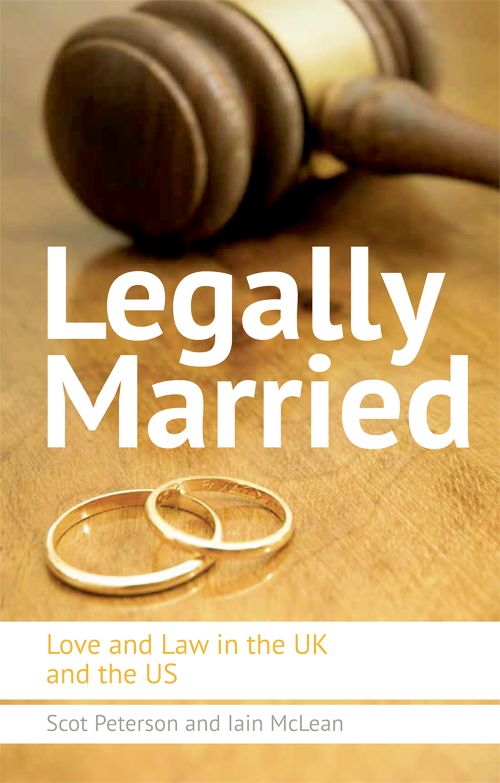
Legally married : love and law in the UK and the US
What does it really mean to be legally married? The answer seems to vary depending on the cultures, religions and laws of different countries. From English teenagers eloping to Gretna Green to tie the knot without their parents' permission, to whether a wife can own property, it's clear that marriage law is different depending on where you live and when. Now, the main debate centres on whether the law should be changed so that same-sex couples can marry. The Scottish and UK governments, plus a number of US states, are to legislate to allow same-sex marriage, prompting both celebration and outrage. But amongst all the assumptions, there are few facts, and the debates about same-sex marriage in the UK and the US are taking place in an informational vacuum filled with emotion and rhetoric. 'Legally Married' combines insights from history and law from the UK and Scotland with international examples of how marriage law has developed. Scot Peterson and Iain McLean show how many assumptions about marriage are contestable on a number of grounds, separate fact from fiction and explain the claims made on both sides of the argument over same-sex marriage in terms of their historical context.
eBook

Scottish Illegitimacy: Social Adjustment or Moral Economy?
Blaikie discusses the interaction between changing economic circumstances and customary sexual arrangements in Scotland. Using historic data, he examines regional and national patterns of irregular marriage and illegitimacy, considering whether differences in sexual and nuptial behavior can be explained by cultural attitudes or by economically rational responses to particular material circumstances.
Journal Article

SIMULATED CLIENTS IN 'NATURAL' SETTINGS: CONSTRUCTING A CLIENT TO STUDY PROFESSIONAL PRACTICE
In this paper, we outline the use of a data collection technique referred to as the 'simulated client' which was developed in order to gather information about how solicitors negotiate the financial aspects of divorce with clients. The purpose of the study was to examine how a specific piece of law reform is incorporated into the usual practice of solicitors. The setting was the solicitor's first meeting with a client seeking divorce. The intention was to study the process of negotiation in a setting which was as natural as possible while at the same time covering a specific set of issues for study. This presents the seemingly incompatible needs of observing the natural process unstructured by the researcher and at the same time controlling the information presented, and thus the data gathered, in order to ensure coverage of specific issues for study. The extensive personal history of the 'simulated client' was constructed in order to address specific principles in new legislation and then presented to solicitors as a usual client. Solicitors conducted the one hour meetings as usual, seeking details from the client and providing legal advice and information. Data were gathered from tape recorded sessions with fifty-eight solicitors.
Journal Article