
Catalogue Search | MBRL


Are you sure you want to remove the book from the shelf?

{{itemTitle}}
16,722
result(s) for
"Marriage History."
Sort by:


Unmarriages
The Middle Ages are often viewed as a repository of tradition, yet what we think of as traditional marriage was far from the only available alternative to the single state in medieval Europe. Many people lived together in long-term, quasimarital heterosexual relationships, unable to marry if one was in holy orders or if the partners were of different religions. Social norms militated against the marriage of master to slave or between individuals of very different classes, or when the couple was so poor that they could not establish an independent household. Such unions, where the protections that medieval law furnished to wives (and their children) were absent, were fraught with danger for women in particular, but they also provided a degree of flexibility and demonstrate the adaptability of social customs in the face of slowly changing religious doctrine.Unmarriagesdraws on a wide range of sources from across Europe and the entire medieval millennium in order to investigate structures and relations that medieval authors and record keepers did not address directly, either in order to minimize them or because they were so common as not to be worth mentioning. Author Ruth Mazo Karras pays particular attention to the ways women and men experienced forms of opposite-sex union differently and to the implications for power relations between the genders. She treats legal and theological discussions that applied to all of Europe and presents a vivid series of case studies of how unions operated in specific circumstances to illustrate concretely what we can conclude, how far we can speculate, and what we can never know.
eBook

Tying the knot : a world history of marriage
From Cinderella to The Bachelor and The Bachelorette reality TV shows, and from lavish destination weddings to the marriage equality movement, getting married has taken center stage in the 21st century. What purpose has the institution served across the centuries? How do proposals, ceremonies, and expectations of marriage differ across cultures? What can couples do to ensure a strong marriage, and what happens if they can't make it work? See how answers to these questions have changed across the centuries, and hear what long-term married couples have to say about the secret to their success.
Book

Marriage and Violence
Marriage is often described as a melding of two people into one. But what-or who-must be lost, fragmented, or buried in that process? We have inherited a model of marriage so flawed, Frances E. Dolan contends, that its logical consequence is conflict. Dolan ranges over sixteenth- and seventeenth-century Puritan advice literature, sensational accounts of \"true crime,\" and late twentieth-century marriage manuals and films about battered women who kill their abusers. She reads the inevitableTaming of the Shrewagainst William Byrd's diary of life on his Virginia plantation, Noel Coward'sPrivate Lives, and Barbara Ehrenreich's assessment inNickel and Dimedof the relationship between marriage and housework. She traces the connections between Phillippa Gregory's best-selling novelThe Other Boleyn Girland documents about Anne Boleyn's fatal marriage and her daughter Elizabeth I's much-debated virginity. By contrasting depictions of marriage in the sixteenth and seventeenth centuries and our own time, she shows that the early modern apprehension of marriage as an economy of scarcity continues to haunt the present in the form of a conceptual structure that can accommodate only one fully developed person. When two fractious individuals assert their conflicting wills, resolution can be achieved only when one spouse absorbs, subordinates, or eliminates the other. In an era when marriage remains hotly contested, this book draws our attention to one of the histories that bears on the present, a history in which marriage promises both intimate connection and fierce conflict, both companionship and competition.
eBook


Marriage, Sex, and Civic Culture in Late Medieval London
Awarded honorable mention for the 2007 Wallace K. Ferguson Prize sponsored by the Canadian Historical Association How were marital and sexual relationships woven into the fabric of late medieval society, and what form did these relationships take? Using extensive documentary evidence from both the ecclesiastical court system and the records of city and royal government, as well as advice manuals, chronicles, moral tales, and liturgical texts, Shannon McSheffrey focuses her study on England's largest city in the second half of the fifteenth century. Marriage was a religious union-one of the seven sacraments of the Catholic Church and imbued with deep spiritual significance-but the marital unit of husband and wife was also the fundamental domestic, social, political, and economic unit of medieval society. As such, marriage created political alliances at all levels, from the arena of international politics to local neighborhoods. Sexual relationships outside marriage were even more complicated. McSheffrey notes that medieval Londoners saw them as variously attributable to female seduction or to male lustfulness, as irrelevant or deeply damaging to society and to the body politic, as economically productive or wasteful of resources. Yet, like marriage, sexual relationships were also subject to control and influence from parents, relatives, neighbors, civic officials, parish priests, and ecclesiastical judges. Although by medieval canon law a marriage was irrevocable from the moment a man and a woman exchanged vows of consent before two witnesses, in practice marriage was usually a socially complicated process involving many people. McSheffrey looks more broadly at sex, governance, and civic morality to show how medieval patriarchy extended a far wider reach than a father's governance over his biological offspring. By focusing on a particular time and place, she not only elucidates the culture of England's metropolitan center but also contributes generally to our understanding of the social mechanisms through which premodern European people negotiated their lives.
eBook


Breaking the Ties That Bound
Russia's Great Reforms of 1861 were sweeping social and legal changes that aimed to modernize the country. In the following decades, rapid industrialization and urbanization profoundly transformed Russia's social, economic, and cultural landscape. Barbara Alpern Engel explores the personal, cultural, and political consequences of these dramatic changes, focusing on their impact on intimate life and expectations and the resulting challenges to the traditional, patriarchal family order, the cornerstone of Russia's authoritarian political and religious regime. The widely perceived \"marriage crisis\" had far-reaching legal, institutional, and political ramifications. InBreaking the Ties That Bound, Engel draws on exceptionally rich archival documentation-in particular, on petitions for marital separation and the materials generated by the ensuing investigations-to explore changing notions of marital relations, domesticity, childrearing, and intimate life among ordinary men and women in imperial Russia.
Engel illustrates with unparalleled vividness the human consequences of the marriage crisis. Her research reveals in myriad ways that the new and more individualistic values of the capitalist marketplace and commercial culture challenged traditional definitions of gender roles and encouraged the self-creation of new social identities. Engel captures the intimate experiences of women and men of the lower and middling classes in their own words, documenting instances not only of physical, mental, and emotional abuse but also of resistance and independence. These changes challenged Russia's rigid political order, forcing a range of state agents, up to and including those who spoke directly in the name of the tsar, to rethink traditional understandings of gender norms and family law. This remarkable social history is thus also a contribution to our understanding of the deepening political crisis of autocracy.
eBook

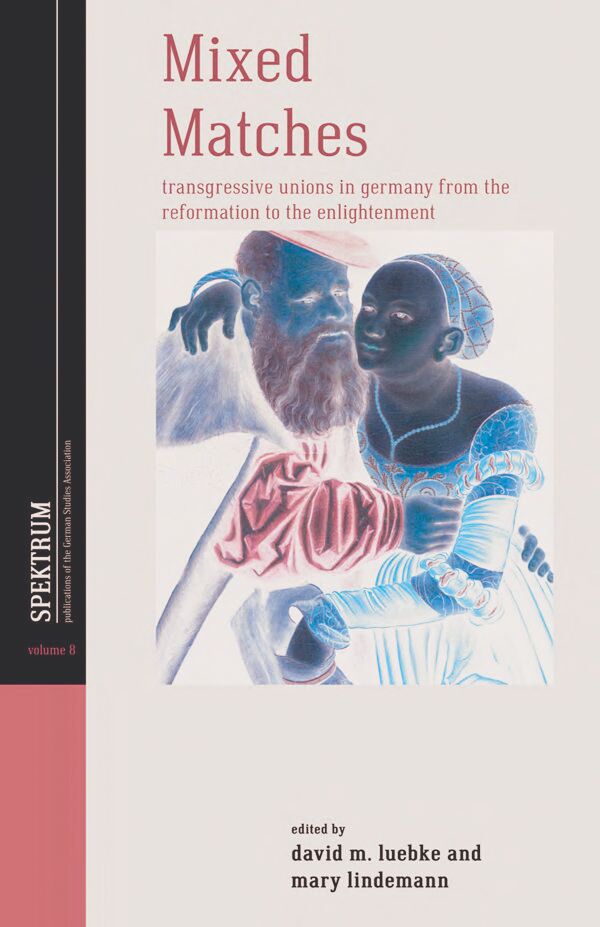
Mixed Matches
The significant changes in early modern German marriage practices included many unions that violated some taboo. That taboo could be theological and involve the marriage of monks and nuns, or refer to social misalliances as when commoners and princes (or princesses) wed. Equally transgressive were unions that crossed religious boundaries, such as marriages between Catholics and Protestants, those that violated ethnic or racial barriers, and those that broke kin-related rules. Taking as a point of departure Martin Luther's redefinition of marriage, the contributors to this volume spin out the multiple ways that the Reformers' attempts to simplify and clarify marriage affected education, philosophy, literature, high politics, diplomacy, and law. Ranging from the Reformation, through the ages of confessionalization, to the Enlightenment, Mixed Matches addresses the historical complexity of the socio-cultural institution of marriage.
eBook