
Catalogue Search | MBRL


Are you sure you want to remove the book from the shelf?

{{itemTitle}}
3
result(s) for
"Marriage law -- Europe -- History -- 16th century"
Sort by:
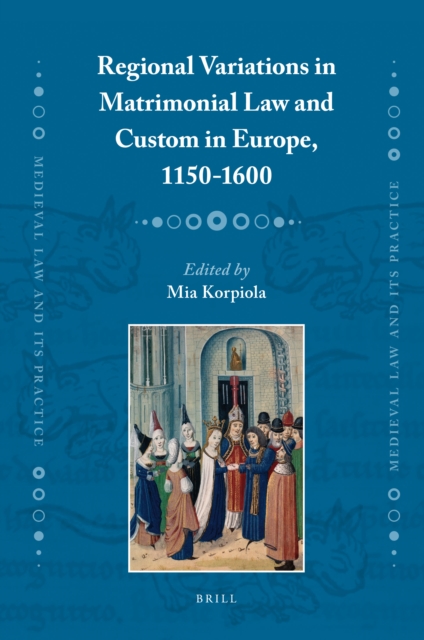
Regional Variations in Matrimonial Law and Custom in Europe, 1150-1600
The book approaches medieval marriage law and custom from a comparative perspective. Although concentrating on source material from one region, some articles discuss the regionality and universality of matrimonial practices and norms. Others compare several regions.
eBook

Blood, Bodies and Families
This collection of essays contains a wealth of information on the nature of the family in the early modern period. This is a core topic within economic and social history courses which is taught at most universities. This text gives readers an overview of how feminist historians have been interpreting the history of the family, ever since Laurence Stone's seminal work FAMILY, SEX AND MARRIAGE IN ENGLAND 1500-1800 was published in 1977.The text is divided into three coherent parts on the following themes: bodies and reproduction; maternity from a feminist perspective; and family relationships. Each part is prefaced by a short introduction commenting on new work in the area.This book will appeal to a wide variety of students because of its sociological, historical and economic foci.
eBook

The Economics of the Counter-Reformation: Incumbent-Firm Reaction to Market Entry
The Catholic Church reacted to the Protestant Reformation by taking on the defensive posture of an incumbent‐firm monopoly fighting to survive in the face of new competition. Contemporary firms typically respond to rival entry by rewriting their corporate charter. So did the medieval Catholic Church. But the Council of Trent failed as a reorganization plan because to keep economic rents flowing as before, it left intact the distribution of powers and property rights among the governing body of pope and cardinals—thus demonstrating that entrenched economic interests are powerful inducements to behavior, even in spiritual institutions.
Journal Article