
Catalogue Search | MBRL


Are you sure you want to remove the book from the shelf?

{{itemTitle}}
4,956
result(s) for
"Mars (Planet) Exploration."
Sort by:


Exploration and Engineering
Getting to Mars required engineering genius, scientific strategy, and the drive to persevere in the face of failure.
Although the Jet Propulsion Laboratory in Pasadena, California, has become synonymous with the United States' planetary exploration during the past half century, its most recent focus has been on Mars. Beginning in the 1990s and continuing through the Mars Phoenix mission of 2007, JPL led the way in engineering an impressive, rapidly evolving succession of Mars orbiters and landers, including roving robotic vehicles whose successful deployment onto the Martian surface posed some of the most complicated technical problems in space flight history.
In Exploration and Engineering, Erik M. Conway reveals how JPL engineers' creative technological feats led to major breakthroughs in Mars exploration. He takes readers into the heart of the lab's problem-solving approach and management structure, where talented scientists grappled with technical challenges while also coping, not always successfully, with funding shortfalls, unrealistic schedules, and managerial turmoil.
Conway, JPL's historian, offers an insider's perspective into the changing goals of Mars exploration, the ways in which sophisticated computer simulations drove the design process, and the remarkable evolution of landing technologies over a thirty-year period.
eBook

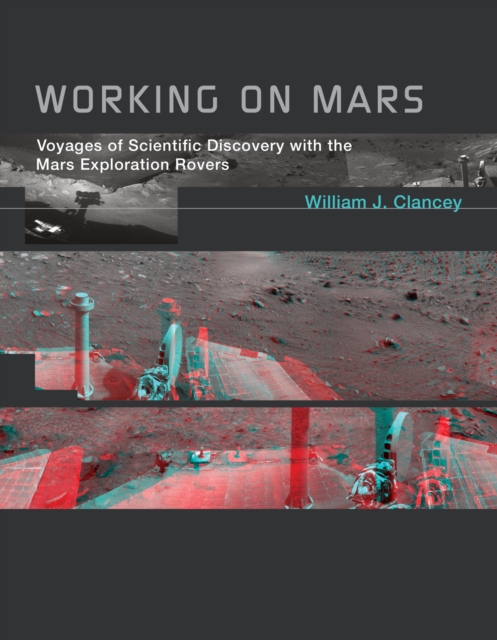
Working on Mars
Geologists in the field climb hills and hang onto craggy outcrops; they put their fingers in sand and scratch, smell, and even taste rocks. Beginning in 2004, however, a team of geologists and other planetary scientists did field science in a dark room in Pasadena, exploring Mars from NASA's Jet Propulsion Laboratory (JPL) by means of the remotely operated Mars Exploration Rovers (MER). Clustered around monitors, living on Mars time, painstakingly plotting each movement of the rovers and their tools, sensors, and cameras, these scientists reported that they felt as if they were on Mars themselves, doing field science. The MER created a virtual experience of being on Mars. In this book, William Clancey examines how the MER has changed the nature of planetary field science. NASA cast the rovers, Spirit and Opportunity, as \"robotic geologists,\" and ascribed machine initiative (\"Spirit collected additional imagery...\") to remotely controlled actions. Clancey argues that the actual explorers were not the rovers but the scientists, who imaginatively projected themselves into the body of the machine to conduct the first overland expedition of another planet. The scientists have since left the darkened room and work from different home bases, but the rover-enabled exploration of Mars continues. Drawing on his extensive observations of scientists in the field and at the JPL, Clancey investigates how the design of the rover mission enables field science on Mars, explaining how the scientists and rover engineers manipulate the vehicle and why the programmable tools and analytic instruments work so well for them. He shows how the scientists felt not as if they were issuing commands to a machine but rather as if they were working on the red planet, riding together in the rover on a voyage of discovery. http://www.youtube.com/watch?v=oZQSWSZnTYs&feature=youtube_gdata
eBook

The story of Mars
Explore a whole new world! Could Mars be a future home for humans? Were there ever aliens on the red planet? How does Mars compare to our own planet? Discover the answer to these questions, and more, with The Story of Mars. The Story of Mars takes a fascinating look at the history, geography, astronomy and science of the red planet. For ages 9+.
BOOK

Why Mars : NASA and the politics of space exploration
Traces NASA's torturous journey to Mars from the fly-bys of the 1960s to landing rovers and seeking life today.
Mars has captured the human imagination for decades. Since NASA's establishment in 1958, the space agency has looked to Mars as a compelling prize, the one place, beyond the Moon, where robotic and human exploration could converge. Remarkably successful with its roaming multi-billion-dollar robot, Curiosity, NASA's Mars program represents one of the agency's greatest achievements.
Why Mars analyzes the history of the robotic Mars exploration program from its origins to today. W. Henry Lambright examines the politics and policies behind NASA's multi-decade quest, illuminating the roles of key individuals and institutions along with their triumphs and defeats.
Lambright outlines the ebbs and flows of policy evolution, focusing on critical points of change and factors that spurred strategic reorientation. He explains Mars exploration as a striking example of \"big science\" and describes the ways a powerful advocacy coalition—composed of NASA decision makers, the Jet Propulsion Laboratory, the Mars academic science community, and many others—has influenced governmental decisions on Mars exploration, making it, at times, a national priority.
The quest for Mars stretches over many years and involves billions of dollars. What does it take to mount and give coherence to a multi-mission, big science program? How do advocates and decision makers maintain goals and adapt their programs in the face of opposition and budgetary stringency? Where do they succeed in their strategies? Where do they fall short? Lambright's insightful book suggests that from Mars exploration we can learn lessons that apply to other large-scale national endeavors in science and technology.
eBook

Mysteries of Mars
This book introduces the reader to the wonders of Mars, covering all aspects from our past perceptions of the planet through to the latest knowledge on its history, its surface processes such as impact cratering, volcano formation, and glaciation, and its atmosphere and climate. In addition, a series of ten intriguing open issues are considered in a more advanced way. These include such thought-provoking questions as What turned off the planet's magnetic field?, Why are the northern and southern hemispheres so different?, What was the fate of the once abundant water?, and Is there, or was there, life on Mars? Numerous original figures, unavailable elsewhere, reproduce details of images from Viking, CTX, MOC, HiRISE, THEMIS, and HRSC.
Book

The Planning and Execution of Human Missions to the Moon and Mars
In The Planning and Execution of Human Missions to the Moon and Mars expert contributors from government, academia, and private enterprise explore the myriad challenges that must be overcome in order to conduct deep space travel. From spacecraft operation, mission architecture, and communications to interplanetary supply chains, in-space manufacturing, and beyond, this book is a must-read for everyone from industry professionals to those who dream of an off -world future.
eBook

Mars rover Curiosity : an inside account from Curiosity's chief engineer
In Mars Rover Curiosity: An Inside Account from Curiosity's Chief Engineer, Rob Manning, the project's chief engineer, tells of bringing the groundbreaking spacecraft to life. Manning and his team at NASA's Jet Propulsion Laboratory, tasked with designing a lander many times larger and more complex than any before, faced technical setbacks, fights over inadequate resources, and the challenges of leading an army of brilliant, passionate, and often frustrated experts.
Book
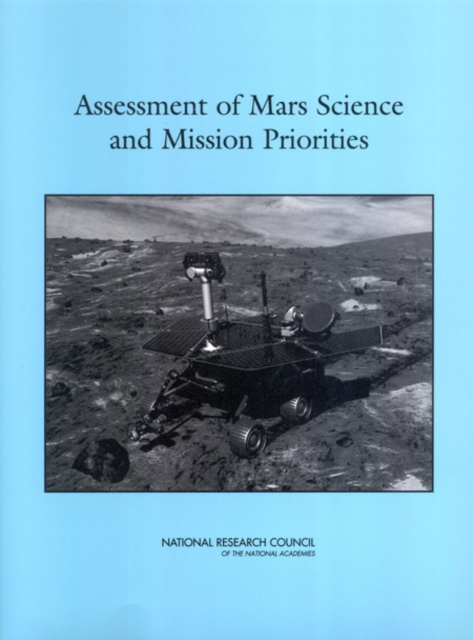
Assessment of Mars Science and Mission Priorities
Within the Office of Space Science of the National Aeronautics and Space Administration (NASA) special importance is attached to exploration of the planet Mars, because it is the most like Earth of the planets in the solar system and the place where the first detection of extraterrestrial life seems most likely to be made. The failures in 1999 of two NASA missions-Mars Climate Orbiter and Mars Polar Lander-caused the space agency's program of Mars exploration to be systematically rethought, both technologically and scientifically. A new Mars Exploration Program plan (summarized in Appendix A) was announced in October 2000. The Committee on Planetary and Lunar Exploration (COMPLEX), a standing committee of the Space Studies Board of the National Research Council, was asked to examine the scientific content of this new program. This goals of this report are the following:
-Review the state of knowledge of the planet Mars, with special emphasis on findings of the most recent Mars missions and related research activities;
-Review the most important Mars research opportunities in the immediate future;
-Review scientific priorities for the exploration of Mars identified by COMPLEX (and other scientific advisory groups) and their motivation, and consider the degree to which recent discoveries suggest a reordering of priorities; and
-Assess the congruence between NASA's evolving Mars Exploration Program plan and these recommended priorities, and suggest any adjustments that might be warranted.
eBook