
Catalogue Search | MBRL


Are you sure you want to remove the book from the shelf?

{{itemTitle}}
36
result(s) for
"Masoretic Text"
Sort by:

Joshua 24 and Textual Pluriformity
This article considers the cumulative effect of the variants in the Greek text of Joshua 24 under the understanding that its Hebrew
represents a text distinct from what became the Masoretic Text (MT). The best explanation for the textual phenomena in Joshua 24 may be the persistence of two Hebrew texts that were mutually informative among the communities that received the book of Joshua and the Former Prophets. This essay will attempt to demonstrate the value of text pluriformity in text-critical decisions and in the compositional strategy represented in these texts.
Journal Article

The problematic Hebrew word ‘ועבר’ Nahum 1:12: The study of ancient translations
What is the meaning of ‘ועבר’ found in Nahum 1:12? The textual tradition is divided. The Septuagint (LXX) omits this Hebrew word, while the Vulgate translates literally as ‘et pertransibit’ in Nahum 1:12. Although the Peshitta has a similar translation with the Masoretic text and the Vulgate, it differs on the subject: they will go through or ‘ܘܥܒܪܘ’. Targum, on the other hand, interprets the Hebrew word as ‘ויעברון על פרת ית’ or ‘they passed on the Euphrates’. This disagreement raises important questions about the original wording of the verse, its interpretation and the sources of the various readings that emerged during its transmission.Intradisciplinary and/or interdisciplinary implicationsThis article employs textual criticism as its primary method, examining manuscript evidence, evaluating the chances of transcription and translation differences and considering contextual and linguistic factors. The aim is to determine the most likely original text and to investigate the possible reasons for the inconsistencies found among these ancient sources.
Journal Article
Uzziah like his Son: Portraits of Uzziah in the Masoretic Text and the Syriac Peshitta of Chronicles
The various textual witnesses reveal more than one portrait of Uzziah. Two distinctive portraits of Uzziah emerge, one within the Masoretic tradition and another in the Syriac Peshitta. The present article aims to explore these portraits in order to demonstrate the shape of each portrait of Uzziah in light of Jotham and to determine what these portraits reveal about the nature of the textual transmission of the account of Uzziah in Chronicles.
Journal Article

Viewing the Evil Eye in the Scripture: Reclaiming the Magical Thinking in Modern Times
The eye is a complex anthropological term in the Old Testament theology. The eye represents insight, mindfulness, but also it is an entrance for malefic influences. This article will scrutinize the magical function of the eye in the Hebrew Bible, as well as the connection of the eye with evil. The Hebrew terms of the Masoretic Text will be compared to the Greek translation of the Septuagint and the Hellenistic mindset in order to perceive similarities and differences between both cultures.
Journal Article

The Tyrian King in MT and LXX Ezekiel 28:12b–15
The biblical prophecy in Ezekiel 28:11–19 records a dirge against the king from Tyre. While the Hebrew Masoretic Text (MT) identifies the monarch as a cherub, the Greek Septuagint (LXX) distinguishes the royal from the cherub. Scholarly debates arise as to which edition represents the more original version of the prophecy. This article aims to contribute to the debates by adopting a text-critical approach to the two variant literary editions of the dirge, comparing and analyzing their differences, while incorporating insights gleaned from the extra-biblical literature originating from the ancient Near East, Second Temple Period, and Late Antiquity. The study reaches the conclusion that the current MT, with its presentation of a fluid boundary between the mortal and divine, likely builds on a more ancient interpretation of the Tyrian king. On the other hand, while the Hebrew Vorlage of LXX Ezekiel 28:12b–15 resembles the Hebrew text of the MT, the Greek translator modifies the text via literary allusions and syntactical rearrangement, so that the final result represents a later reception that suppresses any hints at the divinity of the Tyrian ruler. The result will contribute to our understanding of the historical development of the ancient Israelite religion.
Journal Article

On the Vorlage, Tendenz, and Scribal Negligence of AT Esth 1:10-15
Abstract
In this article, a section of the Alpha-Text Esther story (1:10-15) is brought to the foreground to reveal the hitherto unrecognized hints that point to the Hebrew Vorlage, the literary Tendenz, and the scribal negligence unparalleled in either the Septuagint or the Masoretic text. All these literary phenomena suggest that the Alpha-Text and the Masoretic text versions reflect two variant archetypes of a Hebrew text, but this does not mean that both archetypes cannot overlap at places. When the archetypes do overlap, some of the unique readings in the Alpha-Text actually reflect later exegeses or misunderstandings that are dependent on the readings preserved in both the Masoretic text and the Septuagint. The later exegeses in particular help locate the Sitz im Leben of Alpha-Text Esth 1:10-15 in the Hasmonean period and thereafter when the Jewish-gentile relationship is strained.
Journal Article
The Septuagint and the Masoretic Text in the Orthodox Church(es)
In this article, I intend to survey the reception of versions of the Old Testament in the Orthodox churches, focusing on the Greek, Russian and Romanian Church, respectively. While Western biblical scholars gave precedence to the Hebrew text over the Septuagint, in the Orthodox world one can see a tension in the relationship between the two textual witnesses and sometimes, even recently, there are voices which tend to give the Septuagint total authority in the Church. Orthodox scholars in the field of Old Testament studies usually resort to the Hebrew text, but especially scholars from outside this field tend to promote the Septuagint as the Old Testament of the Orthodox Church. I shall use the argument of authority, which is improper for scientific argumentation, but it suits my research, as I try to understand the confessional positions held within Eastern Orthodoxy. Consequently, if a certain saint, acknowledged as such by a national Orthodox Church or by the entire Eastern Orthodox communion, embraces a particular view on this subject, this bears significantly on the issue.
Journal Article

Performance in Ancient and Medieval Judaism
Abstract
This article explores the performance of Jewish sacred textual traditions. Performance, as we define it, is both textual and oral and works dynamically between the two. In the Second Temple period, we show the variety of performance which embodies the vitality of the texts. Performance is a feature of scribal practice and liturgy (e.g., Hodayot). It draws on existing text to create something new (e.g., Apostrophe to Zion). From the Second Temple period into the Middle Ages, we see continued pluriformity in the oral performance of the written text of the Hebrew Bible. Creativity is evident across oral and material representation. The texts discussed throughout this article remained dynamic and diverse. The focus and scope of this article also prepares for many of the ideas picked up by the essays which follow in this volume.
Journal Article
The Hebrew of the Dead Sea Scrolls and the Tiberian Reading Tradition
The most authentic portrait of Second Temple Hebrew is afforded by the Dead Sea Scrolls, especially by those texts actually composed in Hellenistic and Roman times. On salient linguistic points Dead Sea Scrolls Hebrew agrees with the vocalization of the Tiberian reading tradition against the testimony of the written, i.e., consonantal, tradition of Masoretic Classical Biblical Hebrew material. This article presents a case study. On the one hand, these Dead Sea-Tiberian vocalization affinities are evidence of the relatively late character of their respective linguistic traditions and of the secondary character of the developments in the Tiberian reading tradition vis-à-vis the classical biblical written tradition. On the other hand, these same affinities demonstrate that the Tiberian pronunciation tradition is plausibly regarded as one that crystallized in the Second Temple Period, rather than in Byzantine or medieval times. Lastly, since joint Dead Sea-Tiberian reading departures from the classical biblical consonantal tradition constitute a tiny minority of their relevant linguistic data, most of which are characterized by historical continuity and/or linguistic heterogeneity of comparable historical depth, it is clear that the Second Temple crystallization of Dead Sea Scrolls Hebrew and the Tiberian reading tradition in no way preclude their routine preservation of authentic Iron Age features.
Journal Article
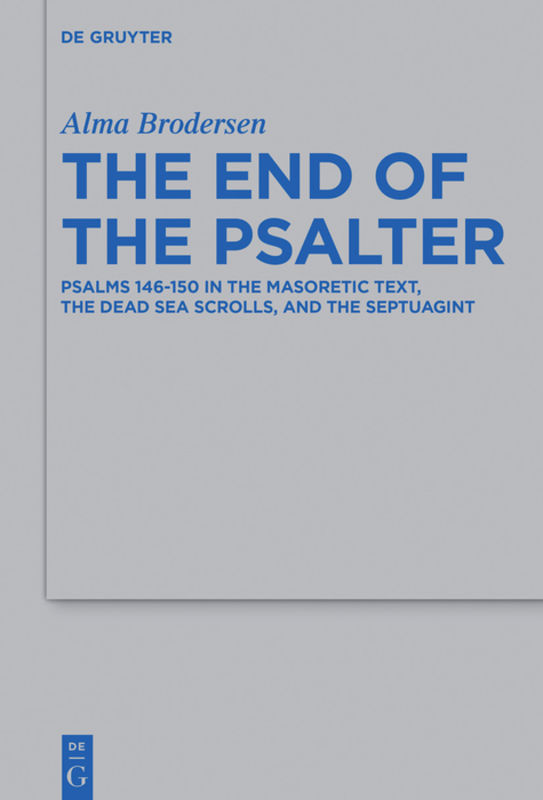
The end of the Psalter : Psalms 146-150 in the Masoretic Text, the Dead Sea Scrolls, and the Septuagint
The series Beihefte zur Zeitschrift für die alttestamentliche Wissenschaft (BZAW) covers all areas of research into the Old Testament, focusing on the Hebrew Bible, its early and later forms in Ancient Judaism, as well as its branching into many neighboring cultures of the Ancient Near East and the Greco-Roman world. _x000D_.
eBook