
Catalogue Search | MBRL


Are you sure you want to remove the book from the shelf?

{{itemTitle}}
6,119
result(s) for
"Mass media -- Influence"
Sort by:

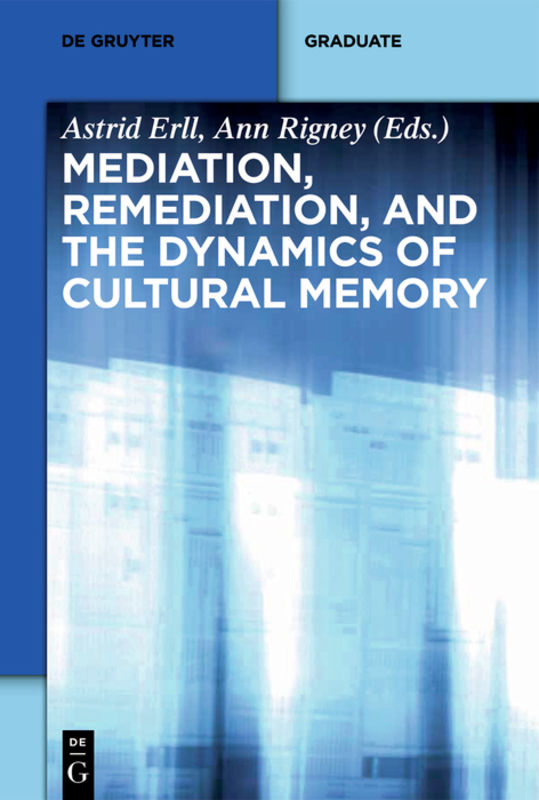
Mediation, remediation, and the dynamics of cultural memory
This interdisciplinary series addresses the relation between media and cultural memory. Its publications study how media construct, store, and disseminate memory. The series' focus is on different media and technologies, such as text and image, the cinema and the new digital media, on transmediality, intermediality, and remediation, as well as on the social (and increasingly transnational and transcultural) contexts of mediated memory. The aim of the series is to provide a vibrant international platform for research and scholarly exchange in the field of media and memory studies. Manuscripts submitted to the series are peer reviewed by expert referees.
eBook

Major theories of media effects : analysis and evaluation
\"In Major Theories of Media Effects, six major theories of media effects are thoroughly analyzed and then evaluated to construct a picture of the current state of knowledge about the scholarly field of media effects. These six theories are cultivation, agenda setting, framing, uses and gratifications, social learning, and third person effect. Each of these six theories is examined in detail using fourteen analytical dimensions organized into four categories: how the theory was originally conceptualized, its original components, patterns of empirical testing of its claims, and how the theory has developed over time. The theories are then compared and contrasted along five evaluation dimensions (scope, precision, heuristic value, empirical validity, and openness), plus one summary evaluative dimension that compares their overall utility to generating knowledge about media effects. The insights generated through these analyses and evaluations are used to address questions such as: \"What is a theory?\"; \"Who qualifies as a theoretician?\"; and, \"Within the scholarly field of media effects, why are there so many theories yet so little theory usage as foundations for empirical studies?\" Concise and accessible analyses of major media effects theories--alongside helpful reference lists that handily index important literature in the field--make Major Theories of Media Effects both a vital reference for scholars and a valuable textbook for graduate and advanced undergraduate courses in media studies\"-- Provided by publisher.
Book
Media and participation
Participation has become fashionable again, but at the same time it has always played a crucial role in our contemporary societies, and it has been omnipresent in a surprisingly large number of societal fields. In the case of the media sphere, the present-day media conjuncture is now considered to be the most participatory ever, but media participation has had a long and intense history. To deal with these paradoxes, this book looks at participation as a structurally unstable concept and as the object of a political-ideological struggle that makes it oscillate between minimalist and maximalist versions. This struggle is analysed in theoretical reflections in five fields (democracy, arts, development, spatial planning and media) and in eight different cases of media practice. These case studies also show participation’s close connection to power, identity, organization, technology and quality.
eBook


Fredric Wertham and the Critique of Mass Culture
Too often remembered solely as the psychiatrist and cultural critic whose testimony in Senate subcommittees sparked the creation of the Comics Code, Fredric Wertham was a far more complex man. Author Bart Beaty traces the evolution of Wertham's attitudes toward popular culture and reassesses his place in the debate about pop culture's effects on youth and society.
WhenThe Seduction of the Innocentwas published in 1954, Wertham (1895-1981) became instantly known as an authority on child psychology. Although he had published several books beforeSeduction, its sharp criticism of popular culture in general--and comic books in particular--made it a touchstone for debate about issues of censorship, child protection, and freedom of speech.
Fredric Wertham and the Critique of Mass Culture, a fresh perspective on Wertham's career, reinterprets his intellectual legacy and challenges notions about his alleged cultural conservatism. Drawing upon Wertham's published works as well as his unpublished private papers, correspondence, and notes, Beaty reveals a man whose opinions, life, and career offer more subtlety of thought than previously assumed. In particular, the book examines Wertham's change of heart in the 1970s, when he began to claim that comics could be a positive influence in American society.
The Wertham that emerges is a critic who was significantly more progressive and multifaceted than his reputation would suggest.
Bart Beaty is associate professor of communication and culture at the University of Calgary. His work has been published in theComics Journal,International Journal of Comic Art,Canadian Journal of Communication,Essays in Canadian Writing, andCanadian Review of American Studies.
eBook

Mediarchy
\"We think that we live in democracies: in fact, we live in mediarchies. In this major book, Yves Citton maps out the new regime of experience, media and power that he designates by the term 'mediarchy'. This comprehensive and far-reaching book examines the multiple complex ways that the media shape our social, political and personal lives today\"-- Provided by publisher.
Book

Narrative Landmines
Islamic extremism is the dominant security concern of many contemporary governments, spanning the industrialized West to the developing world.Narrative Landminesexplores how rumors fit into and extend narrative systems and ideologies, particularly in the context of terrorism, counter-terrorism, and extremist insurgencies. Its concern is to foster a more sophisticated understanding of how oral and digital cultures work alongside economic, diplomatic, and cultural factors that influence the struggles between states and non-state actors in the proverbial battle of hearts and minds. Beyond face-to-face communication, the authors also address the role of new and social media in the creation and spread of rumors.
As narrative forms, rumors are suitable to a wide range of political expression, from citizens, insurgents, and governments alike, and in places as distinct as Singapore, Iraq, and Indonesia-the case studies presented for analysis. The authors make a compelling argument for understanding rumors in these contexts as \"narrative IEDs,\" low-cost, low-tech weapons that can successfully counter such elaborate and expansive government initiatives as outreach campaigns or strategic communication efforts. While not exactly the same as the advanced technological systems or Improvised Explosive Devices to which they are metaphorically related, narrative IEDs nevertheless operate as weapons that can aid the extremist cause.
eBook


Media Events in a Global Age
\"This volume assembles an estimable range of critical analyses of one of the most important mediated artifacts of the modern world-the media event. The authors challenge the construct, extend its usefulness, expand its theoretical basis and application, and examine media events in a far larger and richer context than ever before. Students of global media today are well served by this superb collection of essays. David Morgan, Duke University, USA
A welcome and worthy successor to Dayan and Katz's path-breaking study that expands and enriches the discourse on global media events.
Daya Thussu, University of Westminster, UK
This is an excellent collection, that will enable new kinds of argument about, and hopefully research into, the spectacular functions of the contemporary media.
Graeme Turner, University of Queensland, Australia
We live in an age where the media is intensely global and profoundly changed by digitalization. Not only do many media events have audiences who access them online, but additionally digital media flows are generating new ways in which media events can emerge. In times of increasingly differentiated media technologies and fragmented media landscapes, the 'eventization' of the media is increasingly important for the marketing and everyday appreciation of popular media texts.
The events covered include Celebrity Big Brother, 9/11, the Iraq war and World Youth Day 2005 to give readers an understanding of the major debates in this increasingly high-profile area of media and cultural research.
eBook