
Catalogue Search | MBRL


Are you sure you want to remove the book from the shelf?

{{itemTitle}}
2,813
result(s) for
"Mass media -- United States -- History"
Sort by:


The girl on the magazine cover : the origins of visual stereotypes in American mass media
From the Gibson Girl to the flapper, from the vamp to the New Woman, Carolyn Kitch traces mass media images of women to their historical roots on magazine covers, unveiling the origins of gender stereotypes in early-twentieth-century American culture.
eBook


Chicanx Utopias
Amid the rise of neoliberalism, globalization, and movements for
civil rights and global justice in the post-World War II era,
Chicanxs in film, music, television, and art weaponized culture to
combat often oppressive economic and political conditions. They
envisioned utopias that, even if never fully realized, reimagined
the world and linked seemingly disparate people and places. In the
latter half of the twentieth century, Chicanx popular culture
forged a politics of the possible and gave rise to utopian dreams
that sprang from everyday experiences.
In Chicanx Utopias , Luis Alvarez offers a broad study
of these utopian visions from the 1950s to the 2000s. Probing the
film Salt of the Earth , brown-eyed soul music, sitcoms,
poster art, and borderlands reggae music, he examines how Chicanx
pop culture, capable of both liberation and exploitation, fostered
interracial and transnational identities, engaged social movements,
and produced varied utopian visions with divergent possibilities
and limits. Grounded in the theoretical frameworks of Walter
Benjamin, Stuart Hall, and the Zapatista movement, this book
reveals how Chicanxs articulated pop cultural utopias to make sense
of, challenge, and improve the worlds they inhabited.
eBook


The Performative Presidency
The Performative Presidency brings together literatures describing presidential leadership strategies, public understandings of citizenship, and news production and media technologies between the presidencies of Theodore Roosevelt and Bill Clinton, and details how the relations between these spheres have changed over time. Jason L. Mast demonstrates how interactions between leaders, publics, and media are organized in a theatrical way, and argues that mass mediated plot formation and character development play an increasing role in structuring the political arena. He shows politics as a process of ongoing performances staged by motivated political actors, mediated by critics, and interpreted by audiences, in the context of a deeply rooted, widely shared system of collective representations. The interdisciplinary framework of this book brings together a semiotic theory of culture with concepts from the burgeoning field of performance studies.
eBook


Feeling Mediated
New technologies, whether text message or telegraph, inevitably
raise questions about emotion. New forms of communication bring
with them both fear and hope, on one hand allowing us deeper
emotional connections and the ability to forge global communities,
while on the other prompting anxieties about isolation and
over-stimulation. Feeling Mediated investigates the larger context
of such concerns, considering both how media technologies intersect
with our emotional lives and how our ideas about these
intersections influence how we think about and experience emotion
and technology themselves. Drawing on extensive archival research,
Brenton J. Malin explores the historical roots of much of our
recent understanding of mediated feelings, showing how earlier
ideas about the telegraph, phonograph, radio, motion pictures, and
other once-new technologies continue to inform our contemporary
thinking. With insightful analysis, Feeling Mediated explores a
series of fascinating arguments about technology and emotion that
became especially heated during the early 20th century. These
debates, which carried forward and transformed earlier discussions
of technology and emotion, culminated in a set of ideas that became
institutionalized in the structures of American media production,
advertising, social research, and policy, leaving a lasting impact
on our everyday lives.
eBook

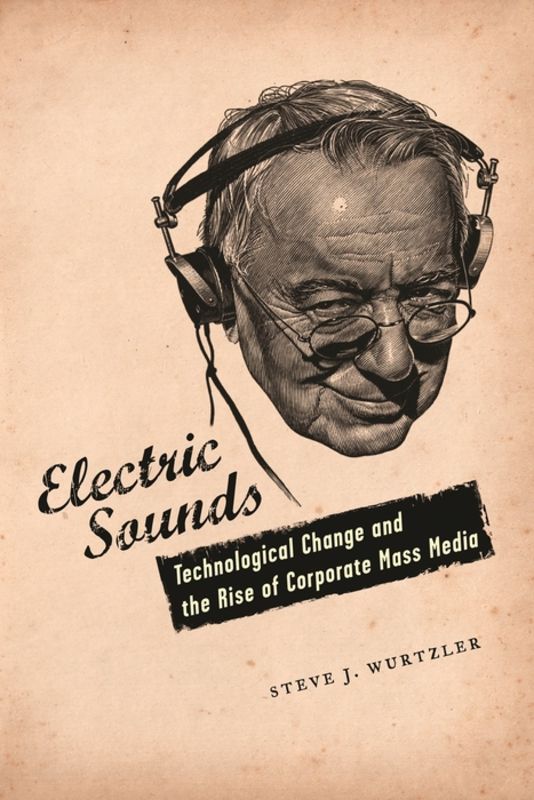
Electric Sounds
Electric Sounds brings to vivid life an era when innovations in the production, recording, and transmission of sound revolutionized a number of different media, especially the radio, the phonograph, and the cinema. The 1920s and 1930s marked some of the most important developments in the history of the American mass media: the film industry's conversion to synchronous sound, the rise of radio networks and advertising-supported broadcasting, the establishment of a federal regulatory framework on which U.S. communications policy continues to be based, the development of several powerful media conglomerates, and the birth of a new acoustic commodity in which a single story, song, or other product was made available to consumers in multiple media forms and formats. But what role would this new media play in society? Celebrants saw an opportunity for educational and cultural uplift; critics feared the degradation of the standards of public taste. Some believed acoustic media would fulfill the promise of participatory democracy by better informing the public, while others saw an opportunity for manipulation. The innovations of this period prompted not only a restructuring and consolidation of corporate mass media interests and a shift in the conventions and patterns of media consumption but also a renegotiation of the social functions assigned to mass media forms. Steve J. Wurtzler's impeccably researched history adds a new dimension to the study of sound media, proving that the ultimate form technology takes is never predetermined. Rather, it is shaped by conflicting visions of technological possibility in economic, cultural, and political realms. Electric Sounds also illustrates the process through which technologies become media and the ways in which media are integrated into American life.
eBook