
Catalogue Search | MBRL


Are you sure you want to remove the book from the shelf?

{{itemTitle}}
135
result(s) for
"Massachusetts Concord."
Sort by:


Black Walden
Concord, Massachusetts, has long been heralded as the birthplace of American liberty and American letters. It was here that the first military engagement of the Revolutionary War was fought and here that Thoreau came to \"live deliberately\" on the shores of Walden Pond. Between the Revolution and the settlement of the little cabin with the bean rows, however, Walden Woods was home to several generations of freed slaves and their children. Living on the fringes of society, they attempted to pursue lives of freedom, promised by the rhetoric of the Revolution, and yet withheld by the practice of racism. Thoreau was all but alone in his attempt \"to conjure up the former occupants of these woods.\" Other than the chapter he devoted to them in Walden, the history of slavery in Concord has been all but forgotten.In Black Walden: Slavery and Its Aftermath in Concord, Massachusetts, Elise Lemire brings to life the former slaves of Walden Woods and the men and women who held them in bondage during the eighteenth century. After charting the rise of Concord slaveholder John Cuming, Black Walden follows the struggles of Cuming's slave, Brister, as he attempts to build a life for himself after thirty-five years of enslavement. Brister Freeman, as he came to call himself, and other of the town's slaves were able to leverage the political tensions that fueled the American Revolution and force their owners into relinquishing them. Once emancipated, however, the former slaves were permitted to squat on only the most remote and infertile places. Walden Woods was one of them. Here, Freeman and his neighbors farmed, spun linen, made baskets, told fortunes, and otherwise tried to survive in spite of poverty and harassment.With a new preface that reflects on community developments since the hardcover's publication, Black Walden reminds us that this was a black space before it was an internationally known green space and preserves the legacy of the people who strove against all odds to overcome slavery and segregation.
eBook

American Spring : Lexington, Concord, and the road to revolution /
\"When we reflect on our nation's history, the American Revolution can feel almost like a foregone conclusion. In reality, the first weeks of the war were much more tenuous, and a fractured and ragtag group of colonial militias had to coalesce to have even the slimmest chance of toppling the mighty British Army. American Spring follows a fledgling nation from Paul Revere's little-known ride of December 1774 and the first shots fired on Lexington Green through the catastrophic Battle of Bunker Hill, culminating with a Virginian named George Washington taking command of colonial forces on July 3, 1775. Focusing on the colorful heroes John Hancock, Samuel Adams, Mercy Otis Warren, Benjamin Franklin, and Patrick Henry, and the ordinary Americans caught up in the revolution, Walter R. Borneman uses newly available sources and research to tell the story of how a decade of discontent erupted into an armed rebellion that forged our nation\"--Publisher description.
Book
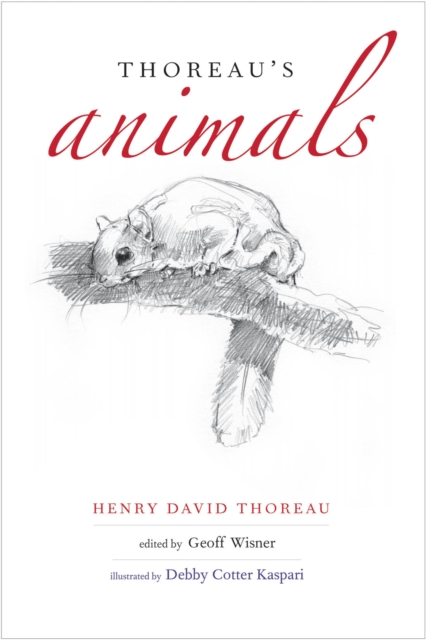
Thoreau's animals
From Thoreau's renowned Journal, a treasury of memorable, funny, and sharply observed accounts of his encounters with the wild and domestic animals of Concord Many of the most vivid writings in the renowned Journal of Henry David Thoreau concern creatures he came upon when rambling the fields, forests, and wetlands of Concord and nearby communities. A keen and thoughtful observer, he wrote frequently about these animals, always sensitive to their mysteries and deeply appreciative of their beauty and individuality. Whether serenading the perch of Walden Pond with his flute, chasing a loon across the water's surface, observing a battle between black and red ants, or engaging in a battle of wits with his family's runaway pig, Thoreau penned his journal entries with the accuracy of a scientist and the deep spirituality of a transcendentalist and mystic. This volume, like its companion Thoreau's Wildflowers, is arranged by the days of the year, following the progress of the turning seasons. A selection of his original sketchbook drawings is included, along with thirty-five exquisite illustrations by naturalist and artist Debby Cotter Kaspari.
eBook

The boatman : Henry David Thoreau's river years
The Boatman gives readers a Thoreau for the Anthropocene epoch. As a backyard naturalist and river enthusiast, Thoreau was keenly aware of the way humans had altered the waterways and meadows of his beloved Concord River Valley. And he recognized that he himself--a land surveyor by trade--was as complicit in these transformations as the bankers, lawyers, builders, landowners, and elected officials who were his clients. Robert Thorson tells a compelling story of intellectual growth, as Thoreau moved from anger, to lament, to acceptance of the way humans had changed the river he cherished more than Walden Pond.
Book

Photographs and herbarium specimens as tools to document phenological changes in response to global warming
Global warming is affecting natural systems across the world. Of the biological responses to warming, changes in the timing of phenological events such as flowering are among the most sensitive. Despite the recognized importance of phenological changes, the limited number of long-term records of phenological events has restricted research on the topic in most areas of the world. In a previous study in Boston (American Journal of Botany 91: 1260-1264), we used herbarium specimens and one season of field observations to show that plants flowered earlier as the climate warmed over the past 100 yr. In our new study, we found that two extra years of data did not strengthen the explanatory power of the analysis. Analysis of herbarium specimens without any field data yielded results similar to analyses that included field observations. In addition, we found that photographs of cultivated and wild plants in Massachusetts, data similar to that contained in herbarium specimens, show changes in flowering times that closely match independent data on the same species in the same locations. Dated photographs of plants in flower represent a new resource to extend the range of species and localities addressed in global-warming research.
Journal Article


Global Warming and Flowering Times in Thoreau's Concord: A Community Perspective
As a result of climate change, many plants are now flowering measurably earlier than they did in the past. However, some species' flowering times have changed much more than others. Data at the community level can clarify the variation in flowering responses to climate change. In order to determine how North American species' flowering times respond to climate, we analyzed a series of previously unstudied records of the dates of first flowering for over 500 plant taxa in Concord, Massachusetts, USA. These records began with six years of observations by the famous naturalist Henry David Thoreau from 1852 to 1858, continued with 16 years of observations by the botanist Alfred Hosmer in 1878 and 1888—1902, and concluded with our own observations in 2004, 2005, and 2006. From 1852 through 2006, Concord warmed by 2.4°C due to global climate change and urbanization. Using a subset of 43 common species, we determined that plants are now flowering seven days earlier on average than they did in Thoreau's times. Plant flowering times were most correlated with mean temperatures in the one or two months just before flowering and were also correlated with January temperatures. Summer-flowering species showed more interannual variation in flowering time than did spring-flowering species, but the flowering times of spring-flowering species correlated more strongly to mean monthly temperatures. In many cases, such as within the genera Betula and Solidago, closely related, co-occurring species responded to climate very differently from one another. The differences in flowering responses to warming could affect relationships in plant communities as warming continues. Common St. John's wort (Hypericum perforatum) and highbush blueberry (Vaccinium corymbosum) are particularly responsive to changes in climate, are common across much of the United States, and could serve as indicators of biological responses to climate change. We discuss the need for researchers to be aware, when using data sets involving multiple observers, of how varying methodologies, sample sizes, and sampling intensities affect the results. Finally, we emphasize the importance of using historical observations, like those of Thoreau and Hosmer, as sources of long-term data and to increase public awareness of biological responses to climate change.
Journal Article

The ride : Paul Revere and the night that saved America
\"Timed for the 250th anniversary of one of America's most famous founding events: Paul Revere's legendary ride, newly told with fresh research into little-known aspects of the myth that every American learns in school On April 18, 1775, a Boston-based silversmith, engraver, and anti-British political operative named Paul Revere set out on a borrowed horse to fulfill a dangerous but crucial mission: to alert American colonists of advancing British troops, which would seek to crush their nascent revolt. Revere was not the only rider that night, and indeed, he had completed at least 18 previous rides throughout New England, disseminating intelligence about British movements. But this ride was like no other, and its consequences in the months and years to come-as the American Revolution morphed from isolated skirmishes to a full-fledged war-became one of our founding legends. In The Ride, Kostya Kennedy presents a dramatic new narrative of the events of April 18 and 19, 1775, informed by fresh primary and secondary source research into archives, family letters and diaries, contemporary accounts, and more. Kennedy reveals Revere's ride to be more complex than it is usually portrayed-a coordinated series of rides by numerous men, near-disaster, capture by British forces, and finally success. While Revere was central to the ride and its plotting, Kennedy reveals the other men (and, perhaps, a woman with information about the movement of British forces) who helped to set in motion the events that would lead to America's independence. Thrillingly written in a dramatic, unstoppable narrative, The Ride re-tells an essential American story for a new generation of readers\"-- Provided by publisher.
BOOK