
Catalogue Search | MBRL


Are you sure you want to remove the book from the shelf?

{{itemTitle}}
7,533
result(s) for
"Matérialisme."
Sort by:


Disability and difference in global contexts : enabling a transformative body politic
This book explores the possibilities and limitations re-theorizing disability using historical materialism in the interdisciplinary contexts of social theory, cultural studies, social and education policy, feminist ethics, and theories of citizenship.
eBook

Subject Lessons
Responding to the ongoing \"objectal turn\" in contemporary humanities and social sciences, the essays inSubject Lessons present a sustained case for the continued importance- indeed, the indispensability-of the category of the subject for the future of materialist thought. Approaching matters through the frame of Hegel and Lacan, the contributors to this volume, including the editors, as well as Andrew Cole, Mladen Dolar, Nathan Gorelick, Adrian Johnston, Todd McGowan, Borna Radnik, Molly Anne Rothenberg, Kathryn Van Wert, and Alenka Zupancic-many of whom stand at the forefront of contemporary Hegel and Lacan scholarship-agree with neovitalist thinkers that material reality is ontologically incomplete, in a state of perpetual becoming, yet they maintain that this is the case not in spite of but, rather,because of the subject. Incorporating elements of philosophy, psychoanalysis, and literary and cultural studies,Subject Lessons contests the movement to dismiss the subject, arguing that there can be no truly robust materialism without accounting for the little piece of the Real that is the subject.
eBook

Entangled Worlds
Historically speaking, theology can be said to operate \"materiaphobically.\" Protestant Christianity in particular has bestowed upon theology a privilege of the soul over the body and belief over practice, in line with the distinction between a disembodied God and the inanimate world \"He\" created. Like all other human, social, and natural sciences, religious studies imported these theological dualisms into a purportedly secular modernity, mapping them furthermore onto the distinction between a rational, \"enlightened\" Europe on the one hand and a variously emotional, \"primitive, \" and \"animist\" non-Europe on the other. The \"new materialisms\" currently coursing through cultural, feminist, political, and queer theories seek to displace human privilege by attending to the agency of matter itself. Far from being passive or inert, they show us that matter acts, creates, destroys, and transforms—and, as such, is more of a process than a thing. Entangled Worlds examines the intersections of religion and new and old materialisms. Calling upon an interdisciplinary throng of scholars in science studies, religious studies, and theology, it assembles a multiplicity of experimental perspectives on materiality: What is matter, how does it materialize, and what sorts of worlds are enacted in its varied entanglements with divinity? While both theology and religious studies have over the past few decades come to prioritize the material contexts and bodily ecologies of more-than-human life, Entangled Worlds sets forth the first multivocal conversation between religious studies, theology, and the body of \"the new materialism.\" Here disciplines and traditions touch, transgress, and contaminate one another across their several carefully specified contexts. And in the responsiveness of this mutual touching of science, religion, philosophy, and theology, the growing complexity of our entanglements takes on a consistent ethical texture of urgency.
eBook
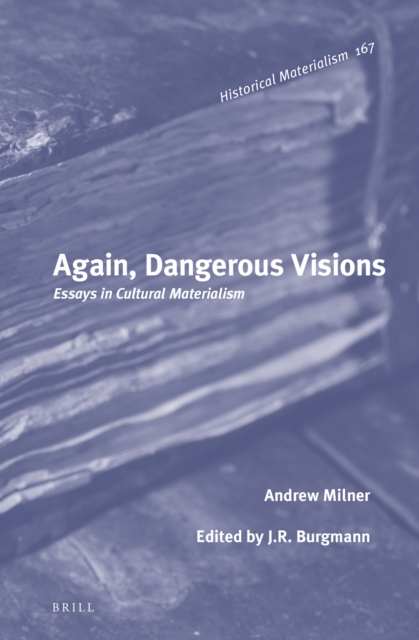
Again, Dangerous Visions
Again, Dangerous Visions: Essays in Cultural Materialism brings together twenty-six essays charting the development of Andrew Milner's distinctively Orwellian version of cultural materialism between 1981 and 2015. The essays address three substantive areas: the sociology of literature, cultural materialism and the cultural politics of the New Left, and utopian and science fiction studies. They are bookended by two conversations between Milner and his editor J.R. Burgmann, the first looking back retrospectively on the development of Milner's thought, the second looking forward prospectively towards the future of academia, the political left and science fiction.
eBook

UNE SCIENTIA SEXUALIS FACE À LA MYSTIQUE FASCISTE
The article proposes a rereading of Wilhelm Reich’s The Mass Psychology of Fascism in counterpoint to the Foucaldian historicization of the « repressive hypothesis ». It tests another hypothesis, according to which fascism not only represented one of the first objects of a Freudo-Marxist synthesis, but in effect overdetermined its formulation, causing it to take on (at the risk of breaking with the postulates of psychoanalysis and of Marxism) a dimension of excess analogous to that which it posited in the case of fascism, identifying it as the factor accounting for the latter’s traction on the « masses ». In the case of Reich, this would involve the idea of a « natural sexuality » or of an « orgasmic economy », to be turned back against a nazi biologism. It would also imply, in the case of Georges Bataille, writing at the same time, the idea of a « heterology » combining the lessons of the Freudian Massenpsychologie and those of the sociology of the sacred stemming from Durkheim, Hubert and Mauss, which could thus be turned against the fascist mysticism.
Journal Article
ÉCOLE DE FRANCFORT ET FREUDO-MARXISME
Psychoanalysis is central to the « critical theory » of the Frankfurt School, a feature it shares with « Freudo-Marxism ». The articulation between Marx and Freud can however take on various meanings. Starting from the programme of Horkheimer and Fromm in the 1930s, the article shows how the articulation went through two contrasting developments, testifying to two distinct conceptions of history. We can thus distinguish between the position of Fromm who, repudiating the theory of drives, was to become a « revisionist », drawing on psychoanalysis as a component in a theory of socialization, and an antithetical position, in line with the use of psychoanalysis which Adorno shares with Benjamin, and to which Horkheimer would subscribe, where the radicality of Freud constitutes the critical principle through which is revealed the social processes of reification, thus subverting the materialist framework. Evidence of this opposition can be found in the neo-revisionist quarrel (between Marcuse and Fromm) and, to a certain extent, in Habermas and Honneth, whose work shows a certain continuity with that of Fromm.
Journal Article
LE SAVOIR-FAIRE DE L’ANALYSTE
To take as the object of one’s inquiry the analyst’s « know-how » is an indication that, while psychoanalysis is indeed a theory, it remains essential to the understanding of its status and of the effects produced by it outside its specific field that it be addressed in terms of its actual, clinical working out. The aim of the article is to demonstrate how psychoanalysis manifests a practical orientation, thus situating it in what is a strategic position for any politics aimed at the opening of the space of conflict by effecting a change in its coordinates, instead of the attempted erasure of the latter, or the attempt to introduce an instance of moderation or justice into the specific cases of conflict. Insofar as its clinic takes precedence over an anthropology, to the point where it can ultimately do without the latter, psychoanalysis enables us to reconsider the relations between the masses and ordinary singularities, thus envisaging a politics without an anthropology.
Journal Article
LE PSYCHIATRE, L’INFIRMIER, LE FOU ET LA PSYCHANALYSE. POUR UNE HISTOIRE POPULAIRE DE LA PSYCHANALYSE 2
In opposition to the revisionism characterizing contemporary psychoanalysis, this article pursues our investigation aimed at foregrounding the constituent elements of a popular history of psychoanalysis. In the aftermath of the 1939-45 war, there emerged, throughout Europe, a series of enterprises which sought to reappraise the issue of madness, with the result that a host of new practical approaches saw the day. These were, to begin with, the initiatives of psychiatrists, who in many cases were psychoanalysts. Having been active in the resistance, and drawing on their experience as political activists, sometimes as Marxists, they continued their struggle in the immediate aftermath of the war, explicitly formulating as their goal the destruction of the alienating structures of the psychiatric hospital. Our intention is thus to focus on the French psychiatrico-psychanalytical context of the 1950s, in the period prior to the contribution of Félix Guattari from the beginning of the 1960s and the seminal perspectives he opened up, through which to rethink a revolutionary praxis.
Journal Article
DIALECTISER LE SEXE. RÉÉLABORATIONS MATÉRIALISTES ET PSYCHANALYTIQUES DANS LES APPROCHES DE GENRE
Starting from a reading of Shulamith Firestone’s ground-breaking book, The Dialectic of Sex, the article questions the dialectical approach used in certain gender theories which reevaluate both psychoanalysis and Engels and Marx’s materialism. The very notion of the dialectical–which can have different meanings–enables us to address the sexual question by way of the socio-historical production of gender-oriented discourses and practices, in articulation with the psychosexual basis of this production. The dialectical approach, the thrust of which is critical and revolutionary, must however undergo a conceptual rephrasing of their psychoanalytical and Marxist formulation, in particular regarding the relations between biology, class and sex, with a view to deciphering the gendered bias latent in their unconscious and ideological conceptualization. The inherited theoretical framework, proper to Marxism and to psychoanalysis, is thus tested in the confrontation with the historical specificity of the articulation between the social relations of sex, class, and race, thus leading to the elaboration of a materialistic approach to psychoanalysis.
Journal Article