
Catalogue Search | MBRL


Are you sure you want to remove the book from the shelf?

{{itemTitle}}
75,198
result(s) for
"Materials Mathematical models."
Sort by:

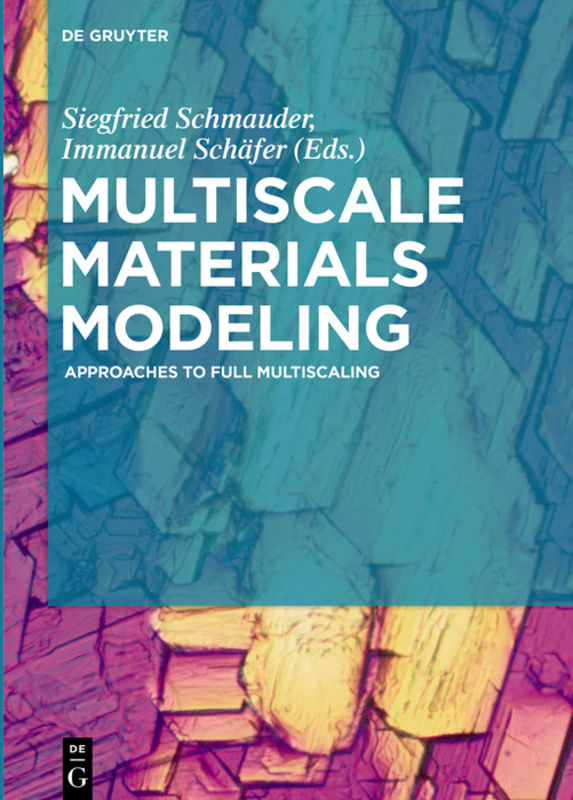
Multiscale Materials Modeling
This book presents current spatial and temporal multiscaling approaches of materials modeling. Recent results demonstrate the deduction of macroscopic properties at the device and component level by simulating structures and materials sequentially on atomic, micro- and mesostructural scales. The book covers precipitation strengthening and fracture processes in metallic alloys, materials that exhibit ferroelectric and magnetoelectric properties as well as biological, metal-ceramic and polymer composites. The progress which has been achieved documents the current state of art in multiscale materials modelling (MMM) on the route to full multi-scaling. Contents: Part I: Multi-time-scale and multi-length-scale simulations of precipitation and strengthening effects Linking nanoscale and macroscale Multiscale simulations on the coarsening of Cu-rich precipitates in ?-Fe using kinetic Monte Carlo, Molecular Dynamics, and Phase-Field simulations Multiscale modeling predictions of age hardening curves in Al-Cu alloys Kinetic Monte Carlo modeling of shear-coupled motion of grain boundaries Product Properties of a two-phase magneto-electric composite Part II: Multiscale simulations of plastic deformation and fracture Niobium/alumina bicrystal interface fracture Atomistically informed crystal plasticity model for body-centred cubic iron FE2AT ? finite element informed atomistic simulations Multiscale fatigue crack growth modeling for welded stiffened panels Molecular dynamics study on low temperature brittleness in tungsten single crystals Multi scale cellular automata and finite element based model for cold deformation and annealing of a ferritic-pearlitic microstructure Multiscale simulation of the mechanical behavior of nanoparticle-modified polyamide composites Part III: Multiscale simulations of biological and bio-inspired materials, bio-sensors and composites Multiscale Modeling of Nano-Biosensors Finite strain compressive behaviour of CNT/epoxy nanocomposites Peptide?zinc oxide interaction
eBook

Guidelines for determining the probability of ignition of a released flammable mass
\"Complemented by an estimating tool spreadsheet based on a fixed set of chemicals to assist in all siting studies, [Guidelines for determining the probability of ignition of a released flammable mass] converts a \"best guess\" to a calculated value based on available information and current technology. The text provides a technology-based approach to deriving the probability that a flammable mass will find an ignition source and ignite. It offers valuable information in the development of a facility's Emergency Response Plan\"-- Provided by publisher.
Book
Introduction to the Network Approximation Method for Materials Modeling
In recent years the traditional subject of continuum mechanics has grown rapidly and many new techniques have emerged. This text provides a rigorous, yet accessible introduction to the basic concepts of the network approximation method and provides a unified approach for solving a wide variety of applied problems. As a unifying theme, the authors discuss in detail the transport problem in a system of bodies. They solve the problem of closely placed bodies using the new method of network approximation for PDE with discontinuous coefficients, developed in the 2000s by applied mathematicians in the USA and Russia. Intended for graduate students in applied mathematics and related fields such as physics, chemistry and engineering, the book is also a useful overview of the topic for researchers in these areas.
eBook


Physical and Numerical Simulation of Materials Processing VII
Selected, peer reviewed papers from the 7th International Conference on Physical and Numerical Simulation of Materials Processing (ICPNS 13), June 16-19, 2013, Oulu, Finland.
eBook

Advances in materials and pavement prediction II : contributions to the 2nd International Conference on Advances in Materials and Pavement Performance Prediction (AM3P 2020), 27-29 May 2020, San Antonio, TX, USA
\"Inspired from the legacy of the previous four 3DFEM conferences held in Delft and Athens as well as the successful 2018 AM3P conference held in Doha, the 2020 AM3P conference continues the pavement mechanics theme including pavement models, experimental methods to estimate model parameters, and their implementation in predicting pavement performance. The AM3P conference is organized by the Standing International Advisory Committee (SIAC), at the time of this publication chaired by Professors Tom Scarpas, Eyad Masad, and Amit Bhasin. Advances in Materials and Pavement Performance Prediction II includes over 111 papers presented at the 2020 AM3P Conference. The technical topics covered include: rigid pavements, pavement geotechnics, statistical and data tools in pavement engineering, pavement structures, asphalt mixtures, asphalt binders. The book will be invaluable to academics and engineers involved or interested in pavement engineering, pavement models, experimental methods to estimate model parameters, and their implementation in predicting pavement performance.\"-- Provided by publisher.
Book
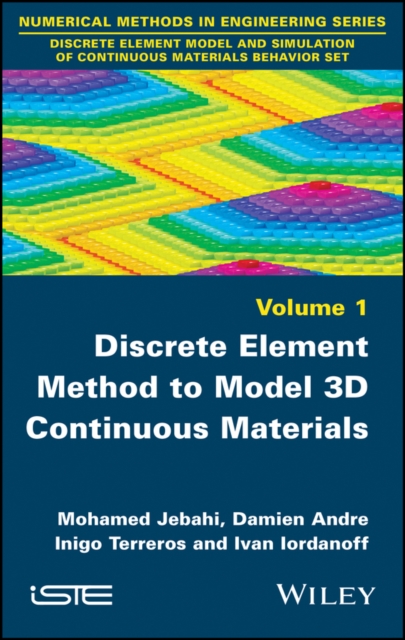
Discrete Element Method to Model 3D Continuous Materials
Complex behavior models (plasticity, cracks, visco elascticity) face some theoretical difficulties for the determination of the behavior law at the continuous scale.When homogenization fails to give the right behavior law, a solution is to simulate the material at a meso scale in order to simulate directly a set of discrete properties that are.
eBook

Computational Materials Discovery
New technologies are made possible by new materials, and until recently new materials could only be discovered experimentally. Recent advances in solving the crystal structure prediction problem means that the computational design of materials is now a reality. This book provides a comprehensive review of this field covering different computational methodologies as well as specific applications of materials design. The book starts by illustrating how and why first-principle calculations have gained importance in the process of materials discovery. The book is then split into three sections, the first exploring different approaches and ideas including crystal structure prediction from evolutionary approaches, data mining methods and applications of machine learning. Section two then looks at examples of designing specific functional materials with special technological relevance for example photovoltaic materials, superconducting materials, topological insulators and thermoelectric materials. The final section considers recent developments in creating low-dimensional materials.
eBook
