
Catalogue Search | MBRL


Are you sure you want to remove the book from the shelf?

{{itemTitle}}
500
result(s) for
"Mathematical analysis Miscellanea."
Sort by:

A mathematical nature walk
How tall is that tree? How far away is that cloud, and how heavy is it? Why are the droplets on that spider web spaced apart so evenly? If you have ever asked questions like these while outdoors, and wondered how you might figure out the answers, this is a book for you.
Book
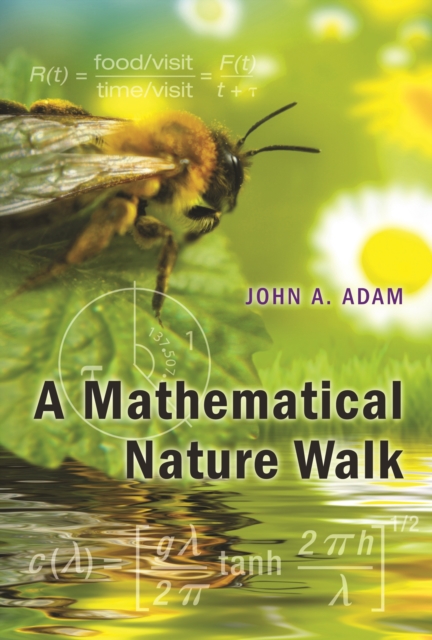
A mathematical nature walk
How heavy is that cloud? Why can you see farther in rain than in fog? Why are the droplets on that spider web spaced apart so evenly? If you have ever asked questions like these while outdoors, and wondered how you might figure out the answers, this is a book for you. An entertaining and informative collection of fascinating puzzles from the natural world around us,A Mathematical Nature Walkwill delight anyone who loves nature or math or both.
John Adam presents ninety-six questions about many common natural phenomena--and a few uncommon ones--and then shows how to answer them using mostly basic mathematics. Can you weigh a pumpkin just by carefully looking at it? Why can you see farther in rain than in fog? What causes the variations in the colors of butterfly wings, bird feathers, and oil slicks? And why are large haystacks prone to spontaneous combustion? These are just a few of the questions you'll find inside. Many of the problems are illustrated with photos and drawings, and the book also has answers, a glossary of terms, and a list of some of the patterns found in nature. About a quarter of the questions can be answered with arithmetic, and many of the rest require only precalculus. But regardless of math background, readers will learn from the informal descriptions of the problems and gain a new appreciation of the beauty of nature and the mathematics that lies behind it.
eBook

Numbers rule
Since the very birth of democracy in ancient Greece, the simple act of voting has given rise to mathematical paradoxes that have puzzled some of the greatest philosophers, statesmen, and mathematicians.Numbers Ruletraces the epic quest by these thinkers to create a more perfect democracy and adapt to the ever-changing demands that each new generation places on our democratic institutions.
In a sweeping narrative that combines history, biography, and mathematics, George Szpiro details the fascinating lives and big ideas of great minds such as Plato, Pliny the Younger, Ramon Llull, Pierre Simon Laplace, Thomas Jefferson, Alexander Hamilton, John von Neumann, and Kenneth Arrow, among many others. Each chapter in this riveting book tells the story of one or more of these visionaries and the problem they sought to overcome, like the Marquis de Condorcet, the eighteenth-century French nobleman who demonstrated that a majority vote in an election might not necessarily result in a clear winner. Szpiro takes readers from ancient Greece and Rome to medieval Europe, from the founding of the American republic and the French Revolution to today's high-stakes elective politics. He explains how mathematical paradoxes and enigmas can crop up in virtually any voting arena, from electing a class president, a pope, or prime minister to the apportionment of seats in Congress.
Numbers Ruledescribes the trials and triumphs of the thinkers down through the ages who have dared the odds in pursuit of a just and equitable democracy.
eBook


On p-values for smooth components of an extended generalized additive model
The problem of testing smooth components of an extended generalized additive model for equality to zero is considered. Confidence intervals for such components exhibit good across-the-function coverage probabilities if based on the approximate result f̂(i) ~ N{f(i), Vf(i,i)}, where f is the vector of evaluated values for the smooth component of interest and Vf is the covariance matrix for f according to the Bayesian view of the smoothing process. Based on this result, a Wald-type test of = 0 is proposed. It is shown that care must be taken in selecting the rank used in the test statistic. The method complements previous work by extending applicability beyond the Gaussian case, while considering tests of zero effect rather than testing the parametric hypothesis given by the null space of the component's smoothing penalty. The proposed p-values are routine and efficient to compute from a fitted model, without requiring extra model fits or null distribution simulation.
Journal Article
Signal-plus-noise matrix models
Estimating eigenvectors and low-dimensional subspaces is of central importance for numerous problems in statistics, computer science and applied mathematics. In this paper we characterize the behaviour of perturbed eigenvectors for a range of signal-plus-noise matrix models encountered in statistical and randommatrix-theoretic settings. We establish both first-order approximation results, i.e., sharp deviations, and second-order distributional limit theory, i.e., fluctuations. The concise methodology presented in this paper synthesizes tools rooted in two core concepts, namely deterministic decompositions of matrix perturbations and probabilistic matrix concentration phenomena. We illustrate our theoretical results with simulation examples involving stochastic block model random graphs.
Journal Article
On causal discovery with an equal-variance assumption
Prior work has shown that causal structure can be uniquely identified from observational data when these follow a structural equation model whose error terms have equal variance. We show that this fact is implied by an ordering among conditional variances. We demonstrate that ordering estimates of these variances yields a simple yet state-of-the-art method for causal structure learning that is readily extendable to high-dimensional problems.
Journal Article
A non-model-based approach to bandwidth selection for kernel estimators of spatial intensity functions
We propose a new bandwidth selection method for kernel estimators of spatial point process intensity functions. The method is based on an optimality criterion motivated by the Campbell formula applied to the reciprocal intensity function. The new method is fully nonparametric, does not require knowledge of higher-order moments, and is not restricted to a specific class of point process. Our approach is computationally straightforward and does not require numerical approximation of integrals.
Journal Article
Choosing between methods of combining p-values
Combining p-values from independent statistical tests is a popular approach to meta-analysis, particularly when the data underlying the tests are either no longer available or are difficult to combine. Numerous p-value combination methods appear in the literature, each with different statistical properties, yet often the final choice used in a meta-analysis can seem arbitrary, as if all effort has been expended in building the models that gave rise to the p-values. Birnbaum (1954) showed that any reasonable p-value combiner must be optimal against some alternative hypothesis. Starting from this perspective and recasting each method of combining p-values as a likelihood ratio test, we present theoretical results for some standard combiners that provide guidance on how a powerful combiner might be chosen in practice.
Journal Article
A consistent multivariate test of association based on ranks of distances
We consider the problem of detecting associations between random vectors of any dimension. Few tests of independence exist that are consistent against all dependent alternatives. We propose a powerful test that is applicable in all dimensions and consistent against all alternatives. The test has a simple form, is easy to implement, and has good power.
Journal Article