
Catalogue Search | MBRL


Are you sure you want to remove the book from the shelf?

{{itemTitle}}
26,850
result(s) for
"Mathematical foundations"
Sort by:

Souslin quasi-orders and bi-embeddability of uncountable structures
We provide analogues of the results from Friedman and Motto Ros (2011) and Camerlo, Marcone, and Motto Ros (2013) (which correspond
to the case
eBook

A Unified Approach to Structural Limits and Limits of Graphs with Bounded Tree-Depth
In this paper we introduce a general framework for the study of limits of relational structures and graphs in particular, which is
based on a combination of model theory and (functional) analysis. We show how the various approaches to graph limits fit to this
framework and that they naturally appear as “tractable cases” of a general theory. As an outcome of this, we provide extensions of known
results. We believe that this puts these into a broader context. The second part of the paper is devoted to the study of sparse
structures. First, we consider limits of structures with bounded diameter connected components and we prove that in this case the
convergence can be “almost” studied component-wise. We also propose the structure of limit objects for convergent sequences of sparse
structures. Eventually, we consider the specific case of limits of colored rooted trees with bounded height and of graphs with bounded
tree-depth, motivated by their role as “elementary bricks” these graphs play in decompositions of sparse graphs, and give an explicit
construction of a limit object in this case. This limit object is a graph built on a standard probability space with the property that
every first-order definable set of tuples is measurable. This is an example of the general concept of
eBook

Minimal Weak Truth Table Degrees and Computably Enumerable Turing Degrees
Two of the central concepts for the study of degree structures in computability theory are computably enumerable degrees and minimal degrees. For strong notions of reducibility, such as m-deducibility or truth table reducibility, it is possible for computably enumerable degrees to be minimal. For weaker notions of reducibility, such as weak truth table reducibility or Turing reducibility, it is not possible to combine these properties in a single degree. We consider how minimal weak truth table degrees interact with computably enumerable Turing degrees and obtain three main results. First, there are sets with minimal weak truth table degree which bound noncomputable computably enumerable sets under Turing reducibility. Second, no set with computable enumerable Turing degree can have minimal weak truth table degree. Third, no \\Delta^0_2 set which Turing bounds a promptly simple set can have minimal weak truth table degree.
eBook

The Philosophy of Mathematical Practice
Contemporary philosophy of mathematics offers us an embarrassment of riches. But anyone familiar with this area will be aware of the need for new approaches that will pay closer attention to mathematical practice. This book provides a unified presentation of this new wave of work in philosophy of mathematics. This new approach is innovative in at least two ways. First, it holds that there are important novel characteristics of contemporary mathematics that are just as worthy of philosophical attention as the distinction between constructive and non constructive mathematics at the time of the foundational debates. Secondly, it holds that many topics that escape purely formal logical treatment — such as visualization, explanation, and understanding — can be nonetheless be subjected to philosophical analysis. The book comprises an introduction and eight sections. Each section consists of a short introduction outlining the general topic followed by a related research article. The eight topics selected represent a broad spectrum of contemporary philosophical reflection on different aspects of mathematical practice: visualization, diagrammatic reasoning and representational systems, mathematical explanation, purity of methods, mathematical concepts, philosophical relevance of category theory, philosophical aspects of computer science in mathematics, philosophical impact of recent developments in mathematical physics.
eBook
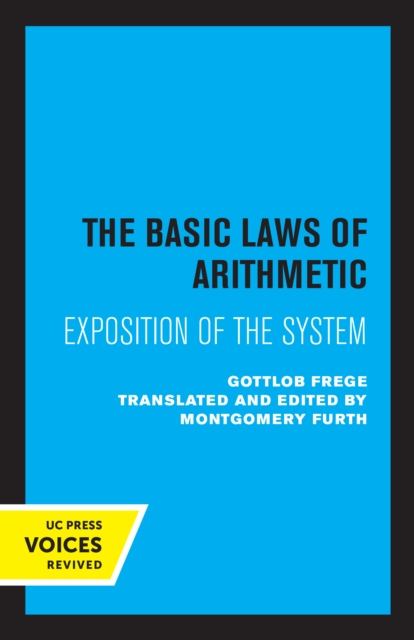
The Basic Laws of Arithmetic
Basic Laws of Arithmetic: Exposition of the System by Gottlob Frege is a seminal work that aims to establish arithmetic and mathematical analysis as logical systems derived from pure logic. Published in 1893, it represents a cornerstone in the history of mathematical and philosophical thought. Frege's primary objective was to substantiate logicism, the view that truths of arithmetic are not irreducibly mathematical, synthetic a priori, or empirical, but are instead expressions of logical truths. The book lays out three core tasks: defining logical propositions and rules of inference, and deriving arithmetic's fundamental truths from these logical principles. While Frege's meticulous approach to these tasks helped establish mathematical logic as a discipline, his work ultimately failed to achieve its purpose, as the set theory underpinning his system proved inconsistent, a flaw brought to his attention by Bertrand Russell. Despite its failure as Frege envisioned it, the work remains profoundly influential. Frege's exploration of logical truth and inference pioneered formal logic, including propositional calculus, quantification theory, and set theory. His philosophy of language, embedded within the system's semantics, offers a deep and nuanced understanding of meaning that continues to resonate within analytical philosophy. Moreover, Frege's precise and rigorous standards of reasoning surpass many subsequent works, including the more widely adopted Principia Mathematica. Although his logicism is untenable in its original form, Frege's ideas remain a vital resource for understanding the intersection of logic, mathematics, and language, making his Grundgesetze a crucial study for philosophers, logicians, and historians. This translation of key sections emphasizes its ongoing relevance to modern philosophical inquiries into meaning and language. This
title is part of UC Press's Voices Revived program, which commemorates University of California Press's mission to seek out and cultivate the brightest minds and give them voice, reach, and impact. Drawing on a backlist dating to 1893, Voices Revived makes high-quality, peer-reviewed scholarship accessible once again using print-on-demand technology. This title was originally published in 1964. Many titles in the Voices Revived program are also newly available as ebooks, offered at a discounted price to support wider access to scholarly work.
eBook
Foundations of linear and generalized linear models
This book presents an overview of the foundations and the key ideas and results of linear and generalized linear models under one cover. Written by a prolific academic, researcher, and textbook writer, Foundations of Linear and Generalized Linear Models is soon to become the gold standard by which all existing textbooks on the topic will be compared. While the emphasis is clearly and succinctly on theoretical underpinnings, applications in \"R\" are presented when they help to elucidate the content or promote practical model building. Each chapter contains approximately 15-20 exercises, primarily for readers to practice and extend the theory, but, also to assimilate the ideas by doing some data analysis. The carefully crafted models and examples convey basic concepts and do not get mired down in non-trivial considerations. An author-maintained web site includes, among other numerous pedagogical supplements, analyses that parallel the \"R\" routines from the book in SAS, SPSS and Stata\"
eBook

The reciprocal theorem in fluid dynamics and transport phenomena
In the study of fluid dynamics and transport phenomena, key quantities of interest are often the force and torque on objects and total rate of heat/mass transfer from them. Conventionally, these integrated quantities are determined by first solving the governing equations for the detailed distribution of the field variables (i.e. velocity, pressure, temperature, concentration, etc.) and then integrating the variables or their derivatives on the surface of the objects. On the other hand, the divergence form of the conservation equations opens the door for establishing integral identities that can be used for directly calculating the integrated quantities without requiring the detailed knowledge of the distribution of the primary variables. This shortcut approach constitutes the idea of the reciprocal theorem, whose closest relative is Green’s second identity, which readers may recall from studies of partial differential equations. Despite its importance and practicality, the theorem may not be so familiar to many in the research community. Ironically, some believe that the extreme simplicity and generality of the theorem are responsible for suppressing its application! In this Perspectives piece, we provide a pedagogical introduction to the concept and application of the reciprocal theorem, with the hope of facilitating its use. Specifically, a brief history on the development of the theorem is given as a background, followed by the discussion of the main ideas in the context of elementary boundary-value problems. After that, we demonstrate how the reciprocal theorem can be utilized to solve fundamental problems in low-Reynolds-number hydrodynamics, aerodynamics, acoustics and heat/mass transfer, including convection. Throughout the article, we strive to make the materials accessible to early career researchers while keeping it interesting for more experienced scientists and engineers.
Journal Article
Stokes flows in three-dimensional fluids with odd and parity-violating viscosities
The Stokes equation describes the motion of fluids when inertial forces are negligible compared with viscous forces. In this article, we explore the consequence of parity-violating and non-dissipative (i.e. odd) viscosities on Stokes flows in three dimensions. Parity-violating viscosities are coefficients of the viscosity tensor that are not invariant under mirror reflections of space, while odd viscosities are those which do not contribute to dissipation of mechanical energy. These viscosities can occur in systems ranging from synthetic and biological active fluids to magnetized and rotating fluids. We first systematically enumerate all possible parity-violating viscosities compatible with cylindrical symmetry, highlighting their connection to potential microscopic realizations. Then, using a combination of analytical and numerical methods, we analyse the effects of parity-violating viscosities on the Stokeslet solution, on the flow past a sphere or a bubble and on many-particle sedimentation. In all the cases that we analyse, parity-violating viscosities give rise to an azimuthal flow even when the driving force is parallel to the axis of cylindrical symmetry. For a few sedimenting particles, the azimuthal flow bends the trajectories compared with a traditional Stokes flow. For a cloud of particles, the azimuthal flow impedes the transformation of the spherical cloud into a torus and the subsequent breakup into smaller parts that would otherwise occur. The presence of azimuthal flows in cylindrically symmetric systems (sphere, bubble, cloud of particles) can serve as a probe for parity-violating viscosities in experimental systems.
Journal Article

Foundations of mathematics: logic at Harvard : essays in honor of Hugh Woodin's 60th birthday, March 27-29, 2015, Harvard University, Cambridge, MA
This volume contains the proceedings of the Logic at Harvard conference in honor of W. Hugh Woodin's 60th birthday, held March 27-29, 2015, at Harvard University. It presents a collection of papers related to the work of Woodin, who has been one of the leading figures in set theory since the early 1980s.The topics cover many of the areas central to Woodin's work, including large cardinals, determinacy, descriptive set theory and the continuum problem, as well as connections between set theory and Banach spaces, recursion theory, and philosophy, each reflecting a period of Woodin's career. Other topics covered are forcing axioms, inner model theory, the partition calculus, and the theory of ultrafilters.This volume should make a suitable introduction to Woodin's work and the concerns which motivate it. The papers should be of interest to graduate students and researchers in both mathematics and philosophy of mathematics, particularly in set theory, foundations and related areas.
eBook

Premise Selection for Mathematics by Corpus Analysis and Kernel Methods
Smart premise selection is essential when using automated reasoning as a tool for large-theory formal proof development. This work develops learning-based premise selection in two ways. First, a fine-grained dependency analysis of existing high-level formal mathematical proofs is used to build a large knowledge base of proof dependencies, providing precise data for ATP-based re-verification and for training premise selection algorithms. Second, a new machine learning algorithm for premise selection based on kernel methods is proposed and implemented. To evaluate the impact of both techniques, a benchmark consisting of 2078 large-theory mathematical problems is constructed, extending the older MPTP Challenge benchmark. The combined effect of the techniques results in a 50 % improvement on the benchmark over the state-of-the-art Vampire/SInE system for automated reasoning in large theories.
Journal Article