
Catalogue Search | MBRL


Are you sure you want to remove the book from the shelf?

{{itemTitle}}
141,096
result(s) for
"Mathematical optimization"
Sort by:

Iterative optimizers : difficulty measures and benchmarks
Almost every month, a new optimization algorithm is proposed, often accompanied by the claim that it is superior to all those that came before it. However, this claim is generally based on the algorithm's performance on a specific set of test cases, which are not necessarily representative of the types of problems the algorithm will face in real life. This book presents the theoretical analysis and practical methods (along with source codes) necessary to estimate the difficulty of problems in a test set, as well as to build bespoke test sets consisting of problems with varied difficulties. The book formally establishes a typology of optimization problems, from which a reliable test set can be deduced. At the same time, it highlights how classic test sets are skewed in favor of different classes of problems, and how, as a result, optimizers that have performed well on test problems may perform poorly in real life scenarios.
Book
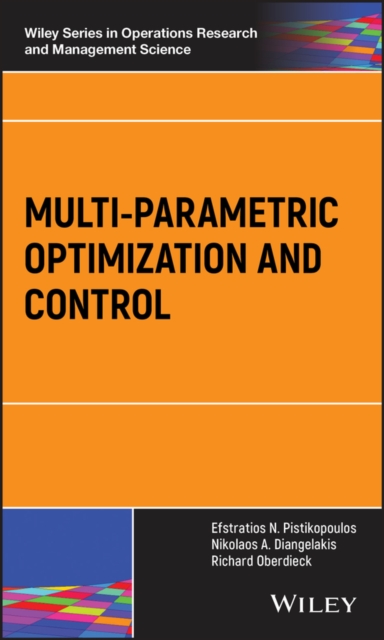
Multi-parametric Optimization and Control
Recent developments in multi-parametric optimization and control Multi-Parametric Optimization and Control provides comprehensive coverage of recent methodological developments for optimal model-based control through parametric optimization. It also shares real-world research applications to support deeper understanding of the material. Researchers and practitioners can use the book as reference. It is also suitable as a primary or a supplementary textbook. Each chapter looks at the theories related to a topic along with a relevant case study. Topic complexity increases gradually as readers progress through the chapters. The first part of the book presents an overview of the state-of-the-art multi-parametric optimization theory and algorithms in multi-parametric programming. The second examines the connection between multi-parametric programming and model-predictive control—from the linear quadratic regulator over hybrid systems to periodic systems and robust control. The third part of the book addresses multi-parametric optimization in process systems engineering. A step-by-step procedure is introduced for embedding the programming within the system engineering, which leads the reader into the topic of the PAROC framework and software platform. PAROC is an?integrated framework and platform for the optimization and advanced model-based control of process systems. * Uses case studies to illustrate real-world applications for a better understanding of the concepts presented * Covers the fundamentals of optimization and model predictive control * Provides information on key topics, such as the basic sensitivity theorem, linear programming, quadratic programming, mixed-integer linear programming, optimal control of continuous systems, and multi-parametric optimal control An appendix summarizes the history of multi-parametric optimization algorithms. It also covers the use of the parametric optimization toolbox (POP), which is comprehensive software for efficiently solving multi-parametric programming problems.
eBook


Correction: Zambou et al. Optimized Nonlinear PID Control for Maximum Power Point Tracking in PV Systems Using Particle Swarm Optimization. Math. Comput. Appl. 2024, 29, 88
Because of the uncertain meaning in the original publication [...]
Journal Article


Metaheuristics for vehicle routing problems
This book is dedicated to metaheuristics as applied to vehicle routing problems.Several implementations are given as illustrative examples, along with applications to several typical vehicle routing problems.
eBook


Correction: COVID-19 prediction using Caviar Squirrel Jellyfish Search Optimization technique in fog-cloud based architecture
[This corrects the article DOI: 10.1371/journal.pone.0295599.].
Journal Article


A Review of Peer-to-Peer Energy Trading Markets: Enabling Models and Technologies
This paper presents a detailed review of the existing literature on peer-to-peer (P2P) energy trading considering market architectures, trading strategies, and enabling technologies. P2P energy trading enables individual users in the electricity network to act as sellers or buyers and trade energy among each other. To facilitate the discussion on different aspects of P2P energy trading, this paper focuses on P2P market mechanisms, relevant bidding strategies, and auction models. In addition, to solve the energy management problems associated with P2P energy trading, this paper investigates widely used solution methods such as game-theoretic models, mathematical optimisation, as well as more recent machine learning techniques and evaluates them in a critical manner. The outcomes of this investigation along with the identification of the challenges and limitations will allow researchers to find suitable P2P energy trading mechanisms based on different market contexts. Moreover, the discussions on potential future research directions are expected to improve the effectiveness of P2P energy trading technologies.
Journal Article