
Catalogue Search | MBRL


Are you sure you want to remove the book from the shelf?

{{itemTitle}}
198
result(s) for
"Mathematics -- Popular works"
Sort by:


Foolproof, and other mathematical meditations
A non-mathematician explores mathematical terrain, reporting accessibly and engagingly on topics from Sudoku to probability.Brian Hayes wants to convince us that mathematics is too important and too much fun to be left to the mathematicians. Foolproof, and Other Mathematical Meditations is his entertaining and accessible exploration of mathematical terrain both far-flung and nearby, bringing readers tidings of mathematical topics from Markov chains to Sudoku. Hayes, a non-mathematician, argues that mathematics is not only an essential tool for understanding the world but also a world unto itself, filled with objects and patterns that transcend earthly reality. In a series of essays, Hayes sets off to explore this exotic terrain, and takes the reader with him.Math has a bad reputation: dull, difficult, detached from daily life. As a talking Barbie doll opined, \"Math class is tough.\" But Hayes makes math seem fun. Whether he's tracing the genealogy of a well-worn anecdote about a famous mathematical prodigy, or speculating about what would happen to a lost ball in the nth dimension, or explaining that there are such things as quasirandom numbers, Hayes wants readers to share his enthusiasm. That's why he imagines a cinematic treatment of the discovery of the Riemann zeta function (\"The year: 1972. The scene: Afternoon tea in Fuld Hall at the Institute for Advanced Study in Princeton, New Jersey\"), explains that there is math in Sudoku after all, and describes better-than-average averages. Even when some of these essays involve a hike up the learning curve, the view from the top is worth it.
eBook
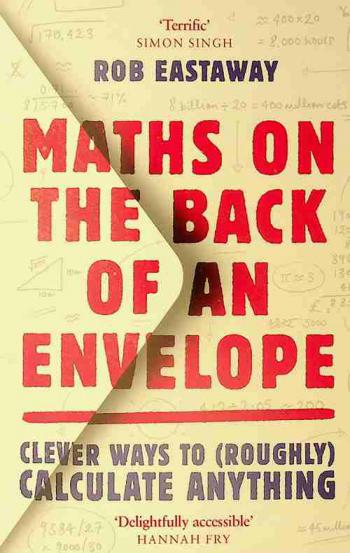
Maths on the back of an envelope : clever ways to (roughly) calculate anything
Does that statistic make sense? How much will this round of drinks come to? And what are the chances of winning the lottery? Twice? Learn how to do complex maths with nothing but the back of an envelope, a pencil and some good old-fashioned brain power. Doing mathematics without a calculator seems like an unnecessary feat in the twenty-first century. These clever little electronic devices have helped to take away the drudgery of arithmetic, and given all of us the power to perform in a few seconds what might previously have taken hours to work out. But much of the time, we don't need the exact answer with its endless decimal points - we just need to know whether something is in the right ballpark. Rob Eastaway's clever mathematical techniques do exactly that, as he takes an entertaining look at how to figure without a calculator. From spotting misleading statistics in the news and bad deals, to estimating how long you'll be standing in that slowly crawling queue, this book is packed with amusing anecdotes and handy back-of-the-envelope calculations for every situation. Most importantly, this book is a timely and welcome reminder that sometimes our own brain is the best tool we have to deal with numbers.

Strange curves, counting rabbits, and other mathematical explorations
How does mathematics enable us to send pictures from space back to Earth? Where does the bell-shaped curve come from? Why do you need only 23 people in a room for a 50/50 chance of two of them sharing the same birthday? InStrange Curves, Counting Rabbits, and Other Mathematical Explorations, Keith Ball highlights how ideas, mostly from pure math, can answer these questions and many more. Drawing on areas of mathematics from probability theory, number theory, and geometry, he explores a wide range of concepts, some more light-hearted, others central to the development of the field and used daily by mathematicians, physicists, and engineers.
Each of the book's ten chapters begins by outlining key concepts and goes on to discuss, with the minimum of technical detail, the principles that underlie them. Each includes puzzles and problems of varying difficulty. While the chapters are self-contained, they also reveal the links between seemingly unrelated topics. For example, the problem of how to design codes for satellite communication gives rise to the same idea of uncertainty as the problem of screening blood samples for disease.
Accessible to anyone familiar with basic calculus, this book is a treasure trove of ideas that will entertain, amuse, and bemuse students, teachers, and math lovers of all ages.
eBook


Math for real life for dummies
The easy way to brush up on the math skills you need in real life Not everyone retains the math they learned in school. Like any skill, your ability to speak \"math\" can deteriorate if left unused. From adding and subtracting money in a bank account to figuring out the number of shingles to put on a roof, math in all of its forms factors into daily life. Math For Real Life For Dummies provides you with the simple formulas and theorems that you're likely to encounter in the workplace, the kitchen, and even when playing games. You can turn to Math For Real Life For Dummies to brush up on your math skills or to handle everyday encounters, like calculating restaurant tips, understanding interest rates, and figuring out percentages and odds. Packed with real-world examples that make sense, Math For Real Life For Dummies takes the stress out of your daily calculation encounters. Provides tips for understanding and using basic mathematical concepts Shows you how math helps the mind to reason and organize complicated situations or problems into clear, simple, and logical steps Covers all of the math skills you're likely to need in everyday situations If you're looking for a practical, plain-English guide to mastering everyday math skills, Math For Real Life For Dummies has you covered.
eBook

Figuring it out : entertaining encounters with everyday math
\"This is a book of mathematical stories--funny and puzzling mathematical stories. They tell of villains who try to steal secrets, heroes who encode their messages, and mathematicians who spend years on end searching for the best way to pile oranges. There are also stories about highway confusions occurring when the rules of Cartesian geometry are ignored, small-change errors due to ignorance of ancient paradoxes, and mistakes in calendars arising from poor numerical approximations. This book is about the power and beauty of mathematics. It shows mathematics in action, explained in a way that everybody can understand.\"--Jacket.
Book

Slicing pizzas, racing turtles, and further adventures in applied mathematics
Have you ever daydreamed about digging a hole to the other side of the world? Robert Banks not only entertains such ideas but, better yet, he supplies the mathematical know-how to turn fantasies into problem-solving adventures. In this sequel to the popularTowing Icebergs, Falling Dominoes(Princeton, 1998), Banks presents another collection of puzzles for readers interested in sharpening their thinking and mathematical skills. The problems range from the wondrous to the eminently practical. In one chapter, the author helps us determine the total number of people who have lived on earth; in another, he shows how an understanding of mathematical curves can help a thrifty lover, armed with construction paper and scissors, keep expenses down on Valentine's Day.
In twenty-six chapters, Banks chooses topics that are fairly easy to analyze using relatively simple mathematics. The phenomena he describes are ones that we encounter in our daily lives or can visualize without much trouble. For example, how do you get the most pizza slices with the least number of cuts? To go from point A to point B in a downpour of rain, should you walk slowly, jog moderately, or run as fast as possible to get least wet? What is the length of the seam on a baseball? If all the ice in the world melted, what would happen to Florida, the Mississippi River, and Niagara Falls? Why do snowflakes have six sides?
Covering a broad range of fields, from geography and environmental studies to map- and flag-making, Banks uses basic algebra and geometry to solve problems. If famous scientists have also pondered these questions, the author shares the historical details with the reader. Designed to entertain and to stimulate thinking, this book can be read for sheer personal enjoyment.
eBook

Is math real? : how simple questions lead us to mathematics' deepest truths
\"Where does math come from? From a textbook? From rules? From deduction? From logic? Not really, Eugenia Cheng writes in Is Math Real?: it comes from curiosity, from instinctive human curiosity, \"from people not being satisfied with answers and always wanting to understand more.\" And most importantly, she says, \"it comes from questions\": not from answering them, but from posing them. Nothing could seem more at odds from the way most of us were taught math: a rigid and autocratic model which taught us to follow specific steps to reach specific answers. Instead of encouraging a child who asks why 1+1 is 2, our methods of education force them to accept it. Instead of exploring why we multiply before we add, a textbook says, just to get on with the order of operations. Indeed, the point is usually just about getting the right answer, and those that are good at that, become \"good at math\" while those who question, are not. And that's terrible: These very same questions, as Cheng shows, aren't simply annoying questions coming from people who just don't \"get it\" and so can't do math. Rather, they are what drives mathematical research and push the boundaries in our understanding of all things. Legitimizing those questions, she invites everyone in, whether they think they are good at math or not. And by highlighting the development of mathematics outside Europe, Cheng shows that-western chauvinism notwithstanding--that math can be for anyone who wishes to do it, and how much we gain when anyone can\"-- Provided by publisher.
Book

Nets, Puzzles, and Postmen
What do railways, mingling at parties, mazes, and the internet all have in common? All are networks - people or places or things that connect to one another. Peter Higgins shows that these phenomena - and many more - are underpinned by the same deep mathematical structure, and how this understanding gives us remarkable new insights into the world. - ;What do road and railway systems, electrical circuits, mingling at parties, mazes, family trees, and the internet all have in common?. All are networks - either people or places or things that relate and connect to one another. Only relatively recently have mathematicians begun to explore such networks and connections, and their importance has taken everyone by surprise. The mathematics of networks form the basis of many fascinating puzzles and problems, from tic-tac-toe and circular sudoku to the 'Chinese Postman Problem' (can he deliver all his letters without traversing the same street twice?). Peter Higgins shows how such puzzles as well as many real-world phenomena are underpinned by the same deep mathematical structure. Understanding mathematical networks can give us remarkable new insights into them all. -.
eBook