
Catalogue Search | MBRL


Are you sure you want to remove the book from the shelf?

{{itemTitle}}
654
result(s) for
"Mathematics Study and teaching (Early childhood)"
Sort by:
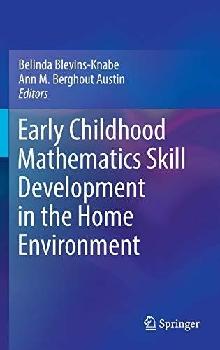
Early childhood mathematics skill development in the home environment
This volume presents current research on the connections between the home and family environment on children's mathematics development. Focusing on infancy through first grade, it details the role of parents and other caregivers in promoting numeracy and the ways their active participation can prepare young children for learning about formal mathematics. Research data answer key questions regarding the development of numeracy alongside cognitive and linguistic skills, early acquisition of specific math skills, and numeracy of children with atypical language skills. The book also provides practical recommendations for parents and other caregivers as well as implications for future research studies and curriculum design. Included in the coverage: Ways to optimize home numeracy environments. Individual differences in numerical abilities. Cross-cultural comparisons and ways to scaffold young children's mathematical skills. Mathematics and language in the home environment. Center-based and family-based child care. Games and home numeracy practice. Early Childhood Mathematics Skill Development in the Home Environment is an essential resource for researchers, graduate students, and professionals in infancy and early childhood development, child and school psychology, early childhood education, social work, mathematics education, and educational psychology.
Book

Mathematics learning in early childhood
Early childhood mathematics is vitally important for young children's present and future educational success. Research demonstrates that virtually all young children have the capability to learn and become competent in mathematics. Furthermore, young children enjoy their early informal experiences with mathematics. Unfortunately, many children's potential in mathematics is not fully realized, especially those children who are economically disadvantaged. This is due, in part, to a lack of opportunities to learn mathematics in early childhood settings or through everyday experiences in the home and in their communities. Improvements in early childhood mathematics education can provide young children with the foundation for school success.
Relying on a comprehensive review of the research, Mathematics Learning in Early Childhood lays out the critical areas that should be the focus of young children's early mathematics education, explores the extent to which they are currently being incorporated in early childhood settings, and identifies the changes needed to improve the quality of mathematics experiences for young children. This book serves as a call to action to improve the state of early childhood mathematics. It will be especially useful for policy makers and practitioners-those who work directly with children and their families in shaping the policies that affect the education of young children.
eBook


Supporting early mathematical development through a 'pattern and structure' intervention program
An Australian longitudinal study of 319 Kindergartners developed, implemented and evaluated an intervention, the Pattern and Structure Mathematics Awareness Program (PASMAP). It comprised of repetitions and growing patterns, structured counting and grouping, grids and shapes, partitioning, additive and multiplicative structures, measurement and data, and transformations. Each component was implemented, evaluated and refined as a cyclic process in collaboration with co-operating teachers, replacing and extending the regular mathematics program. An innovative pedagogical approach was effective in engaging students in modelling and representing, visualising and generalising, and sustaining their learning. On an interview-based measure of mathematics achievement pre- and post-intervention, there were significant differences found between the intervention and comparison groups at the end of the intervention year (p<0.026) and highly significant differences found at the follow-up assessment (p<0.002) ten months later. A descriptive analysis showed students' progress through five levels of structural development where most students advanced through one or more levels as they progressed through the program. The upper third of students demonstrated emergent generalisations at the structural and advanced structural level which supported early algebraic thinking. Less-able students also showed impressive growth - half of these students moved from pre-structural to at least emergent level over the duration of the program. Students' growth in structural development is exemplified at five points during the intervention through fine-grained analyses of mathematical representations and explanations. The study demonstrates that Kindergartners are capable of developing mathematical patterns and structural relationships well beyond curriculum expectations. [Author abstract]
Journal Article

Longitudinal Evaluation of a Scale-Up Model for Teaching Mathematics With Trajectories and Technologies: Persistence of Effects in the Third Year
Using a cluster randomized trial design, we evaluated the persistence of effects of a research-based model for scaling up educational interventions. The model was implemented in 42 schools in two city districts serving low-resource communities, randomly assigned to three conditions. In pre-kindergarten, the two experimental interventions were identical, but one included follow-through in the kindergarten and first-grade years, including knowledge of the pre-K intervention and ways to build upon that knowledge using learning trajectories. Students in the experimental group scored significantly higher than control students (g = .51 for those who received follow-through intervention in kindergarten and first grade; g = .28 for non—follow-through), and follow-through students scored significantly higher than non—follow-through students (g = .24).
Journal Article

Making and tinkering with STEM : solving design challenges with young children
\"Teaching and learning STEM subjects (science, technology, engineering, and mathematics) is more accessible than ever before! Children will be inspired, delighted, and challenged as they use everyday materials and STEM concepts to design and build solutions to problems faced by characters in their favorite books\"-- Back cover.
Book

Engaging young children in mathematics
This book consists of conclusions drawn from the expertise shared at the Conference on Standards for Prekindergarten and Kindergarten Mathematics Education. It offers substantive detail regarding young students' understandings of mathematical ideas.
eBook

Teaching STEM in the early years : activities for integrating science, technology, engineering, and mathematics
\"The foundation for science, technology, engineering, and mathematics (STEM) education begins in the early years. This book provides more than ninety activities and learning center ideas that seamlessly integrate STEM throughout early childhood classrooms. These hands-on STEM experiences enhance cooking, art, and music activities, block play and sensory table exploration, and field trips and outdoor time. Information on assessment and early learning standards is also provided.Sally Moomaw, EdD, has spent much of her career researching and teaching STEM education. She is an assistant professor at the University of Cincinnati and the author of several early education books\"-- Provided by publisher.
Book

Special Issues in Early Childhood Mathematics Education Research
In this book, 23 contributors offer new insights on key issues in mathematics education in early childhood. The chapters cover all mathematics curriculum-related issues in early childhood (number, geometry, patterns and structures and mathematics in daily life). Special attention is given to teachers knowledge and innovative research issues such as quantifiers among young children.Contributors are: Abraham Arcavi, Ruthi Barkai, Douglas H. Clements, Bat-Sheva Eylon, Dina Hassidov, Rina Hershkowitz, Leah Ilani, Bat-Sheva Ilany, Candace Joswick, Esther Levenson, Zvia Markovits, Zemira Mevarech, Joanne Mulligan, Sherman Rosenfeld, Flavia Santamaria, Julie Sarama, Juhaina Awawdeh Shahbari, Amal Sharif-Rasslan, Tal Sharir, Nora Scheuer, Pessia Tsamir, Dina Tirosh and Ana Clara Ventura.
eBook