
Catalogue Search | MBRL


Are you sure you want to remove the book from the shelf?

{{itemTitle}}
117
result(s) for
"Mathematics Study and teaching Data processing."
Sort by:

Digital Curricula in School Mathematics
The mathematics curriculum is influenced by digital technology in delivery and practice. This volume, from a 2014 University of Chicago conference, explores changes in curricular materials, student learning, and teacher roles. Experts discuss how technology impacts math education, challenging traditional paper-and-pencil methods.
eBook


ICT and Primary Mathematics
This book is for teachers who are looking for interesting and practical ways to incorporate ICT into their daily lesson plans. It shows how ICT can be used as a tool for mathematics, but more importantly how its proper use can enhance the mathematics being taught. The authors cover all current aspects of ICT and mathematics, including:
databases
spreadsheets
logo and the use of floor turtles and control technology
handling of resources including interactive whiteboards
management of ICT within the classroom
how ICT can be used to present mathematical topics and links to other areas of the curriculum.
With plenty of suggestions on how to use the software and hardware described in the book, this is a useful resource for all primary teachers, particularly subject co-ordinators for ICT and mathematics. It will also be of interest to students on PGCE and Initial Teacher Training courses.
John Williams has worked in primary education for many years as a class teacher, headteacher, and advisor for science and technology and more recently as Senior Lecturer in Higher Education at Anglia Polytechnic University. Nick Easingwood is Senior Lecturer for ICT in Education and ICT Co-ordinator for the School of Education at Anglia Polytechnic University.
'This book should have a place on the staffroom bookshelf, and should be required reading for Primary PGCE students.' - Education Today
Introduction 1. Planning the Mathematics Lesson 2. Delivering the Lesson 3. Using an Interactive Whiteboard 4. The Use of Floor and Screen Turtles 5. The Transition from Floor Turtle to Screen Turtle 6. Why does LOGO merit a place in the Primary Mathematics Curriculum? 7. Handling Data 8. Using Graphs 9. Mathematics Across the Curriculum 10. Some Ideas for Other Mathematics and the Use of ICT
eBook

ICT and primary mathematics
This book is for teachers who are looking for interesting and practical ways to incorporate ICT into their daily lesson plans. It shows how ICT can be used as a tool for mathematics, but more importantly how its proper use can enhance the mathematics being taught. The authors cover all current aspects of ICT and mathematics, including: databases spreadsheets logo and the use of floor turtles and control technology handling of resources including interactive whiteboards management of ICT within the classroom how ICT can be used to present mathematical topics and links to other areas of the curriculum. With plenty of suggestions on how to use the software and hardware described in the book, this is a useful resource for all primary teachers, particularly subject co-ordinators for ICT and mathematics. It will also be of interest to students on PGCE and Initial Teacher Training courses.
eBook
Digitale Medien im Mathematikunterricht der Primarstufe
Long description: Seit dem Aufkommen digitaler Medienangebote für den Mathematikunterricht schreibt man dem Medieneinsatz das Potenzial zu, Mathematikunterricht zu verändern und zwar sowohl bezogen darauf was Schülerinnen und Schüler lernen als auch darauf wie sie das lernen. Der Einfluss hängt nicht nur vom Medium ab, sondern vor allem auch von der Art des Einsatzes, weshalb Lehrpersonen spezifische Medienkompetenzen erwerben müssen. In den Bildungsstandards für die Lehrerbildung finden sich Forderungen nach Medienbildung als „Umgang mit Medien unter konzeptionellen, didaktischen und praktischen Aspekten“ (KMK 2004, S. 5) und das Kennen von „Möglichkeiten und Grenzen eines anforderungsgerechten Einsatzes von Medien im Unterricht“ (a.a.O., S. 7).
Daher richtet sich dieser Band besonders an Lehrende aber auch an Studierende für das Lehramt der Primarstufe mit Mathematik als Haupt- oder Nebenfach, an Lehramtsanwärterinnen und Lehramtsanwärter mit dem Fach Mathematik aber auch an Lehrkräfte, die nach neuen Einsatzmöglichkeiten digitaler Medien im Mathematikunterricht suchen.
Die Beiträge im Buch sollen vielfältige Anregung für den Einsatz digitaler Medien geben, die in Seminaren an der Universität, im Studienseminar oder auch in Fortbildungsveranstaltungen umgesetzt werden können. Die Umsetzung kann dabei als einzelne Veranstaltung erfolgen aber auch das ganze Semester begleiten.
eBook

Investigating teachers’ understanding through topic modeling: a promising approach to studying teachers’ knowledge
Examining teachers’ knowledge on a large scale involves addressing substantial measurement and logistical issues; thus, existing teacher knowledge assessments have mainly consisted of selected-response items because of their ease of scoring. Although open-ended responses could capture a more complex understanding of and provide further insights into teachers’ thinking, scoring these responses is expensive and time consuming, which limits their use in large-scale studies. In this study, we investigated whether a novel statistical approach, topic modeling, could be used to score teachers’ open-ended responses and if so, whether these scores would capture nuances of teachers’ understanding. To test this hypothesis, we used topic modeling to analyze teachers’ responses to a proportional reasoning task and examined the associations of the topics identified through this method with categories identified by a separate qualitative analysis of the same data as well as teachers’ performance on a measure of ratios and proportional relationships. Our findings suggest that topic modeling seemed to capture nuances of teachers’ responses and that such nuances differentiated teachers’ performance on the same concept. We discuss the implications of this study for education research.
Journal Article

Teaching Subtraction with the Think-Aloud Method to a Student with Mild Intellectual Disability
Bu araştırma, çıkarma işlemi becerisini sesli düşünme yöntemiyle öğretebilmek amacıyla yürütülmüştür. Araştırma nitel araştırma yöntemlerinden eylem araştırmasıyla yapılmıştır. Araştırmanın katılımcısı hafif düzeyde zihinsel yetersizliğe sahip bir öğrencidir. Araştırmada kullanılan veri toplama araçları, eylem araştırma sürecine uygun olarak ön ve son test ölçüt bağımlı ölçüm araçları, performans kayıt tabloları, öğretmen ve öğrenci günlükleri, sesli düşünme yöntemi öğrenci görüşme formudur. Araştırma eylem planlarının hazırlık ve değerlendirilme aşamasına kadar geçen tüm süreç ses kaydı ile kaydedilmiştir. Araştırma sonucunda öğrencinin çıkarma işlemi basamaklarını bağımsız olarak gerçekleştirdiği, çıkarma işleminin anlamına ilişkin bilgiyi elde ettiği ve bunu söylediği görülmüştür. Bu araştırmanın öğrencinin akademik becerilerini geliştirdiği için alanyazına katkısı olacağı düşünülmektedir. The research was conducted to teach subtraction skills through the think-aloud method. The research was carried out through action research, one of the qualitative research methods. The study group in the research consists of a mildly intellectually disabled student. Data collection tools used in the research are criterion-referenced measurement tools employed in pre-test and post-test following action research process, performance record charts, teacher and student journals, and the think-aloud method student interview form. The research was recorded through tape recording during the whole process until the preparation and evaluation phases of the research action plans. According to the research results, it was observed that the student was able to perform the steps of subtraction independently; she obtained the information regarding the meaning of subtraction and told this. It is thought that this research will contribute to the literature since it improved the student’s academic and self-expression skills.
Journal Article
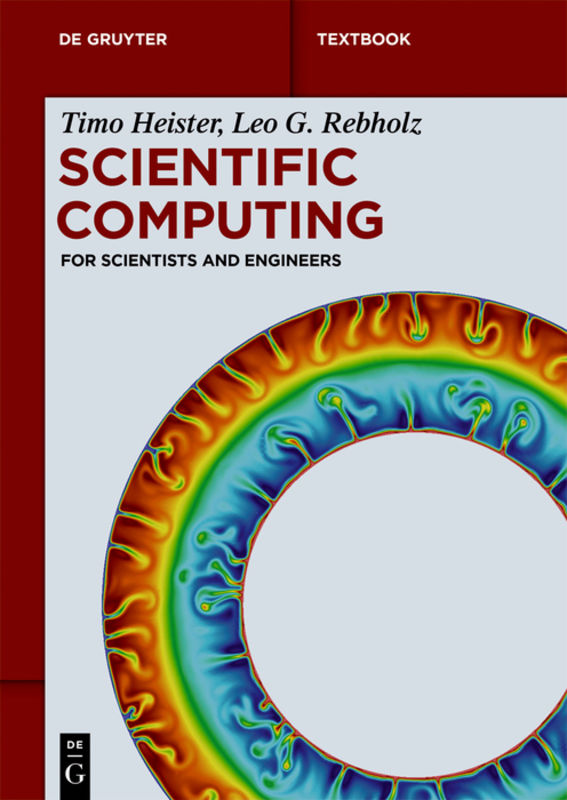
Scientific Computing
Scientific Computing for Scientists and Engineers is designed to teach undergraduate students relevant numerical methods and required fundamentals in scientific computing.Most problems in science and engineering require the solution of mathematical problems, most of which can only be done on a computer.
eBook