
Catalogue Search | MBRL


Are you sure you want to remove the book from the shelf?

{{itemTitle}}
474,553
result(s) for
"Mathematics. Analysis"
Sort by:

Mathematical inequalities : a perspective
\"Provides an overview of the expanding field of mathematical inequalities and their applications. Instead of focusing on narrow treatments of various mathematical inequalities, the authors present a number of classical and recent results across the field, covering integral inequalities, discrete inequalities, and inequalities in abstract spaces. They also make new connections and investigate intimate relationships between inequalities ... The text offers simple proofs for young researchers yet incorporates sufficient detail to appeal to experts and graduate students in real and functional analysis\"-- Provided by publisher.
Book

Finite Element Analysis of Structures through Unified Formulation
The finite element method (FEM) is a computational tool widely used to design and analyse complex structures. Currently, there are a number of different approaches to analysis using the FEM that vary according to the type of structure being analysed: beams and plates may use 1D or 2D approaches, shells and solids 2D or 3D approaches, and methods that work for one structure are typically not optimized to work for another. Finite Element Analysis of Structures Through Unified Formulation deals with the FEM used for the analysis of the mechanics of structures in the case of linear elasticity. The novelty of this book is that the finite elements (FEs) are formulated on the basis of a class of theories of structures known as the Carrera Unified Formulation (CUF). It formulates 1D, 2D and 3D FEs on the basis of the same 'fundamental nucleus' that comes from geometrical relations and Hooke's law, and presents both 1D and 2D refined FEs that only have displacement variables as in 3D elements. It also covers 1D and 2D FEs that make use of 'real' physical surfaces rather than 'artificial' mathematical surfaces which are difficult to interface in CAD/CAE software. Key features: * Covers how the refined formulation can be easily and conveniently used to analyse laminated structures, such as sandwich and composite structures, and to deal with multifield problems * Shows the performance of different FE models through the 'best theory diagram' which allows different models to be compared in terms of accuracy and computational cost * Introduces an axiomatic/asymptotic approach that reduces the computational cost of the structural analysis without affecting the accuracy * Introduces an innovative 'component-wise' approach to deal with complex structures * Accompanied by a website hosting the dedicated software package MUL2 (www.mul2.com) Finite Element Analysis of Structures Through Unified Formulation is a valuable reference for researchers and practitioners, and is also a useful source of information for graduate students in civil, mechanical and aerospace engineering.
eBook
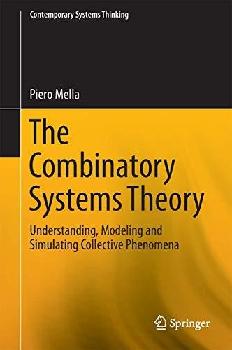
The combinatory systems theory : understanding, modeling and simulating collective phenomena
This study adopts the logic of systems thinking and control systems, presenting a simple but complete theory called the theory of combinatory systems. This new theory is able to describe, interpret, explain, simulate and control collective phenomena and their observable effects. Despite specific differences among these phenomena - many of which are 'one way', non-repeatable or reproducible - they can all be described or explained, and thus understood, using the model, as simple as it is general, of combinatory systems.
Book

Frailty Models in Survival Analysis
Accessible to nonspecialists, this book explains the basic ideas in frailty modeling and statistical techniques, with a focus on real data application and interpretation of the results. It extensively explores how univariate frailty models can represent unobserved heterogeneity. It also emphasizes correlated frailty models as extensions of univariate and shared frailty models. The author analyzes similarities and differences between frailty and copula models, discusses problems related to frailty models, and describes parametric and semiparametric models using both frequentist and Bayesian approaches. He also shows how to apply the models to real data using R, SAS, and Stata.
eBook

Mathematical analysis : a very short introduction
Richard Earl describes the nascent evolution of mathematical analysis, its development as a subject in its own right, and its wide-ranging applications in mathematics and science, modelling reality from acoustics to fluid dynamics, from biological systems to quantum theory.
BOOK

Introduction to the explicit finite element method for nonlinear transient dynamics
\"This is the first book to specifically address the explicit finite element method for nonlinear transient dynamics. This book aids readers in mastering the explicit finite element method as well as programming a code without extensively reading the more general finite element books. This book consists of 12 chapters within four sections including: the variation principles and formulation of the explicit finite element method for nonlinear transient dynamics; the finite element technology with 4-node and 3-node Reissner-Mindlin plate bending elements, the 8-node solid elements, etc.; plasticity and nonlinear material models; and contact algorithms and other kinematic constraint conditions. Each chapter contains a list of carefully chosen references intended to help readers to further explore the related subjects\"--
eBook


Advanced Numerical and Semi-Analytical Methods for Differential Equations
<p><b>Examines numerical and semi-analytical methods for differential equations that can be used for solving practical ODEs and PDEs</b> <p>This student-friendly book deals with various approaches for solving differential equations numerically or semi-analytically depending on the type of equations and offers simple example problems to help readers along. <p>Featuring both traditional and recent methods, <i>Advanced Numerical and Semi-Analytical Methods for Differential Equations</i> begins with a review of basic numerical methods. It then looks at Laplace, Fourier, and weighted residual methods for solving differential equations. A new challenging method of Boundary Characteristics Orthogonal Polynomials (BCOPs) is introduced next. The book then discusses Finite Difference Method (FDM), Finite Element Method (FEM), Finite Volume Method (FVM), and Boundary Element Method (BEM). Following that, analytical/semi<i>-</i>analytic methods like Akbari Ganji's Method (AGM) and Exp-function are used to solve nonlinear differential equations. Nonlinear differential equations using semi-analytical methods are also addressed, namely Adomian Decomposition Method (ADM), Homotopy Perturbation Method (HPM), Variational Iteration Method (VIM), and Homotopy Analysis Method (HAM). Other topics covered include: emerging areas of research related to the solution of differential equations based on differential quadrature and wavelet approach; combined and hybrid methods for solving differential equations; as well as an overview of fractal differential equations. Further, uncertainty in term of intervals and fuzzy numbers have also been included, along with the interval finite element method. This book: <ul> <li>Discusses various methods for solving linear and nonlinear ODEs and PDEs</li> <li>Covers basic numerical techniques for solving differential equations along with various discretization methods</li> <li>Investigates nonlinear differential equations using semi-analytical methods</li> <li>Examines differential equations in an uncertain environment</li> <li>Includes a new scenario in which uncertainty (in term of intervals and fuzzy numbers) has been included in differential equations</li> <li>Contains solved example problems, as well as some unsolved problems for self-validation of the topics covered</li> </ul> <p><i>Advanced Numerical and Semi-Analytical Methods for Differential Equations</i> is an excellent textbook for graduate as well as post graduate students and researchers studying various methods for solving differential equations, numerically and semi-analytically.
eBook


Applied nonlinear functional analysis : an introduction
The aim of this book is to provide a concise but complete introduction to the main mathematical tools of nonlinear functional analysis, which are also used in the study of concrete problems in economics, engineering, and physics. This volume gathers the mathematical background needed in order to conduct research or to deal with theoretical problems and applications using the tools of nonlinear functional analysis. Contents Basic Topology Measure Theory Basic Functional Analysis Banach Spaces of Functions and Measures Convex Functions – Nonsmooth Analysis Nonlinear Analysis
eBook